Tuesday, May 10, 2011

Marvel Zombies 3 (comics)

Writer: Fred Van Lente
Artist: Kevin Walker
Collects: Marvel Zombies 3 #1-4

So did you hear the one about those wacky Marvel Zombies?

Here's the problem with Marvel Zombies; in some ways it's essentially a joke in comic form. It's popularity was borderline ridiculous for a while there and they've since turned it into a franchise. The original appeal, however, rested largely on the novelty and giggles gained from seeing a bunch of zombified heroes eat things.

But the reality of comedy is that if you keep telling the same joke over and over, eventually it's just not funny anymore. How many jokes do you know with sequels? Even the second volume seemed almost cognizant of this; the dark humor was dialed down and while it was generally more of a real story, it also seemed to make it quite clear this concept couldn't sustain itself forever without an overhaul.

So overhaul it they did. This time, the regular Marvel 616 Universe is involved*. The result leaves me thinking that just maybe there's a little life left in this quickly rotting husk.

The last volume pretty much picked up where the first left off and it ended on a cliffhanger, presumably for this volume to pick up on. It doesn't. Actually, this volumes story doesn't even take place after the events of volume 2**. The 616 universe we all know and love is clearly set in present continuity while the time period of the Zombieverse they encounter is actually the time between the cosmic seven leaving and returning. This takes a bit of retconning, really***, but whatever, I can roll with it.

The story opens with a mission gone horribly wrong. Floridas Initiative team, the Command, combs the swamps of Citrusville after a distress call, quickly finding themselves confronted with a grisly scene. Before they can realize what's happened, they're wiped out; only one survives, while another goes into hibernation for an uncertain amount of time to try and purge the virus. One of the zombies from that troublesome universe managed to make it over using the Nexus of All Realities; no one knows how many infected are roaming the swamp, which is, of course, a problem, especially if they make it out of the swamp. Before you know it, the "fleshy" hating Machine Man is sent into the zombie universe to get a sample to help come up with some manner of vaccine.

You can probably guess how smoothly that mission goes.

The new approach actually does wonders for extending the life of the flagging franchise. For the first time, we've got a pretty distinct set of characters for our main cast. It feels more like they're trying to tell an actual story - with, of course, the dark humor - instead of constantly trying to outgross themselves. The zombies are now an element, not the sole driving force of the series, and it makes a bigger difference than you'd think.

Van Lente's style is a fair amount of why this works. He brings back the comedy elements that had been toned down last time, but it's no longer about the joke or hearing about Daredevils blood bloated ankles needing to be punctured. The chief character, Machine Man, actually shows character growth over the course of the volume.

Starting as the distinct NEXTWAVE version Warren Ellis introduced us to, he changes a bit as the volume goes on, especially when confronted about his dickery by an old robot flame. By the end, he's even accepting of a name he long denied. That's a pretty big jump in actual storytelling for a series that mostly subsided on things like Hulk eating a human and then having the bones explode through his stomach when he reverts to zombie Banner.

We even get a pretty decent addition to the Marvel universe out of ARMOR, an organization dedicated to handling inter-dimensional threats. In a way, it completes the circle in some way. It's not just the acronyms - you know, armor goes with sword goes with shield - but the fact that it makes sense that the Marvel world would have an organization each dedicated to different threats. With SHIELD handling most Earth based problems, SWORD dealing with space and ARMOR handling threats from other dimensions, they're pretty much covered.

I hope this is the last of these though. If I see HELMET or BOOTS, I'll be unable to keep from laughing uncontrollably. As it is, we still have HAMMER lingering around as a villain organization when it really should have dissolved entirely at the end of Osborns time at the top.

This time, we have Kevin Walker on art. His work is a bit cleaner, but when it comes time to illustrate the yuck, he doesn't shy away. Check out the image of the zombie Kingpin, champagne glass full of blood and eyeballs, bloody human bones on the table behind him. It's ridiculous, but a fun ridiculous. I wonder how much of the little touches were Walkers idea and how much was actually in the script. Either way, a good job all around.

One last thing to note. This volume does come complete with a cover gallery, one that goes the whole nine and collects all the zombie variants that were on books while this series ran. I'm always happy to see a full cover gallery in volumes, but good grief these zombie variants. Can we nix these whenever a Marvel Zombies miniseries shambles around? I'm tired of them. The joke - you know, taking iconic covers and zombifying them to disgusting effect - is just not funny anymore. See above about telling the same joke too many times.

The Score: 8 out of 10

I actually really enjoyed this one. Moreso than both of the preceding volumes. Van Lente and Walker revitilize a concept that was withering on the vine. Worth checking out; hell, despite the number three on the cover, you don't need to read the previous ones. Skip 'em, if you're so inclined. Originally I thought this would be the last volume for me, but I'm going to stick around, especially considering the next one is going to have Man-Thing and the Midnight Sons.

I am always down for teams of ridiculous super movie monsters.


* Interestingly, this is probably the first time there's been any kind of actual link between the Main universe and the Ultimate universe. Both have come into conflict with the Zombieverse by now, which is the closest the two ever came to crossing over. Whether Marvel will stick to their guns on the determination not to let the two directly meet remains to be seen.

** I don't believe the story and characters of the first two Marvel Zombies are wrapped up within the numbered line. MZ4 is apparently a direct sequel to the events of this volume. I'm pretty sure they got around to tying the original plots off in one of the numerous offshoots.

*** The end of the first volume had the remaining members of the main zombie crew we followed assert dominance over the right to eat Galactus. They were, quite simply, the alpha zombies. I recall it being pretty clearly implied they wiped out the rest of the zombies who tried to get in the way of their cosmic meal. The events of volume 2 - where aside from the docile Hawkeye, Wasp and Colonel America there isn't a zombie to be found on Earth - backed it up. As you can probably guess, this volume shows us that there's still a pretty damn big contingent of zombies floating around after the cosmic zombies left. Doesn't make much sense, but the first two miniseries were riddled with odd contradictory moments, so it's not worth thinking on too much.

Thursday, April 28, 2011

Shin Megami Tensei: Persona (video game)

Platform: PSP
Developer: Atlus
Genre: RPG
ESRB Rating: T
Release Date: September 22nd, 2009

Can we all agree that the Playstation era was a bitchin' time for RPG's? Seems like that system had a truckload of classics in the genre. Many of them hold up pretty well to this day, despite now antiquated graphics*.

Today, I'm going to talk about one that hasn't aged gracefully; this game's the equivalent of a hundred year old man who's nothing but skin and bones kept alive through an IV drip and an oxygen mask.

The story is that you're a group of students at a local high school. In this school rumors about gaining magical powers by circling a room are apparently taken at face value, so you find yourself goaded into doing this by the class jerkoff. Shockingly, it works and each student finds themselves with a "Persona", or basically some spirit thing that gives them abilities and determines their strengths and weaknesses.

Because this is clearly not something to be overly concerned with, they then proceed to a hospital to check on a friend. Then demons invade because what the hell else were you going to use your Persona for, cooking? Clearly, this must be stopped, so off you go to find some baddies to stomp.

This PSP port is billed as a remake, but the truth is that it's really more of an upgrade. When I think remake, I think rebuilt from the ground up. When you look at screenshots of the original and this, however, it's obvious that little has really changed. The graphics are essentially the same - even the neat first person dungeon crawling view has it's early Playstation pixelation intact - the gameplay hasn't really changed - which is the real shame - and the music seems the same. That's... a lot of things left as is for a "remake".

So what has changed? The script, mostly; while I haven't played the original localization, what I've seen makes it clear the new translation is leagues ahead of it. There's less Americanization as well. Hell, they even kept Mark as a goofy white graffiti artist instead of randomly changing his race. There's an entirely separate quest line available that was never localized in the original edition. Cut scenes were apparently touched up too, switched over to more of a cel shaded look - they still look like really bad early CG animation with a new coat of paint though.

The graphics are... well, dated. The isometric view for rooms with NPC's and battle scenes look alright for their age, but the first person dungeon crawling definitely retains that old "early Playstation" look. Oh, have I mentioned the cutscenes? I really do not get why, if they were serious about the "remake" aspect, they didn't give it a facelift or redo this stuff entirely. Say what you want about Square, but if this was one of their projects the visuals would have been rebuilt from the ground up.

The gameplay is where this old game just falls apart. It's clear the developers were going for something different with this game, but clearly forgot that different doesn't necessarily mean good. Each character has different weapons and skills, all of which have attack ranges. You place your characters anywhere on a grid on your side. Neat idea, but far from practical; if a character doesn't have an enemy in range of any of his attacks, he's going to sit there like a doofus unless you waste a turn switching the positions up.

The result is a combat system that feels boring. Mix with the fact that this is one of those "two or three steps before a random encounter" games and you've got a recipe for trouble. The battle system wears out its welcome before the halfway mark. I'm usually not averse to level grinding, but games like this make the process extremely tedious.

Speaking of leveling, that's another problem. This game went with the lovely idea of having experience for each party member depend on how much damage they've done. You probably know where I'm going with this. Eventually, a party member is going to lag behind the others in level pretty significantly. This party member is usually Mark, who sucks. So they end up being little more than canon fodder for a turn or two. This is not the best leveling system I've ever encountered.

Oh, there's the phases of the moon thing, too. As you play the game, it cycles through the different phases. In theory, this is supposed to give different advantages and disadvantages depending on the phase. In practice, it does little of value. Aside from giving you a bit of a head start on negotiations with the monsters during a certain phase, it really doesn't affect the game much at all, or at least not in a way that's very apparent, making it a worthless feature.

It's not all bad though; occasionally there's a good idea hidden in the rough. In this game, you're able to contact your enemies and try to befriend them, with the rewards ranging from spell cards used to conjure up new personas to items. Each characters has different ways of interacting with monsters and not all of them will appreciate the same responses. Obviously, if you fail, there are drawbacks, but it adds an interesting wrinkle. Why not just talk your way out of a situation from time to time, right?

I also liked the fact that, depending on your choices, you can basically pick your fifth party member. Unfortunately, you can't mix and match your party with the available options - otherwise, Mark would be the first to go given his general uselessness - but the option is nice to have and was still relatively novel in RPG's back in '96. It just didn't happen very often - in the RPG's people actually played, at least - barring a notable exception or two.

A lot of other mechanics are kind of confusing, though. The game does allow you to have guided creation of personas, but manual is like an odd puzzle without a clear solution. You really don't know what will affect what and the possibility of creating fusion accidents is frustrating. There are so many variables involved with it that even the basic instructions given to you don't help much, leaving guided fusion as the preferable option.

Mechanics like this seem to come with the expectation that you were probably going to drop a twenty on a strategy guide - remember those days? - to help you grasp it. Even with free game FAQs readily available online, I still don't care for needlessly obtuse things like this. The kind of guesswork required by things like the manual fusion of this game is not the fun kind.

Sounds a bit iffy as well. The voiceovers are pretty iffy for an upgrade made about a year ago - I assume they didn't bother redubbing - and sometimes some of the music can get a bit grating. Usually video game music is fantastic and easy to listen to over and over again. This game uses some ambient scores with plenty of j-pop. Listening to a battle song over and over every time you have a random battle is much easier when there aren't vocals.

The Score: 6 out of 10

I'm afraid I can't really recommend it. I'm interested in some of the ideas put forth here, so I'll be back for the sequels, but this game doesn't really stand the test of time. Why Atlus didn't just go the full remake route, I haven't a clue, because this game has aged badly. It's very easy to find yourself bored around the halfway mark. It's probably only worth it if you're a die-hard Persona fan; otherwise it's a relic that was probably better left buried.

* Antiquated is my way of being nice. Seriously, I cannot believe the crap we used to think was stunning back in the late nineties. Back then 3D models were the new, shiny thing, so it was a big step forward, but good lord do some of those games look like ass. I suppose time's affected my opinion on this though; I'm used to the HD era, which is a stark contrast to the blockiness of early 3D modeled games. They just don't hold up like 2D sprites do, but back then it was an exciting new frontier. Ah well.

Saturday, April 16, 2011

Marvel Zombies 2 (comics)

Writer: Robert Kirkman
Artist: Sean Phillips
Collects: Marvel Zombies 2 #1-5

As with all things uber popular, Marvel Zombies eventually found itself with a sequel by the originals creative team. They teased it being kind of a "Marvel Zombies Civil War", to which I responded "oh really now? This I gotta see!" Because, you know, how do you really do that, much less follow up with a sequel? There weren't even enough zombies left by the end - somewhere around seven, I recall - for much more than a minor skirmish, much less a war.

Besides which, for all its goofy stupidity, the first series had a relatively solid conclusion; the remaining zombies took the place of Galactus in the galaxy while the remaining humans arrived back on Earth to take back their planet.

Turns out you do it by twisting things a bit. The zombies didn't really take the place of Galactus. They end up being worse than Galactus, literally devouring the universe within the space of forty years. Once they run out of food, they remember, hey, Reed Richards had a dimensional portal, so lets use that and go to a universe with fresh meat. Back on Earth, the survivors have etched out a respectable living for themselves, but of course, political strife is evident. These two things colliding spells trouble for the surviving humans.

This go around, the dark humor is toned down. The sequel isn't as darkly comic as the original was, which I'm unsure is a good thing. It's played a bit more straight this time, with even a hint of redemption for the zombies afoot. All this means that there's more of a real story here this time, but there aren't as many "moments" that stick in your mind like the first go around had.

I mentioned in my review of the first volume that I lamented the lack of different perspective on the overall zombie infection of the heroes. Kirkman wisely avoids the pitfalls this time, as we find ourselves with focus split between the survivors and the former heroes. It actually made for a better story, I think, because the last time the humans weren't much more than meat. There was no way to get attached to the two or three left barring Magneto, which was a bit of a problem.

Everything isn't a bed of roses here, though. Kirkman even tries to make the zombies a bit more likable this go around - a real problem last time - but whether he succeeds or not is debateable. He elaborates on the concept he introduced at the end of the first volume; mainly, the zombies lose their hunger the longer they go without eating. Spider-Man has noticed this too and starts to relate it to Luke Cage. Seems simple enough, right?

Here's the problem. With the hunger gone, their heads are clearer, but it was established last time that their thoughts were clear right after they ate as well. Spider-Man was the only one who felt any real remorse. So they've turned into these gigantic pricks thanks to the zombie virus, but once the hunger is gone, hey, please forgive us, right? A bit hard for me to buy; even in their most lucid moments prior they still didn't have much problem with hunting down survivors for their next meal.

Also, how would this only just happen in such a short span of time after forty years of hunting the galaxy. It seems like it's only a couple weeks at best before they get to Earth again. They even stop to snack on Ego the Living Planet along the way. But in the forty years they spent in space, they didn't realize this until just now? Even with the time spent between worlds, traveling the stars?

So, as you can tell, there are still logic problems here. Like the first miniseries, you can't think about this one too much, otherwise too many unanswered questions and plotholes crop up. This is, again, stupid fun comics. Just with a bit more of a real story this time around. I'd say it holds up around the same as the first series, maybe just a bit weaker.

I won't spoil the ending, but there is a cliffhanger at the end. One that may not even be resolved. Kirkman didn't return for a third round - there's an entirely different creative team for three on - so what he had planned for the rather obvious second sequel is a mystery. There's overall resolution to the volumes events, but if he wasn't sure he'd be coming back, Kirkman probably shouldn't have had a cliffhanger epilogue.

As for the art, Sean Phillips is back and everything I said last time applies here too. His work is still good and he does well with providing a squick factor to the dark proceedings. There isn't as much dark comedy for him to work with as in the original miniseries, but he makes due regardless. I hope to see more or his art outside of this context, though, as it's hard to judge how he'd do on a more traditional story.

The Score: 7 out of 10

I still don't get why this was such a phenomenon, but at least they turned out to be solid comics so far. How long it can hold up as legitimate stories, I'm not so sure. Even Kirkman seems to realize the joke has a shelf life, because he mixed more of the same in with something new. I guess I'll have to find out, won't I? Worth it if you just really like Marvel Zombies, even if the novelty's started wearing off.

Friday, April 15, 2011

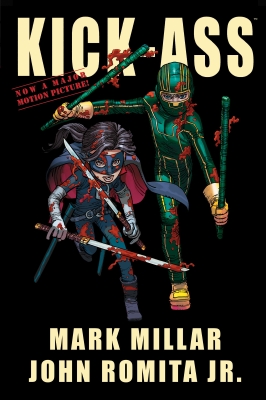
Kick Ass (comics)

Writer: Mark Millar
Artist: John Romita Jr.
Collects: Kick-Ass #1-8

So, Kick-Ass. Another of Mark Millars lovely projects that feel like they were tailor made more for the silver screen than the comic page. Hell, the film adaption of this one was actually in development while the miniseries was running; for a bit there, it looked like the film might have even released before the series finished. Millars public persona may be grating as all holy hell, but it seems to work for him.

Kick-Ass tries to use a very basic concept I'm sure a lot of us have given thought to before. "What if superheroes existed in the real world?" The main character - Dave - is a comic geek with some pretty crappy luck who decides, hey, this life is pretty boring, Imma get a wetsuit and go beat the hell out of a couple of Hispanic guys. Excess foul language and ridiculous amounts of violence ensue.

Right off the bat, we've got a problem. No matter how much he brings up things like Myspace or Youtube, Millar can't get out of his old habits. It doesn't take long - by the end of the second issue, in fact - for the perceived "realism" to vacate the premises. At first, it seems like he's going to stick with it - the consequences of Dave's hubris costs him six months of his life and requires intensive therapy to recover from - but then, fresh off his crutches, Dave suits back up and goes to pick a fight. Only this time, he wins. Right after months of healing and with no training. From there it's all downhill.

Everything is over the top here, from almost every character swearing worse than a sailor - Daves dad is literally the only character not to curse every other word - to little girls no older than ten being badass ninjas who slice people to ribbons. Literally, from the first time we see Hit-Girl, we know that any sense of realism has gone straight out the goddamn window. We're in Millars domain; the comics with the most disgusting, shocking ideas he can think of to try and appeal to the lowest common denominator.

As far as unrealistic goes, I could talk about some of the dialogue - I swear whenever Dave is in a comic shop I think Millar's contracted Whedonitis - but we won't go there.

Worse still, it often seems like there's an undercurrent of racism here. Again, not shocking, given this is Millar, but still a worry. It seems like everyone Kick-Ass fights, from street toughs on down, is a minority of some kind. From hispanics to blacks to italians, everyone offed in the course of this series is of some sort of racial stereotype.

Necessary? No. But it'll sure get some attention.

Mark Millars writing tends to come back to bite him. He is, as we all know, about as subtle as an atom bomb when it comes to pretty much anything. You pretty much know which character is going to be a traitor as soon as you see him and another characters fate is blown thanks to overuse of foreshadowing plus a flashback late in the book so blatant the narration box might as well have screamed "THIS IS CHEKHOVS GUN, PAY ATTENTION".

Then, as I briefly mentioned earlier, there's the lack of adherance to the concept. I expect the violence and the cursing; Millar does it whenever he isn't writing corporate owned superheroes. But as much of a huckster as Millar tends to be, I still expected him to stick to the "vigilantes in the real world" concept, or at least make an honest effort. Sure, superpowers are kept out of it - and Millar even makes some jokes using some superhero cliches - but the book doesn't stick to anything resembling "realistic". Considering that was the line that sold me on reading it at all, that's a legitimate disappointment. I feel like Millar could have made more of an effort, or at least been a little clearer up front.

So, with all those problems, why the hell is this goddamn book so endearing? Why is Hit Girl endearing? Most everything in this book sets off every alarm bell I've got, yet I still somehow enjoyed it. This should be a textbook case of "EWW, EWW, BURN IT, BURN IT!" Yet, despite this undeniable fact, I find myself interested in seeing where Kick-Ass and his pint-sized affront against good taste go from here. There's something crude but oddly likable here, even though our main character is a downright insulting stand-in for a typical comic reader and our breakout characters main feature is that she's a ten year old that kills everything in sight and swears like you read about.

It's fun, in an odd way. It's crude, it's tasteless, it's really ridiculous and it completely fails to uphold it's promise of showing superheroes in the "real world". But it's kind of like a roller coaster ride of gratuitous violence and numerous other negative adjectives as only Mark Millar can provide. I'm not exactly Mark Millars biggest fan - sometimes, I feel like he's a one trick pony - but he's put together enjoyable projects in the past. I think this one fits, even if it's offensive on every conceivable level.

Make no mistake, a lot of why this works despite everything against it is the artwork of John Romita Jr. He seems to revel in the hyperviolence he's tasked to draw, getting pretty gratuitous with some scenes. When someones head is chopped off, you WILL see the actual chopping. Romita's a bit more polarizing an artist than his dad ever was - he seems to have as many detractors as he does fans - but he does good work here, aside from the occasional page that just looks off. Mark Millar's kind of like Jeph Loeb in this way; while it's a crapshoot whether a given project will actually be decently written, he's pretty damn good at attracting top tier talent. In a way, it saves some of his books.

The Score: 6.5 out of 10

This one was kind of hard to grade. On the one hand, I enjoyed it in a goofy, dumb fun kind of way. But on the other hand, this book can piss you off; and really, this is not exactly premium comics. Either way, it may be worth a look, but it warrants a warning. If certain social issues tend to be your red button, skip this. It's practically designed to offend.

Wednesday, March 23, 2011

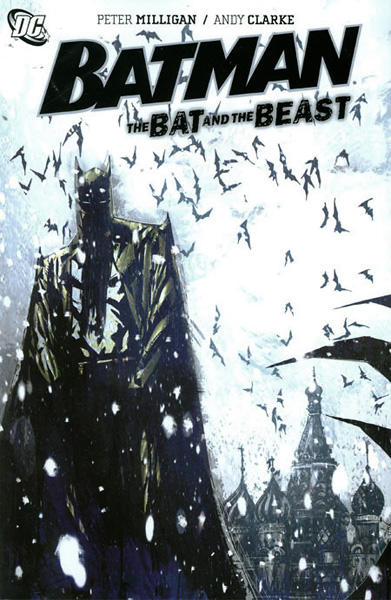
Batman: The Bat and the Beast (comics)

Writer: Peter Milligan
Artist: Andy Clarke
Collects: Batman Confidential #31-35

So hey, one time, Batman totally decided it would be a rad idea to go chill in Russia and smack around their mob; unfortunately, this does not involve any communists finding themselves acquainted with Batmans boot, but I guess you can't have everything.

Peter Milligans back in this arc of the gone-too-soon Batman Confidential. Milligan apparently had a respectable run on the Dark Knight in the very early 90's, but I've never read any of it as of yet. It's not collected in trade and for the most part - Dark Knight, Dark City aside - seems like it was completely forgotten over time, especially considering Knightfall is the storyline everyone equates with the early 90's. Regardless of the quality of his work then, he's managed to come back now and pen a solid Batman adventure.

Basically, the Russian mob decides it wants to expand its business and Gotham seems as good a place as any. Batman gets wind of it - because there's nothing that slips by a badass of his caliber - and promptly boots them back out. Once he warns them off, something disturbing is brought to light; the person behind the whole thing has a nuke and if Gotham won't be the city destroyed by it, he'll just detonate it in another city.

Batman, never being one to leave a job half done, immediately leaves for Moscow to settle this matter. This is the meat of the story. Essentially cut off in a very foreign land, he has to start off from scratch. Unlike Gotham - where his name and reputation sends shivers down the spines of the underworld - the criminal element of Russia are not afraid of him. Oh sure, they've heard of him - something very likely, despite the Bat offices insistence in the 90's that word of Batman wouldn't get around as anything but an urban legend - but as far as fear they just see him as a kook in a costume. So if Batman wants to get at the head honcho of the whole thing, he needs to make them afraid, one goon at a time, while avoiding the big nasty beastie looking to protect its master.

Now, I've mentioned in the past that I like it when Batman has an adventure or two in other countries - it's good to get an adventure outside of Gotham once in a while - so right away you can probably guess that the choice of setting won points with me. It's more than just that, though. Milligan writes a very solid adventure in general with a fitting ending. He clearly knows what he's doing; and while we're always keeping an eye out for the next classic, it's never a bad thing to have a book that's just good, solid Batman comics. Especially when they get out of Gotham.

There aren't any real problems with the writing. Milligan writes an enjoyable, somewhat standard Batman adventure in a foreign setting. There aren't any greater meanings to be found here. Milligan does show us Batman essentially starting from scratch in his new setting, however, which isn't something we see too often. Here, he's faced with a different type of criminal; and Milligan shows Batman adapting, as he always does.

Andy Clarke is the artist and his work even helps elevate the book into something really enjoyable. Sometimes it's hard to describe why an artists work is good when there isn't some truly noticable style or choice. Sometimes an artist simply knows how to tell a story through art to the point where you don't even think much about it. I'd say Andy Clarke is one of those artists.

The Score: 7.5 out of 10

This is just good, solid Batman comics with the twist of a foreign setting. I had fun and felt like Milligan did good work, which makes me hope to see his old Batman work hit trade so I can check that out. Sometimes a guy just wants to see Batman kick ass and do his thing in a different country. This story scratches that itch nicely, so if you're down with that, give it a look. Stuff like this is why it's a shame Batman Confidential is ending.

Monday, March 21, 2011

World of Warcraft: Book One (comics)

Writer: Walt Simonson
Artist: Ludo Lullabi
Collects: World of Warcraft #1-7

I've never played World of Warcraft. I know, it's odd. I must be one of the three guys who haven't. But it's not even just that. I've never really paid attention to Warcraft, period. Of Blizzards franchises, I was always more interested in the others; your Starcrafts and Diablos. So why am I reading a World of Warcraft comic?

Well, the name "Walt Simonson" is a pretty good reason to give anything a fair shot.

The story follows a dark elf, an elf druid and a human they dub Croc-Bait, all three slaves to an orc who trains them to be gladiators. But slavery is not for them - or, well, anyone really - so naturally they decide to flip him the bird and escape. Since it quickly becomes apparent that there's more to Croc-Bait than meets the eye, they decide figuring out who he is and why he's important is as good an idea as any. Thus, it's time for our trio to get into trouble, because what else is going to happen?

Since, as I mentioned, I'm not at all familiar with Warcraft, I suspected it might take a while for me to get what was going on. Surprisingly, it was easy to catch on. The Warcraft universe appears to pull from some pretty standard fantasy tropes, which made it easy to get the gist of the races. The only thing I was particularly in the dark about is the characters. I assume the three are at least semi-important to the WoW universe - who Croc-Bait turns out to be is one of those things that seems to be one of those "this guy is from the game" deals - but how or why eludes me. Doesn't much matter; they're likable for the most part, even if Croc-Bait himself is a bit stiff a character.

As I expected he might, Simonson plays the long game. There's no real "story arc" to be found here; while a given issue might contain some measure of resolution or revelation, there's no real stop to the flow between issues. Issue seven ends with the three sailing onwards towards their next destination, more or less saying "buy the next volume". I like it; you don't always see much of this kind of thing anymore.

Overall, the book is pretty well written. It feels a bit old fashioned - the amount of dialogue and exposition makes it feel a bit more 80's than something from the 2000's - but that seems to fit it just fine. For some reason, that sort of writing goes well with fantasy and Simonson knows how to make it work for the book.

Now, Walt Simonson is a definite legend - his Thor run alone puts him at that level, but I'm also a sucker for Robocop vs Terminator - but he doesn't draw this. Ludo Lullabi - who the inside cover tells me is a French artist - does and manages to keep pace. I'd say his art is almost manga-esque in appearance. Lots of simple lines keep a clean look to the book that's rather appealing to the eye, especially great use of color all over the book. Lullabi's storytelling deserves some praise as well; action beats are easy to follow and flow well from panel to panel.

Speaking as someone who's not really knowledgeable about Warcraft, I was able to enjoy this volume just fine just as a fantasy themed ongoing. I imagine there's a lot here that will carry a lot of weight with actual Warcraft fans, but I was pleased with how readable it is on a basic level. I'm not sure just how much of that is Simonson and how much of it is the accessible nature of this variety of genre setting, but no doubt Simonson played a part.

The Score: 7.5 out of 10

I don't know how much better this might be to a fan, but at the very least it's an enjoyable book from start to finish. Not even for a video game based comic. It's just enjoyable in general. I think it's worth giving a shot and I had a decent enough time once I got my head around the world I was presented with that I'll probably check out volume 2 at some point.

Saturday, March 5, 2011

The New Avengers: Power (comics)

Writer: Brian Michael Bendis
Artists: Billy Tan, Alex Maleeve and a truckload of guests on issue #50
Collects: Secret Invasion: Dark Reign, New Avengers #48-50

After a two volume interruption for some Secret Invasion tie-ins, New Avengers is back to it's regular programming. Whatever that is. I don't read the book aside from occasional, random times like this. I like team books, but I've got a good idea of what I want and expect out of a book starring the triple A team of a comic universe. The Avengers very rarely hit that ideal.

First up is the Secret Invasion: Dark Reign special that bridges one even to the next overarching theme, included here because where the hell else were they going to put it? It's basically Norman Osborn - now the head of national security because 90% of the regular humans of the Marvel Universe are borderline retarded - telling other top shelf villains how it's gonna be. Cute, but too long. It's a lot of talking stretched to full comic size and as such it gets old quick. It's the kind of thing that, these days, would be relegated to a free twelve page digital exclusive to be collected later.

Instead, it's a full issue. Of talking ad nausem about things we could either already figure out or did not need so many pages. Yeah.

Next are the three issues of New Avengers they decided to collect with this volume. Two deal with a plot point that was set up at the end of Secret Invasion, with Luke Cages daughter swiped by the Jarvis Skrull as a hostage. Surprisingly, Bendis doesn't drag the kidnapping plot out for months, instead wrapping it within two issues, a much appreciated move on his part.

It feels a bit transitionary; I got the feeling just reading this volume that the Skrulls weren't going to be around for a while as they give way to the new Dark Reign plot. Bendis toys a bit with the remnants of the Skrulls - even the ones who just want to exist amongst humans with no problems - being essentially walking targets; much like how the Japanese were mistreated during and after World War II, it looks like, if found out, they'll receive little mercy*. Bendis doesn't exactly go anywhere with it though.

The last issue of the three is issue fifty; as you can probably guess, it's oversized. In it, the New Avengers become acutely aware of the fact that a dude who's crazy about goblins now controls SHIELDS and Avengers assets, not to mention has assembled his own team using their names. Understandably, they're kind of annoyed by this, so they decide it would be a pretty good idea to lure him into a trap before he's got his crap together. It's probably not much of a spoiler to say this doesn't exactly go as planned. Afterwards, Clint Barton proves he actually has a working brain by pulling a move the others should have thought of, but then considering what morons populate the Marvel Universe you can be sure he'll be brushed off.

It's all written okay, but I'm hard pressed to think of anything that really stood out here. It was nice to have the baby disappearance story play out as quick and neat as it did, but aside from that there's really nothing of note aside from the reactions to Osborns Avengers. The only thing it has going for it is the usual witty banter Bendis is known for, but that's not exactly enough to carry it.

The art's pretty mixed. Alex Maleev handles the Dark Reign special. I've enjoyed his work in the past, but I did not care for it one bit here. It's common to see characters not looking remotely like themselves. See Norman Osborn or even Namor, who looks like an unshaven hobo fresh off an alcoholic blackout. He draws a nice Emma Frost and his Dr. Doom is suitably menacing, but the others just look outright bad. Even female Loki has some unflattering panels.

Billy Tan handles the bulk of the rest. He's not too bad. Still, there are some "what the hell" moments. One full page splash shows a Norman Osborn at his desk who must have recently taken up weightlifting, judging by the sudden bulk he has. Other odd moments crop up, but not on the level of the SI:DR special.

As for the rest, issue fifty has a truckload of guest artists that literally draw a page a piece of the fight. I didn't understand the purpose of it at all. I get the whole issue fifty thing and that it's something of a milestone. No, the problem is that it's not exactly what I'd call a suitable conflict for such a showing of artists. It's basically a brawl with a super-powered gang. Sure, maybe it was too early into the new status quo for it, but the teased fight with the Dark Avengers may have served it far better.

The Score
: 6 out of 10

It wasn't all that great, but it wasn't aggressively terrible either. It's not exactly something I imagine making someone desperate for more of the book. Not much really happens and not much is collected in this thin volume. Can't recommend it, unless you're a completist or you have more of an attachment to the series than I do.

*By little mercy I mean shot in the side of the head, which is pretty much the heroes fault for happening. They walked into a bar filled with stressed, now unemployed SHIELD agents who just got done fighting for the planet and pointed out a skrull amongst them with the intent of interrogating her. What in the blue hell did they think was going to happen? A pat on her shoulder and "no hard feelings about that whole invasion thing"? I realize there was the pressing matter of finding Cages kid but goddamn. Good going heroes.