Writer: Kieron Gillen
Artists: Greg Land, Carlos Pacheco
Collects: Uncanny X-Men #5-10 (2011)
The library insists on stocking a bajillion X-Men books, so you can scratch my statement a while ago that I was done with Cyclops team. I'm not thrilled to get my hands on a volume, but Kieron Gillen is a good enough writer that it's worth borrowing. If it were anyone else writing I probably wouldn't have bothered; as you recall I was not a fan of the Fraction run at all.
Uncanny X-Men seems relegated to aftermath duty this volume, as it tackles the leftovers of an Uncanny X-Force plot. Seems a temporal distortion created a pocket world within it, which went through millions of years in the span of the outside worlds day. Some people who went in to investigate are now missing and Cyclops seems to figure a rescue is in order.
Gillen looks to do some world building in this arc, but I had difficulty connecting with it. It's very exposition heavy and Tabula Rasa frankly did nothing for me. I guess Gillen is setting up a new locale for the Marvel Universe to have some adventures in. Fair enough. Gillens skill managed to keep me interested long enough to make it through the arc. He's very good at injecting levity into proceedings with a well timed gag or sharp line of dialogue. Plus he writes a hell of a Namor; dude will straight up seduce anything if he needs to, to Hopes disgust and our amusement.
If there's a downside, it's that the other two plots are, frankly, pointless. The Colossus and Magik part spans maybe five pages across all four issues and doesn't serve any purpose higher than giving Colossus a chance to reflect on how close the Cyrotek gem brings him to being a monster. Hope chillin' with Namor in the river is given more time - and is the best part of the arc - but it's clearly there mainly to give the two something to do.
For some reason, we're stuck with Greg Land for these four issues. At least he remembers Psylocke is supposed to be asian. Seems like most artists forget that part in their haste to draw her ass into whatever panel she appears; not that Land is above the ass shot, but he does it less here than most. I don't know, standard complaints about Lands art stand, but it feels as though it's not as questionable as it usually is? There are some rough patches but I found less to hate. I'd still prefer someone else.
The other two issues* are ten times better. Carlos Pacheco is back on art for those two issues and Gillen uses the cast to play with the toys he created in the SWORD miniseries**. We don't see that much, so whenever Gillen manages to fit them in is a treat. The only downside here is that it only lasts two issues; it doesn't even require having read SWORD, so anyone can jump in and enjoy it. On top of all that, they have some relevance to other events as well; this is where we start to see the seeds of the conflict to come with the Avengers. These two issues are great reading.
It's a good thing too, because those two issues save this volume; had they been pushed to another volume I'd have said this volume was worth skipping.
The Score: 7 out of 10
The first arc isn't bad, but it's nothing spectacular. It's the last two issues that make the volume worth reading. Pick it up for those issues.
Cyclops Douchebaggery Alert: He's really not that bad in this volume. Still, he basically ditches the Avengers - who rightly note that Cyclops has, like, four other teams to either do the rescue or back the Avengers up - to charge headfirst into battle without any idea what is going on or how to handle the situation. Granted, it's trouble involving Hope and it isn't like the Avengers aren't the best heroes in the world, but the X-Men totally dropped out on them with barely a moments notice. Cap, being Cap, doesn't even get mad; just states that Cyclops basically went against his word that the world is his number one priority and proved otherwise. Which, of course, seems to piss the X-Men off judging by the art, because I guess Captain America has no right to question how they do things? Nevermind that it would have taken all of three seconds to send the order for another team to go back the Avengers up.
* Holy crap! Six issues? In a Marvel trade? Shocking, isn't it?
** SWORD was supposed to be an ongoing, actually, but Marvel being Marvel they canceled it before the first issue had even released, cutting it off at five and making it the equivalent of a miniseries. Low pre-orders or something, I guess. They pulled that with She-Hulks as well, a book that clearly suffered for the switch. Hell, they outright canceled a Doctor Doom miniseries because of it. It's one of those habits of theirs I hate.
Showing posts with label 7. Show all posts
Saturday, March 2, 2013
Thursday, February 28, 2013
The Incredible Hulk by Jason Aaron vol. 1 (comics)
Writer: Jason Aaron
Artists: Marc Silvestri, Whilce Portacio
Collects: Incredible Hulk (vol. 4) #1-7
Jason Aaron is a writer who has yet to let me down. That said, I didn't have high hopes for this book. It was announced that Jason Aarons run on the book was, for whatever reason, wrapping up long before the first volume even hit paperback to make way for a new primary Hulk title under the Marvel NOW! banner. That's just not enough time to put together a classic, memorable run and I adjusted my expectations accordingly.
Still, I think the potential was there as the book has an intriguing high concept; what if Bruce Banner was the real monster of the two personalities? Somehow, Hulk has found a way to physically separate the two, allowing them to go their own way. Only problem is that something is clearly wrong with Banner, who has gone off the deep end now that he's been separated from the Hulk; he creates an island full of transformed abominations in his continued effort to recreate the accident that led to the Hulk and is now a danger to the world.
This time, it's the Hulk who has to stop Bruce Banner.
I like the role reversal. It's such a simple idea, but one that we - that I'm aware of - have not seen before. The trouble is, I'm not sure it does the character any favors. The story seems to say that it's possible, had the Hulk never existed, Banner may have ended up as crazed and dangerous to the world as we see him here. I'm not sure that's something I completely buy; in any origin, Banner was at least a good enough person to have been willing to risk his life saving a reckless teenager.
Actually, this seems to be a little bit of a trend of late. I notice some writers have been interested in sort of "redeeming" the Hulk in a way, or making him seem less like a danger and more like a misunderstood teddy bear. It feels like there have been attempts to tone down the destructive qualities of the Hulk, or curb anything that might make him look bad; one glaring example being the time they tried to sell us on the idea that no one had ever died during a Hulk rampage, which even in the realm of fiction is ridiculous. The Hulk is admittedly cool and he represents something we all can relate to - that angry side of us we repress - but I guess I'm trying to say that occasionally it feels as though writers prefer to give him excuses within the narrative.
It's troubling, because I think it dilutes the appeal somewhat. The story does have an out, however; obviously, Hulk couldn't pull off the separation on his own and the person he recieved help from is not known for being the most moral individual. Still, we're clearly meant to at least question if this was who Bruce Banner would have become all along - a mad scientist unleashed - and I feel like something about that question wrecks the dynamic.
Had this been it's own thing - divorced from modern continuity and allowed to simply be, or at least separate enough that you can decide if it's canon or not - it would be a wonderful thing to explore. As it is, it's still an interesting idea and I do want to read the second half of the run. I just have my misgivings.
The art takes a similar approach to Wolverine and the X-Mens first volume - the first three issues with the star artist while another handles some after that - but the switch is far worse than that books. We start off with Marc Silvestri - who has a style I can enjoy well enough - and go right to Whilce Portacio. I hate being down on someones art, I really do, but this is not the first time I've encountered this guys work. I'm sad to say he has not managed to improve a lot since then. There's a higher ratio of decent pages, but the faces, poses and bodies are still borked. The last thing I want to do is begrudge a guy for getting work, but I can't get past how ugly his art can be at times.
The Score: 7 out of 10
An interesting high concept and some good writing manage to elevate this book, but the issues with said concept and the lackluster art in the second half of the book hurt it. I also have to look at the fact that there is only one more volume to this run, which leads me to believe there's little chance it had enough time to reach its full potential. Worth a look if you're a Hulk fan and would like a new take on him.
Artists: Marc Silvestri, Whilce Portacio
Collects: Incredible Hulk (vol. 4) #1-7
Jason Aaron is a writer who has yet to let me down. That said, I didn't have high hopes for this book. It was announced that Jason Aarons run on the book was, for whatever reason, wrapping up long before the first volume even hit paperback to make way for a new primary Hulk title under the Marvel NOW! banner. That's just not enough time to put together a classic, memorable run and I adjusted my expectations accordingly.
Still, I think the potential was there as the book has an intriguing high concept; what if Bruce Banner was the real monster of the two personalities? Somehow, Hulk has found a way to physically separate the two, allowing them to go their own way. Only problem is that something is clearly wrong with Banner, who has gone off the deep end now that he's been separated from the Hulk; he creates an island full of transformed abominations in his continued effort to recreate the accident that led to the Hulk and is now a danger to the world.
This time, it's the Hulk who has to stop Bruce Banner.
I like the role reversal. It's such a simple idea, but one that we - that I'm aware of - have not seen before. The trouble is, I'm not sure it does the character any favors. The story seems to say that it's possible, had the Hulk never existed, Banner may have ended up as crazed and dangerous to the world as we see him here. I'm not sure that's something I completely buy; in any origin, Banner was at least a good enough person to have been willing to risk his life saving a reckless teenager.
Actually, this seems to be a little bit of a trend of late. I notice some writers have been interested in sort of "redeeming" the Hulk in a way, or making him seem less like a danger and more like a misunderstood teddy bear. It feels like there have been attempts to tone down the destructive qualities of the Hulk, or curb anything that might make him look bad; one glaring example being the time they tried to sell us on the idea that no one had ever died during a Hulk rampage, which even in the realm of fiction is ridiculous. The Hulk is admittedly cool and he represents something we all can relate to - that angry side of us we repress - but I guess I'm trying to say that occasionally it feels as though writers prefer to give him excuses within the narrative.
It's troubling, because I think it dilutes the appeal somewhat. The story does have an out, however; obviously, Hulk couldn't pull off the separation on his own and the person he recieved help from is not known for being the most moral individual. Still, we're clearly meant to at least question if this was who Bruce Banner would have become all along - a mad scientist unleashed - and I feel like something about that question wrecks the dynamic.
Had this been it's own thing - divorced from modern continuity and allowed to simply be, or at least separate enough that you can decide if it's canon or not - it would be a wonderful thing to explore. As it is, it's still an interesting idea and I do want to read the second half of the run. I just have my misgivings.
The art takes a similar approach to Wolverine and the X-Mens first volume - the first three issues with the star artist while another handles some after that - but the switch is far worse than that books. We start off with Marc Silvestri - who has a style I can enjoy well enough - and go right to Whilce Portacio. I hate being down on someones art, I really do, but this is not the first time I've encountered this guys work. I'm sad to say he has not managed to improve a lot since then. There's a higher ratio of decent pages, but the faces, poses and bodies are still borked. The last thing I want to do is begrudge a guy for getting work, but I can't get past how ugly his art can be at times.
The Score: 7 out of 10
An interesting high concept and some good writing manage to elevate this book, but the issues with said concept and the lackluster art in the second half of the book hurt it. I also have to look at the fact that there is only one more volume to this run, which leads me to believe there's little chance it had enough time to reach its full potential. Worth a look if you're a Hulk fan and would like a new take on him.
Labels:
7,
Comics,
Hulk,
Jason Aaron,
Marvel Comics,
Review,
Trade Paperback
Monday, November 26, 2012
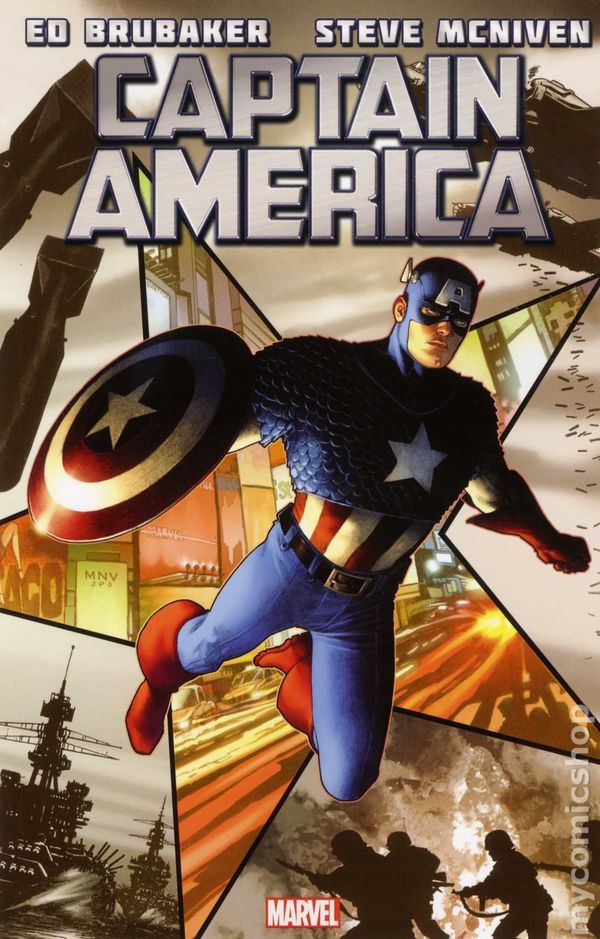
Captain America by Ed Brubaker Vol. 1 (comic)
Writer: Ed Brubaker
Artist: Steve Niven
Collects: Captain America (vol. 5) #1-5
The Marvel love affair with relaunching rolls on. The sad part being that it wasn't twenty issues before that they renumbered the last volume to legacy numbering. Then, this one lasts all of nineteen issues before they relaunch Cap again*! Unbelievable.
Steve Rogers has the mantle again and Ed Brubaker decides to lead off with an accessible story. You need no knowledge of prior volumes to read this one. Brubaker's been pretty generous in giving us an easy in between bigger storylines. "Two Americas" is similar in this regard.
This story leans on a few Captain America cliches to work. Someone from his past returns and is kind of cheesed at him. They fight. Steve then ends up wondering if he's a failure as Cap or if America has lost its way under his watch. On the plus side, Ameridroid shows up for a bit, even if we aren't likely to see him again. What we end up with is more of a straightforward action comic, which is not something Ed Brubaker has done a lot of in the past.
I mentioned Two Americas earlier; this volume has a few similarities to that book. The basic conflict is the same; someone shows up who is pretty unhappy with the way that America has gone, has a pretty concrete view on how it should be and will go to extreme methods to "fix it". The difference is in the message. The point of Two America's is that Crazy 50's Cap was essentially fighting to regain a vision of America that probably never existed. It was pretty clear that, however good the intent may have been, 50's Cap was off his rocker and definitely in the wrong. This time, it's left ambiguous; Rogers himself wonders if the jerkass had a point. Not exactly unfamiliar ground for a Captain America story**, but it's not something I recall Brubaker doing before, so I can cut him some slack here.
The ending points towards another multi-arc plot from Brubaker, but I have no idea if it's resolved. Brubaker's run finally ended - after a staggering eight years - about fourteen issues later. You'd think that would be plenty of time to wrap it up, but it depends on when exactly Bru knew he was leaving and if he got enough space.
Steve McNiven's art is nice, as expected. There's a gaffe or two in there, though. The two panels where Sharon tosses the shield from out a hole in a building immediately come to mind. I wish I could counterbalance with something other than "it was nice", but I'm far from a master art critic.
The Score: 7 out of 10
This arc doesn't hit the highs of the past, but it's solid entertainment. Not a bad place to jump on either; I wouldn't recommend it, but if you just wanted a recent Cap book without six years worth of ongoing plot driving it this is as good a choice as any.
* Because, you know, DC did it and it was pretty successful. They deny it, of course, but they're not fooling anyone. To their credit, though, they're doing a better job with the rollout; instead of the hardline "wrap your shit up before September" approach DC took, Marvel's spreading out the new number ones and allowing books time to finish. So I hesitate to give them too much of a hard time. Still, two Captain America and Uncanny X-Men relaunches within two years?
** We can thank Watergate for that.
Artist: Steve Niven
Collects: Captain America (vol. 5) #1-5
The Marvel love affair with relaunching rolls on. The sad part being that it wasn't twenty issues before that they renumbered the last volume to legacy numbering. Then, this one lasts all of nineteen issues before they relaunch Cap again*! Unbelievable.
Steve Rogers has the mantle again and Ed Brubaker decides to lead off with an accessible story. You need no knowledge of prior volumes to read this one. Brubaker's been pretty generous in giving us an easy in between bigger storylines. "Two Americas" is similar in this regard.
This story leans on a few Captain America cliches to work. Someone from his past returns and is kind of cheesed at him. They fight. Steve then ends up wondering if he's a failure as Cap or if America has lost its way under his watch. On the plus side, Ameridroid shows up for a bit, even if we aren't likely to see him again. What we end up with is more of a straightforward action comic, which is not something Ed Brubaker has done a lot of in the past.
I mentioned Two Americas earlier; this volume has a few similarities to that book. The basic conflict is the same; someone shows up who is pretty unhappy with the way that America has gone, has a pretty concrete view on how it should be and will go to extreme methods to "fix it". The difference is in the message. The point of Two America's is that Crazy 50's Cap was essentially fighting to regain a vision of America that probably never existed. It was pretty clear that, however good the intent may have been, 50's Cap was off his rocker and definitely in the wrong. This time, it's left ambiguous; Rogers himself wonders if the jerkass had a point. Not exactly unfamiliar ground for a Captain America story**, but it's not something I recall Brubaker doing before, so I can cut him some slack here.
The ending points towards another multi-arc plot from Brubaker, but I have no idea if it's resolved. Brubaker's run finally ended - after a staggering eight years - about fourteen issues later. You'd think that would be plenty of time to wrap it up, but it depends on when exactly Bru knew he was leaving and if he got enough space.
Steve McNiven's art is nice, as expected. There's a gaffe or two in there, though. The two panels where Sharon tosses the shield from out a hole in a building immediately come to mind. I wish I could counterbalance with something other than "it was nice", but I'm far from a master art critic.
The Score: 7 out of 10
This arc doesn't hit the highs of the past, but it's solid entertainment. Not a bad place to jump on either; I wouldn't recommend it, but if you just wanted a recent Cap book without six years worth of ongoing plot driving it this is as good a choice as any.
* Because, you know, DC did it and it was pretty successful. They deny it, of course, but they're not fooling anyone. To their credit, though, they're doing a better job with the rollout; instead of the hardline "wrap your shit up before September" approach DC took, Marvel's spreading out the new number ones and allowing books time to finish. So I hesitate to give them too much of a hard time. Still, two Captain America and Uncanny X-Men relaunches within two years?
** We can thank Watergate for that.
Labels:
7,
Captain America,
Comics,
Ed Brubaker,
Marvel Comics,
Review,
Trade Paperback
Saturday, June 30, 2012
Luminous Arc (video game)
Platform: Nintendo DS
Developer: imageepoch
Genre: Tactical RPG
ESRB Rating: Teen
Release Date: August 14th, 2007
The Tactical RPG genre is pretty great, but it also hasn't advanced much over the years. It feels like a lot of these games have a certain sameness that makes it so they just sort of bleed together in your mind. Take this game, for example, which is Textbook TacRPG Example 1A.
You start off as a teenage knight in service of a church, because Japanese games tend to have this odd love affair with underage heroes. Apparently, said church teaches that witches are the bane of all existence. You can see where this is going, right? Kid meets witch, kid changes his mind about them, realizes boobs are pretty great, realizes that the being the church deified is actually a monster and sides with the witches. "We're gonna give God such a pinch" twist aside, it's a by the book coming of age story, sans anything to make it stand out from the pack.
Really, there isn't much about this game that isn't by the book. The story and characters are steeped in Japanese cliche, while the gameplay could be culled from any number of games in this genre. Luminous Arc doesn't have an original bone in its body and you could be forgiven for feeling as though you've played this game before.
Unoriginal as it may be, however, it's still a solid title. The character designs are stock anime for certain, but they're still appealing enough. We get voice acting as well. The gameplay itself is, of course, tried and true. It's certainly not reinventing the wheel, but it has a certain competency that redeems it, even if it doesn't make it something you just gotta have.
The Score: 7 out of 10
I wouldn't recommend this game over any of the classics, but if you've already crushed the greats it could serve as a fair rental. Just don't expect anything unique out of it.
Developer: imageepoch
Genre: Tactical RPG
ESRB Rating: Teen
Release Date: August 14th, 2007
The Tactical RPG genre is pretty great, but it also hasn't advanced much over the years. It feels like a lot of these games have a certain sameness that makes it so they just sort of bleed together in your mind. Take this game, for example, which is Textbook TacRPG Example 1A.
You start off as a teenage knight in service of a church, because Japanese games tend to have this odd love affair with underage heroes. Apparently, said church teaches that witches are the bane of all existence. You can see where this is going, right? Kid meets witch, kid changes his mind about them, realizes boobs are pretty great, realizes that the being the church deified is actually a monster and sides with the witches. "We're gonna give God such a pinch" twist aside, it's a by the book coming of age story, sans anything to make it stand out from the pack.
Really, there isn't much about this game that isn't by the book. The story and characters are steeped in Japanese cliche, while the gameplay could be culled from any number of games in this genre. Luminous Arc doesn't have an original bone in its body and you could be forgiven for feeling as though you've played this game before.
Unoriginal as it may be, however, it's still a solid title. The character designs are stock anime for certain, but they're still appealing enough. We get voice acting as well. The gameplay itself is, of course, tried and true. It's certainly not reinventing the wheel, but it has a certain competency that redeems it, even if it doesn't make it something you just gotta have.
The Score: 7 out of 10
I wouldn't recommend this game over any of the classics, but if you've already crushed the greats it could serve as a fair rental. Just don't expect anything unique out of it.
Saturday, June 23, 2012
X-Men Legacy: Lost Legions (comics)
Writer: Mike Carey
Artist: Khoi Pham
Collects: X-Men Legacy #250-253
Here we are, back again, with what is likely to be my last volume of X-Men Legacy. The last one was just so... yuck that I pretty much haven't felt like reading, much less reviewing, comics recently. Frankly, the last one was so aggressively dull - and questionable - that I would not have continued if I didn't already have this volume in my possession.
Hot on the heels of last volumes events - where we learned several of Legions personalities were running free - we find the cast looking to reclaim them. I mean, they're seperate personalities of a mentally unstable dude each with a power set of their own. You can't just kick back, call it a day and hope somebody else deals with it, especially when one is fond of draining souls and using the bodies like puppets.
This volume redeems the book a little bit. For one, it's a far more straightforward adventure; a far cry from last volume, where a blind mutant mused about bad things coming for the X-Men while semi-invisible giant spiders roamed around and Rogue decided to go have sex with an old homicidal egomaniac. The pleasant characterization returns and hell, Professor X is actually allowed to do something for once, so it can't be all bad.
It's just that there isn't anything remarkable about it. It's good enough that, had last volume not occurred, I may well have continued, but not good enough to erase that sour taste. I'm not sure there was any one element that did it - or if I could even pinpoint what the tipping point was for me - but the previous volume well and truly soured me on this book.
Yet again, we have another artist. It is, of course, no one from the previous two volumes I read, because apparently "regular artist" is a foreign concept to this book. Still, it's Khoi Pham and the work is very, very good. Clean, expressive and far from the muddy, inconsistent art the book has had previously. Frankly, they should have had Pham on from the start.
On the whole, this isn't a bad volume, but it isn't enough to have me keep going. But then, I believe Carey only has one volume left, so who knows. Maybe if it's in the library and I have nothing else to read I'll give it a shot.
The Score: 7 out of 10
And so the search for a good X-Men book continues. Somebody has to put out a good one eventually, right?
Artist: Khoi Pham
Collects: X-Men Legacy #250-253
Here we are, back again, with what is likely to be my last volume of X-Men Legacy. The last one was just so... yuck that I pretty much haven't felt like reading, much less reviewing, comics recently. Frankly, the last one was so aggressively dull - and questionable - that I would not have continued if I didn't already have this volume in my possession.
Hot on the heels of last volumes events - where we learned several of Legions personalities were running free - we find the cast looking to reclaim them. I mean, they're seperate personalities of a mentally unstable dude each with a power set of their own. You can't just kick back, call it a day and hope somebody else deals with it, especially when one is fond of draining souls and using the bodies like puppets.
This volume redeems the book a little bit. For one, it's a far more straightforward adventure; a far cry from last volume, where a blind mutant mused about bad things coming for the X-Men while semi-invisible giant spiders roamed around and Rogue decided to go have sex with an old homicidal egomaniac. The pleasant characterization returns and hell, Professor X is actually allowed to do something for once, so it can't be all bad.
It's just that there isn't anything remarkable about it. It's good enough that, had last volume not occurred, I may well have continued, but not good enough to erase that sour taste. I'm not sure there was any one element that did it - or if I could even pinpoint what the tipping point was for me - but the previous volume well and truly soured me on this book.
Yet again, we have another artist. It is, of course, no one from the previous two volumes I read, because apparently "regular artist" is a foreign concept to this book. Still, it's Khoi Pham and the work is very, very good. Clean, expressive and far from the muddy, inconsistent art the book has had previously. Frankly, they should have had Pham on from the start.
On the whole, this isn't a bad volume, but it isn't enough to have me keep going. But then, I believe Carey only has one volume left, so who knows. Maybe if it's in the library and I have nothing else to read I'll give it a shot.
The Score: 7 out of 10
And so the search for a good X-Men book continues. Somebody has to put out a good one eventually, right?
Labels:
7,
Comics,
Marvel Comics,
Mike Carey,
Review,
Trade Paperback,
X-Men
Tuesday, May 29, 2012
Spider-Man: Season One (comic)
Writer: Cullen Bunn
Artist: Neil Edwards
Original Graphic Novel
Also Included: Avenging Spider-Man #1
Clearly, the gears are a spinning over at Marvel headquarters, because I have to say this new graphic novel line is a good idea.
Unlike DC, Marvel never really changed their continuity around all that much. As such, they've had less need to retell or revise the origin stories of their heroes. They're the same as they were when they first debuted in the 60's. The flipside of that being that said origin stories are not likely to appeal to anyone who may wish to try a Marvel comic.
Lets face it; Stan Lee - along with Jack Kirby and Steve Ditko - may have built a universe from whole cloth, but the stories of their day are very, very dated and can be a bit of a chore to get through.
So, have a creative team produce an original graphic novel updating the origin stories of their most popular characters? A good move by Marvel. Including an issue of a modern day comic of said character - introduced as a "where are they now" after the main feature - to entice them into the monthly grind? That one's a shrewd move. Credit where it's due here; this is a slick, modern, well put together hardcover
The only iffy part is the branding*, but everything else more than makes up for it.
I probably don't need to recap much of the story; it's an iconic tale that everyone knows by heart now. Peter's a nerd who is bit by a radioactive spider, thus giving him amazing powers. At first he tries to take advantage of them for his own gain, but when his uncle dies in a manner that he could have prevented, he realized he has a responsibility to use those powers for good. The Amazing Spider-Man is born.
Cullen Bunn is a new face at Marvel who rose to prominence seemingly overnight. He tackles this in a manner reminiscent of an older comic; lots of thought balloons and a few too many instances of characters talking to themselves at length. I'm not sure if this was a conscious choice - perhaps Bunn was trying to update the storytelling styles of the day for this - but I'm not sure it worked as he may have hoped. There are several instances where it might have been appropriate for Bunn to pull back a bit and let the art do the talking.
The art, by the way, is pretty solid work. It's clean, expressive and does a fine job of telling the story. Neil Edwards doesn't reinvent the wheel or anything here, but at the same time, he doesn't really have to.
There's nothing offensively bad about this graphic novel; it's an alright retelling of Spider-Mans classic origin. It doesn't touch the best - I've long felt Ultimate Spider-Man is the cream of the crop in Spider-Man origins - but it's a step up from the original. If I had to choose one thing that struck me as an issue, it would be the odd pacing and structure.
The story itself feels like it's reached it's natural climax and endpoint when Peter discovers that his uncles murderer is the same man he let go earlier in the story. Instead, the book moves onward into Spider-Mans first real adventure against the Vulture. Trouble is, Vulture was barely mentioned in the first half and it's treated as a part of the same story. Since this part was not separate from the origin - as, say, another chapter in the book - it ends up feeling like a very long denouement instead of another adventure.
As for the extra - a copy of Avenging Spider-Man #1 to show what Spidey is up to in current continuity - it's a pretty fun opener to what seems to have been a multi-part storyline. Spidey teams up with Red Hulk to fight the Mole Men. It's some good fun. It's bolstered by art by Joe Maduriera, who hasn't done interior work on a comic in a good long while.
The Score: 7 out of 10
There are some issues here, but it's not a bad retelling of Spideys origin. I'd say it's worth a look for a newbie. Everyone else won't find much they haven't seen before. Regardless, the line is a good idea; I just hope the overall craft is on a higher level for the other installments.
* The "Season One" moniker is odd. It gets across the general idea; this is starting right from the beginning. It also accomplishes the goal of differentiating their line from DC's "Year One" tagline. But a "season"? That's television terminology that denotes a run of episodes from a serialized program. It's... odd, considering this is a single story, not to mention a comic book. It also breeds expectation; if there's a season one, shouldn't there logically be a second season? Time will tell if there will be a Season Two, but as of this writing there's no word.
Artist: Neil Edwards
Original Graphic Novel
Also Included: Avenging Spider-Man #1
Clearly, the gears are a spinning over at Marvel headquarters, because I have to say this new graphic novel line is a good idea.
Unlike DC, Marvel never really changed their continuity around all that much. As such, they've had less need to retell or revise the origin stories of their heroes. They're the same as they were when they first debuted in the 60's. The flipside of that being that said origin stories are not likely to appeal to anyone who may wish to try a Marvel comic.
Lets face it; Stan Lee - along with Jack Kirby and Steve Ditko - may have built a universe from whole cloth, but the stories of their day are very, very dated and can be a bit of a chore to get through.
So, have a creative team produce an original graphic novel updating the origin stories of their most popular characters? A good move by Marvel. Including an issue of a modern day comic of said character - introduced as a "where are they now" after the main feature - to entice them into the monthly grind? That one's a shrewd move. Credit where it's due here; this is a slick, modern, well put together hardcover
The only iffy part is the branding*, but everything else more than makes up for it.
I probably don't need to recap much of the story; it's an iconic tale that everyone knows by heart now. Peter's a nerd who is bit by a radioactive spider, thus giving him amazing powers. At first he tries to take advantage of them for his own gain, but when his uncle dies in a manner that he could have prevented, he realized he has a responsibility to use those powers for good. The Amazing Spider-Man is born.
Cullen Bunn is a new face at Marvel who rose to prominence seemingly overnight. He tackles this in a manner reminiscent of an older comic; lots of thought balloons and a few too many instances of characters talking to themselves at length. I'm not sure if this was a conscious choice - perhaps Bunn was trying to update the storytelling styles of the day for this - but I'm not sure it worked as he may have hoped. There are several instances where it might have been appropriate for Bunn to pull back a bit and let the art do the talking.
The art, by the way, is pretty solid work. It's clean, expressive and does a fine job of telling the story. Neil Edwards doesn't reinvent the wheel or anything here, but at the same time, he doesn't really have to.
There's nothing offensively bad about this graphic novel; it's an alright retelling of Spider-Mans classic origin. It doesn't touch the best - I've long felt Ultimate Spider-Man is the cream of the crop in Spider-Man origins - but it's a step up from the original. If I had to choose one thing that struck me as an issue, it would be the odd pacing and structure.
The story itself feels like it's reached it's natural climax and endpoint when Peter discovers that his uncles murderer is the same man he let go earlier in the story. Instead, the book moves onward into Spider-Mans first real adventure against the Vulture. Trouble is, Vulture was barely mentioned in the first half and it's treated as a part of the same story. Since this part was not separate from the origin - as, say, another chapter in the book - it ends up feeling like a very long denouement instead of another adventure.
As for the extra - a copy of Avenging Spider-Man #1 to show what Spidey is up to in current continuity - it's a pretty fun opener to what seems to have been a multi-part storyline. Spidey teams up with Red Hulk to fight the Mole Men. It's some good fun. It's bolstered by art by Joe Maduriera, who hasn't done interior work on a comic in a good long while.
The Score: 7 out of 10
There are some issues here, but it's not a bad retelling of Spideys origin. I'd say it's worth a look for a newbie. Everyone else won't find much they haven't seen before. Regardless, the line is a good idea; I just hope the overall craft is on a higher level for the other installments.
* The "Season One" moniker is odd. It gets across the general idea; this is starting right from the beginning. It also accomplishes the goal of differentiating their line from DC's "Year One" tagline. But a "season"? That's television terminology that denotes a run of episodes from a serialized program. It's... odd, considering this is a single story, not to mention a comic book. It also breeds expectation; if there's a season one, shouldn't there logically be a second season? Time will tell if there will be a Season Two, but as of this writing there's no word.
Labels:
7,
Comics,
Cullen Bunn,
Marvel Comics,
Marvel Season One,
Review,
Spider-Man,
Trade Paperback
Tuesday, April 24, 2012
Blackest Night (comics)
Writer: Geoff Johns
Artist: Ivan Reis
Collects: Blackest Night #0-8, Directors Commentary, sketches, scripts for deleted scenes and other bonus material
Ahh, Blackest Night. The culmination of the first five years of Geoff Johns run on Green Lantern and his third big event for DC. Thing is, I'm not a big Green Lantern reader. By all rights, Geoffs run on Green Lantern has a lot of things I generally like in comics - as much as it's been derided by the smarmy corner of internet reviewing, the mutli-colored corps are a hell of a way to throw color around and history will show I like that - but I've long had difficulty really caring*.
To tell the truth, that's been a bit of a problem for me in general regarding Geoff - I'm generally fond of his work, but Teen Titans aside he has quite the affinity for characters I couldn't care less about - but in this case, he threw zombies into the equation. I'm not a rock; I had to get around to this one eventually. It certainly helps that I loved the idea. After all is said and done, this one didn't sell me on the Green Lantern, but I have to admit that this is probably the most accessible - even if it isn't the smartest - event he's done to this point.
So, basically, lots of dudes in neon spandex like killing each other in space with rings that produce colored light. Of course, differences need to be put to the side when, holy crap, black rings show up and start reviving dead bodies. While on Earth, heroes and civilians are celebrating their own day of the dead, honoring the fallen in the line of superheroics. What a lucky coincidence that some black rings are around to raise dead loved ones and have them eat some hearts, right? This looks like a job for... some second stringers!
I'm being snarky, sure, but the idea is pretty sound. Basically, the black rings revive dead heroes and loved ones who could get a rise out of our heroes, causing them to feel emotions. They need these emotions to power up the Black Lantern battery, at which point they could really smack around our heroes. You can see why this was retooled from being just a Green Lantern story to a full on event; there's a lot of potential here for mining the storied DC history - which, at the time, was played as one of DC's defining elements - for emotional drama.
As you can tell by the contents, this was an eight issue event, not including the short zero issue that served as a prologue. That's a hell of a lot of room to work with, arguably too much for an event. These things are sold largely on hype, so somehow you need to keep wowing people each issue, in this case having to do so for eight issues.
To Geoffs credit, he pulls it off. The stakes are high early on and manage to keep going up. Even when you think "this is it, the good guys have it in the bag", Geoff will have one more trick to pull. As such, the book is filled with big moments that will stick in your mind, even if the general story does not. These alone hold your attention very well even in the collection; it must have been really exciting month to month.
It's a good thing Geoff knows how to wow you though, because his writing in this book is not always the sharpest. Some exchanges vary from either hammy to corny, while some of Green Lanterns cracks about "lite bright" and "rainbow brigade" are a little too wink wink, nudge nudge to fan grumblings to really work. For every moment that works - there's some speechifying Flash gives Mera and Atom about halfway through that I thought was effective - there's another that isn't.
Worse still, the book feels like a jigsaw puzzle with a few of the pieces missing. There are some quick cuts that are obvious setups for the tie-ins, but in the process the main story suffers somewhat. Green Lantern is spirited off a third of the way through the book to round up the rest of the corps and doesn't appear again until a while later, the whole recruitment bypassed. Similarly, you could be forgiven for forgetting the Lanterns in space are in trouble too, because after some quick setup early on showing them besieged by black rings, we almost never see them again until the end.
Sloppy, confusing and stupid. Probably easily fixed too with a bit of trimming.
All that said, if you ignore these moments, the book IS readable. Like I said, it's pretty accessible even if you don't care a whit about Green Lantern. This was clearly what they were shooting for. Of course, the fact that "readable" and "genuinely great" aren't the same thing happens to be lost in the process. Still, I'm not sorry I read it, which is a hell of a lot better than some other events I've read.
The event is bolstered by the presence of Ivan Reis, who is on art duties from start to finish. His work is great as always. The coloring isn't quite as lush as Brightest Day - considering this is a story dealing heavily in death, it probably shouldn't be - but the actual linework is still top notch. No artist changes midway through either, which really bolsters the book. Better written events were practically sunk by art shifts partway through; had the same fate befallen Blackest Night I think it would have joined them. Never underestimate the value of a consistent look.
The Score: 7 out of 10
Not as great as I hoped it would be when it was in the midst of monthly serialization, but it's definitely a solid seven. It might have fared better if the Green Lantern issues were included in their proper place; at times it felt like I was only getting half the story. I imagine I will get to that collection eventually. In the meantime, the core event is worth a read at the least. But unless you're a fan of Geoffs ongoing Green Lantern saga I hesitate the recommend an outright purchase.
* Actually, that's not entirely fair. There was a point during Blackest Nights publication where I had honestly considered trying to get into Geoffs Green Lantern starting from Rebirth on. The trade collection plans are what changed my mind. I wasn't happy when I heard the Green Lantern tie-in issues were to be collected separately, as what I'd heard made it sound like they easily slotted in the issues of the event and added a lot of depth. A lot of folks would have just sucked it up and switched off between the two books, but I'd hoped DC would eventually collect Blackest Night and the GL tie-in issues in a big ol' "Ultimate Collection". So far, it hasn't happened.
Artist: Ivan Reis
Collects: Blackest Night #0-8, Directors Commentary, sketches, scripts for deleted scenes and other bonus material
Ahh, Blackest Night. The culmination of the first five years of Geoff Johns run on Green Lantern and his third big event for DC. Thing is, I'm not a big Green Lantern reader. By all rights, Geoffs run on Green Lantern has a lot of things I generally like in comics - as much as it's been derided by the smarmy corner of internet reviewing, the mutli-colored corps are a hell of a way to throw color around and history will show I like that - but I've long had difficulty really caring*.
To tell the truth, that's been a bit of a problem for me in general regarding Geoff - I'm generally fond of his work, but Teen Titans aside he has quite the affinity for characters I couldn't care less about - but in this case, he threw zombies into the equation. I'm not a rock; I had to get around to this one eventually. It certainly helps that I loved the idea. After all is said and done, this one didn't sell me on the Green Lantern, but I have to admit that this is probably the most accessible - even if it isn't the smartest - event he's done to this point.
So, basically, lots of dudes in neon spandex like killing each other in space with rings that produce colored light. Of course, differences need to be put to the side when, holy crap, black rings show up and start reviving dead bodies. While on Earth, heroes and civilians are celebrating their own day of the dead, honoring the fallen in the line of superheroics. What a lucky coincidence that some black rings are around to raise dead loved ones and have them eat some hearts, right? This looks like a job for... some second stringers!
I'm being snarky, sure, but the idea is pretty sound. Basically, the black rings revive dead heroes and loved ones who could get a rise out of our heroes, causing them to feel emotions. They need these emotions to power up the Black Lantern battery, at which point they could really smack around our heroes. You can see why this was retooled from being just a Green Lantern story to a full on event; there's a lot of potential here for mining the storied DC history - which, at the time, was played as one of DC's defining elements - for emotional drama.
As you can tell by the contents, this was an eight issue event, not including the short zero issue that served as a prologue. That's a hell of a lot of room to work with, arguably too much for an event. These things are sold largely on hype, so somehow you need to keep wowing people each issue, in this case having to do so for eight issues.
To Geoffs credit, he pulls it off. The stakes are high early on and manage to keep going up. Even when you think "this is it, the good guys have it in the bag", Geoff will have one more trick to pull. As such, the book is filled with big moments that will stick in your mind, even if the general story does not. These alone hold your attention very well even in the collection; it must have been really exciting month to month.
It's a good thing Geoff knows how to wow you though, because his writing in this book is not always the sharpest. Some exchanges vary from either hammy to corny, while some of Green Lanterns cracks about "lite bright" and "rainbow brigade" are a little too wink wink, nudge nudge to fan grumblings to really work. For every moment that works - there's some speechifying Flash gives Mera and Atom about halfway through that I thought was effective - there's another that isn't.
Worse still, the book feels like a jigsaw puzzle with a few of the pieces missing. There are some quick cuts that are obvious setups for the tie-ins, but in the process the main story suffers somewhat. Green Lantern is spirited off a third of the way through the book to round up the rest of the corps and doesn't appear again until a while later, the whole recruitment bypassed. Similarly, you could be forgiven for forgetting the Lanterns in space are in trouble too, because after some quick setup early on showing them besieged by black rings, we almost never see them again until the end.
Sloppy, confusing and stupid. Probably easily fixed too with a bit of trimming.
All that said, if you ignore these moments, the book IS readable. Like I said, it's pretty accessible even if you don't care a whit about Green Lantern. This was clearly what they were shooting for. Of course, the fact that "readable" and "genuinely great" aren't the same thing happens to be lost in the process. Still, I'm not sorry I read it, which is a hell of a lot better than some other events I've read.
The event is bolstered by the presence of Ivan Reis, who is on art duties from start to finish. His work is great as always. The coloring isn't quite as lush as Brightest Day - considering this is a story dealing heavily in death, it probably shouldn't be - but the actual linework is still top notch. No artist changes midway through either, which really bolsters the book. Better written events were practically sunk by art shifts partway through; had the same fate befallen Blackest Night I think it would have joined them. Never underestimate the value of a consistent look.
The Score: 7 out of 10
Not as great as I hoped it would be when it was in the midst of monthly serialization, but it's definitely a solid seven. It might have fared better if the Green Lantern issues were included in their proper place; at times it felt like I was only getting half the story. I imagine I will get to that collection eventually. In the meantime, the core event is worth a read at the least. But unless you're a fan of Geoffs ongoing Green Lantern saga I hesitate the recommend an outright purchase.
* Actually, that's not entirely fair. There was a point during Blackest Nights publication where I had honestly considered trying to get into Geoffs Green Lantern starting from Rebirth on. The trade collection plans are what changed my mind. I wasn't happy when I heard the Green Lantern tie-in issues were to be collected separately, as what I'd heard made it sound like they easily slotted in the issues of the event and added a lot of depth. A lot of folks would have just sucked it up and switched off between the two books, but I'd hoped DC would eventually collect Blackest Night and the GL tie-in issues in a big ol' "Ultimate Collection". So far, it hasn't happened.
Labels:
7,
Blackest Night,
Comic Event,
Comics,
DC Comics,
Geoff Johns,
Green Lantern,
Ivan Reis,
Review,
Trade Paperback
Saturday, March 24, 2012
X-Men: With Great Power (comics)
Writer: Victor GischlerArtists: Chris Bachalo, Al Barrionuevo
Collects: X-Men (vol. 3) #7-11
It's Round Two for Victor Gischler on X-Men. Does he come out or the corner swinging? Or are we in for another fair-yet-disappointing outing like last time?
Gishlers sophomore arc has a few select X-Men teaming with Spider-Man. Seems kids are going missing back in New York and Cyclops - who seems to be taking a break from being a massive dick this volume - decides he can't find anything just as good for the image of the X-Men close to home and sends them across the country. Things get a bit cold-blooded from there as it looks like The Lizard is the culprit.
The one off issue after the main arc has the X-Men throw a birthday party for Jubilee, whose teeth are a bit pointier after the events of last volume. Jubes, no longer one to pass up a good chance for some angst, blows the whole thing off to go brood, not realizing Batman has that market cornered. Sensing the danger of infringing on Batmans territory - or worried about her, whatever - Professor X goes to cheer her up with a tale from the days when he went on rad adventures prior to the eight or nine times he went through the process of being crippled and subsequently healed.
He's currently able to walk, by the way; much as I hope he stays that way this time, I have a nasty feeling it's a matter of time before some writer drops a rock on his legs or something.
Victor Gischler continues to have problems writing certain characters, unfortunately. While his Wolverine doesn't say anything quite as dumb as "come get some" this time, he still sounds off. Same for his Gambit. He does an okay Spidey, though, having the character as a wisecracker who constantly verges on annoying. The plot is otherwise standard fare; it's nothing to write home about, but Gischler gives his artistic partner interesting things to draw - like the heroes turned to lizard men - often enough to make it worthwhile.
Speaking of the art, Chris Bachalo's on tap here. He is, as usual, completely awesome. I know some folks don't care for his work much, but the more I see of Bachalo the more I'm convinced they should be arrested for being so horribly wrong. I love the way he draws everyone, especially Spidey. His Spideys white eyes are huge round saucers, which has the effect of making Spider-Man look adorable and/or constantly amazed at everything he sees. I love it. Also, more awesome layouts.
If Bachalo could handle a monthly schedule on a well written book, I'd be one happy dude; as it is, his work makes a story that is merely alright completely worth the read.
The one off is a bit clunky as far as the writing goes, but it's enjoyable enough. It features Professor X as a bald hunter in Africa way back when, which I'm totally on board with. Unfortunately, it also features more angsty Jubilee, which I'm not quite as down with. Someone needs to inform every living writer that Twilight selling about a bajillion copies does not mean that stories of vampires angsting all the time is suddenly anything other than a pile of shit. It's still shit; middle aged women just inexplicably gained a fetish for bodily waste. The only thing related to shit that vampires should be in contact with is the asses they kick.
Art duties go to some other dude for this one. It's decent, but occasionally off, mostly in the present day pages; for the most part the flashback stuff is perfectly fine work. I'm going to cut the guy some slack because next to Chris Bachalos work just about anything is going to suffer in comparison.
The Score: 7 out of 10
I have concluded that I need more Chris Bachalo art in my life. Oh, and this volumes not too bad, I guess. It makes a hell of a lot more sense than last time did, anyways. Give it a look if you appreciate Chris Bachalo art, otherwise drop the score half to a full point.
Labels:
7,
Chris Bachalo,
Comics,
Marvel Comics,
Review,
Trade Paperback,
X-Men
Friday, February 24, 2012
The Light (comics)
Writer: Nathan EdmondsonArtist: Brett Weldele
Collects: The Light #1-5
I picked this one up largely because the striking cover caught my eye and I figured what the hell.
Story's pretty simple. We meet a welder who had just lost his job. He's pretty far from a good person; apparently, when his life went to hell, he went all Chris Brown on his wife - which is why they separated - and he's also an alcoholic. His teenage daughter lives with him and his mother for some odd reason - dad's rarely get custody, even if they're the most fit to raise them, which this dude definitely isn't - and it's all set up quickly in the first half of the first issue.
At this point, his old boss comes screaming in the dead of night about lights coming on and people spontaneously combusting. Then a street light comes on and he spontaneously combusts. Our "hero" is saved by his welders goggles. Figuring this is probably not the time to be hanging around the suburbs, he grabs his daughter and blows dodge, because despite the fact that he's kind of a scumbag he does love his kid.
From the opening setup, it's pretty straightforward up until the end. Standard apocalypse scenarios; get supplies, try to find family members at such and such place, bickering and infighting, you know the drill. It's mostly about the father, despite being an asshat, wanting to save his kid and the lengths he'll go to do it. It feels fairly realistic - his teenage daughter borderline hates him and doesn't respect him, which, you know, is understandable considering he smacked her mother around - and the two define dysfunction. There's little else to the book though.
Edmondson takes the Robert Kirkman route of not bothering to really explain what's going on, letting the questions just hang in the air. It's a pretty fair choice, but at the same time the concept is a bit out there and could use a bit of definition. He tries to establish some ground rules - apparently, the light has to hit the eyes or something and the effects only come from something that receives its power from the power grid - but it's mostly for the purpose of giving the dad an option to try and stop the crisis in the immediate vicinity to save his kid. None of that really explains why looking at a light will make somebody burst into flames. Doesn't make much sense to me; probably why he wanted to dodge explaining it.
Given the simplicity of the overall story, I think five issues was kind of pushing it. Obviously Edmondson needed time to establish the father-daughter dynamic, but there are parts where I got a bit of a feeling of killing time. If compacted a bit more - say, three issues - I think the story might have been a bit more punchy; you know, goes in, gets the job done and leaves with a bit of an impression made. As it is, the book is a brisk, fast paced read, so it's not particularly glaring, but I can't help but think it went on a bit too long without anything really "happening".
There's a text piece in the back where Edmondson gives his thoughts on the story and what he was aiming for. He was gunning for tension and horror through use of the fact that we're all connected these days; he probably should have gone with the internet for it, but I suppose power lines do the job. It's a fairly neat concept, for sure, but it's a bit of a minor theme; I think if it were played up more in the story instead of being mostly explained in the text piece this book would have stood a bit taller.
As it stands it's a breezy read with some nice art that's a perfectly acceptable way to kill an hour.
The Score: 7 out of 10
I think this book had more potential, but it's still a decent, inoffensive read. You could skip it and not miss a whole lot, but you won't feel lesser for checking it out. Give it a read if the concept interests you.
Saturday, December 24, 2011
RED (comics)
Writer: Warren EllisArtist: Cully Hamner
Collects: RED #1-3, bonus material
This book kicked my expectations around in the wrong ways. I like the work of Warren Ellis and Cully Hamner is a damn great artist. On a creator owned book, you'd think it would be dynamite. Unfortunately, the book is fairly disappointing.
We don't have any real curveballs in the concept; it's fairly simple. An extremely dangerous CIA agent is in retirement, wanting nothing more than to be left in peace. Unfortunately, when the new administration catches wind of him and the things he'd done in their service, they drop a deuce in their drawers. Fearing the consequences if such knowledge got out, they rashly order him dead. One problem; he's a killing machine and he doesn't take kindly to assassination attempts. Cue the killing.
The book tries to say something about how the younger generation has lost the intestinal fortitude to make the hard choices and to live with them - and that's fine - but throughout the book, it felt like something was missing. It was competent, told it's story in a neat three issue package and made sure to exit without wearing out its welcome. It wasn't until I finished it that I realized what was off.
There's no conflict or real danger.
Paul Moses is never really in a compromising position at any point in this book. Once he turns back the initial assassination attempt without much trouble, everything between him and his destination dies. There is nothing at stake and you don't realize quite how much that effects a story until you have one like this, where the main character literally makes it through the entire book without suffering so much as a hangnail.
Aside from that, it's not bad. Cully Hamner is his usual awesome self. His clean, simple work is always a joy to behold. He doesn't bother using too many lines; this book proves he knows when less is more. His work stands out more for it as well; there are quite a few artists in comics that overdraw their work with lines upon lines to the point of utter ridiculousness.
One last thing; did no one realize prior to the books production that the back cover quote doesn't even describe the book itself? It just describes what goes into one of Warren Ellis' best stories. Odd oversight? Couldn't they find a better quote?
The Score: 7 out of 10
Worth a look for Hamners art alone. Might also be good for a big Ellis fan or to see what inspired the movie*, which I've yet to see. It feels like a bit of a weird read due to what was mentioned earlier in the review, but it's enjoyable enough.
* This is a bit of an odd choice for a movie, too. It has more than enough action to work as a film, sure, but there's not enough here to go on. Of course, Hollywood has made full films out of short stories numerous times over the years, so no huge shock.
Labels:
7,
Comics,
Cully Hamner,
DC Comics,
Review,
Trade Paperback,
Warren Ellis
Monday, October 10, 2011
X-Men Legacy: Collision (comics)
Writer: Mike CareyArtist: Clay Mann
Collects: X-Men Legacy #238-241
I'm just going to preface this review by saying that it's kind of nice to actually read a recent X book that was - shock of shocks - fairly enjoyable, even if it's not really remarkable.
This is pretty much Mike Careys book at this point. As I understand it he's been on it for something like six or seven years (jumping on somewhere in the 180's, I think). It's changed focus a few times, initially having Careys pet character Rogue take over the book - at the time leading a motley crew of mutants - then focusing on Professor X and now back to the southern belle. Nobody seems to talk about it, but most everyone seems able to at least enjoy it.
I jumped into this one cold, which I thought was a bad decision at first because it quickly becomes clear we're dealing with old plotlines from way back in Careys run. Shockingly, aside from the fact that I had no clue what the powers of the kids were supposed to be, I managed to get through without much confusion.
To keep a long story short, one of the young mutants Rogue currently mentors is called back to his homeland, which is besieged by electrical storms of some sort. Magneto - currently an X-Man because Cyclops is a raging moron - finds this particularly interesting, so he tags along. Rogue - who has control of her powers now, it seems, after about twenty freaking years of the no touch thing - is sent as a chauffeur. They quickly find themselves neck deep in trouble.
Apparently, the villains, The Children of the Vault, were stopped by Rogue at some point in the past. This apparently lead to the deaths of some of their own. They're not the forgiving sort, it seems, as it seems they would prefer she stop breathing. If you know anything about Rogue at all, you know her response will probably be a few broken jaws.
Carey offers no help to anyone who may just be jumping on - one thing the other X books have actually done right recently are providing quick captions that run down power sets and who a character is when they show up - but despite that he manages to keep things moving*. His Rogue actually feels like a strong woman; able to take care of herself and get the job done herself. Maybe I just haven't been reading the right books, but it feels like it's been a while since she's been that way.
But, to be blunt, there's really nothing else of note here**. It's a fairly competant, enjoyable read in an era where that seems to be in short supply for the X-Men. It's really not something that's going to grab you so much you'll remember fine details years down the road, but in an era where dumping an entire race on a rock that everyone who hates them knows they're on is treated as a smart, logical thing to do, I'll claim victory just for not having to sigh heavily and wonder why I keep trying.
Oddly, I didn't have as much of a problem with Magnetos presence, either. Carey at least keeps Magnetos terrorist past at the fore and Mags even comments on things hes done himself at times. In other words, he's still a collosal dick, which is kind of refreshing instead of "I'm totally a good guy now, really!" I still felt like he was trying a bit too hard to make him cool, however, but that may just be me. Oh, and going by an exchange midway through the book between the two, apparently Magneto suddenly wants to bone Rogue. This felt kind of random - mostly Rogues comment about it - but I'm going to just assume this is something that Carey's been working in prior to this.
Rogue at least says there's nothing between them, but even the idea is kind of an "ick" moment.
As for the art, it gets the job done. Clay Mann turns out pretty clean and detailed work here. It's not going to reinvent the business, but it doesn't need to. Fairly clear storytelling and some eye pleasing work round off the most enjoyable recent X arc that wasn't a one shot.
The Score: 7 out of 10
So hey, this is pretty decent. If you're not particularly happy with the X books these days, this is a pretty safe bet. Aside from a glimpse of Utopia and Cyclops, there's little to do with the then current status quo. I may check out some future volumes, who knows.
*There are bios of the characters, but they're way in the back. This might just be me, but that would have been great info to have before I started the story. An indicator at the front maybe?
** Well, for me anyways. It DOES work on it's own well enough. But it's another one of those books that I imagine would mean a lot more to someone who'd read the other story where Carey created them. But hey, it happens; you can't go into a television show halfway through a season and expect the revelations to have as much weight for you either.
Labels:
7,
Comics,
Marvel Comics,
Mike Carey,
Review,
Trade Paperback,
X-Men
Sunday, July 17, 2011
Ultimate Comics Avengers: Next Generation (comics)
Artist: Carlos Pacheco
Collects: Ultimate Comics Avengers #1-6
After the events of Ultimatum, which sucked, the world is starting to recover. That sure won't last for long though, because the Red Skull is back. Worse still, he's Captain Americas son; and now Cap knows. When Cap goes rogue, Nick Fury is brought back on the job to do two things; neutralize Americas Greatest Douchebag and take out his son.
Cue, Project Avengers, who in the Ultimate universe are a black ops squad.
Obviously, the Ultimate universe sort of went down the toilet over the years. It started when several of the ongoings started to kind of suck, then Loeb took over the Ultimates and that went about as well as you expected. Then Loeb sort of finished the job with Ultimatum, after which the only real option is to relaunch because good lord did you see what went on in that book? Since Marvel doesn't like producing crap any more than any company, they made a few decisions with this relaunch to try and rebuild its reputation.
First step, get Mark Millar involved again. To their credit, given the success of his Ultimates run, it really wasn't a bad plan. But did it work out?
Now, before I talk about anything else, can I just note that I love the Ultimate Comics trade dress that came with the relaunch of the line? It really works. Simplistic, yet still appealing.
Personally, I'm hot and cold on the Ultimate universe. It's accessible for sure and - at least in the boom years of the line - they did a lot to try and differentiate it from regular Marvel. Sometimes, it works in both small and subtle ways. Others, not so much. The Ultimates - which are basically Ultimate Marvels version of the Avengers - never really appealed to me, because whenever I've seen them they've been less Earths Mightiest Heroes and more Earths Mightiest Assholes. Sure, an asshole can be a great protagonist, but it can also be difficult to give a crap when they have next to no redeeming qualities, yet are supposed to be the premiere superteam.
This is remedied a bit by making the book about a black ops squad; it seems a minor change to quibble over, but it's easy to accept your protagonists as pricks when their root concept or place in the world doesn't require them to be at least somewhat good other than for the hell of it.
Ultimate Comics Avengers actually worked out better than I thought it would. Part of that is because I expect little from Mark Millar these days, so my expectations are easy to exceed. Another part is that they've gone back to trying to put new twists on familiar concepts; and aside from accessibility that's a core draw for the Ultimate universe. Everyone knows of the Red Skull and the fact that he's an old Nazi. Great a villain as he is, we don't need a repeat. But framing him as Caps son brings a different edge to the typical adversarial relationship and had some potential.
Whether it actually worked is tough to say. I was interested in the parts we got in relation to Cap and his son, but it turned out to be few and far between. The two only meet twice in the story. Both scenes are brief. Everything else comes from exposition and flashbacks. We get a sense for what this all means in the grand scheme, but Millar never actually shows it in regard to Ultimate Cap, save for a scene or two at the end of the book. Most of the book he's either fighting the Avengers or smacking around his comrades out of nowhere.
Seriously, I'm not telling you anything new here, but Ultimate Captain America is such a douchebag. Sure, learning the terrorist who just whupped you is your son is definitely an understandable shock to the system. Less understandable is the reaction, where he goes rogue by kicking his friend in the face, beating the snot out of allied soldiers and blowing a hole in the side of his transport plane to escape. I mean, waiting until you'd landed and could escape into NYC is for pussies, right?
Some of Millars other choices also tend to make one scratch their head. Nerd Hulk? What? I mean, the concepts not bad, but even "Professor Hulk" didn't sound this stupid. And the point of Ultimate Iron Mans big brother, aside from the fact that Ultimate Tony himself was busy in other stories?
Regardless, this is one of Millars better efforts. When he wants to, Millar can be a capable storyteller and can reel you into the story. The problem is that this fact can get lost beneath his shock and schlock tactics that reel people in with the lack of good taste but frequently leave nigh unreadable messes ripe with wasted potential. He doesn't fall into some of his usual traps here - at least not as bad as usual - and aside from essentially reusing a scene from some of his earlier comics work he pens a downright readable story, even if most of his protagonists are reprehensible people. If he could reign himself in more often, we'd be in business; but I can't blame him, because that would make him less money.
I haven't even mentioned the art by Carlos Pacheco, but if I need to tell you how great his art is you don't pay enough attention to comics.
The Score: 7 out of 10
Well, it wasn't the best thing I've read all year, but it was readable and kept my interest. I may be rating this a hair too low, but I'm not a hundred percent sure how I feel about it; it's not bad, but I don't think it's something I'll race to re-read. Still, it wasn't bad and next volume features Ultimate Punisher. I'm a pretty big mark for the Punisher in general and I didn't hate this at all, so I'll be back. Give it a look, but don't expect gold.
Labels:
7,
Avengers,
Comics,
Mark Millar,
Marvel Comics,
Review,
Trade Paperback,
Ultimate Marvel
Wednesday, June 15, 2011
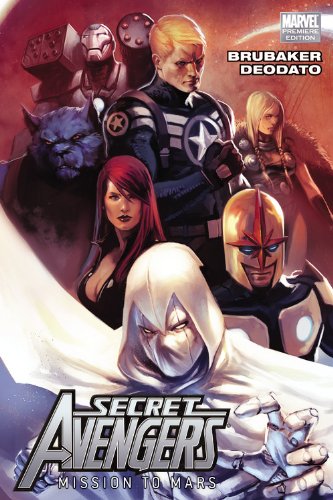
Secret Avengers: Mission to Mars (comics)
Artists: Mike Deodato Jr, David Aja, Michael Lark
Collects: Secret Avengers #1-5
Ed Brubakers run on Secret Avengers was shockingly short. Around when the second arc actually kicked off and the closing issues of said arc were being solicited, suddenly the word was that he was going to be off the book. When this happened, Brubaker admitted something; that he didn't feel like he really fit with the team concept as well, or something to that effect.
I bring this up because I would have gotten that feeling from this book even if he hadn't said it.
For most of this volume, this doesn't necessarily feel like a team book. For the first four issue arc, the focus seems to fall largely upon Steve Rogers. This is, to some extent, expected - he has, after all, been writing the Captain America book for the better part of seven years as of this writing - but it goes to the point where at times this feels more like a secondary Steve Rogers book with some allies tagging along on adventures than the team book it's supposed to be. Steve is in the vast majority of the scenes in this comic - I'd say about three quarters - he's clearly in charge and it comes down to him to stop the threat of the main four issue arc.
There are a few scenes spotlighting different characters - Black Widow and Valkyrie have a few decent scenes in here while Ant-Man does help in saving the day - but the other half of the team is just there. Nova himself has like one scene, Beast barely plays much of a role and both War Machine and Moon Knight have few lines, much less anything to actually do. I can barely remember anything War Machine said or did and I just read the damn thing. Fair focus on the team at large, this ain't.
The last issue barely has any of the team in it, as it's a bit of a "revelations" issue, which sheds light on a mystery or two introduced in the first four issues.
This is not to say the story is bad. It's well written, as expected, Brubaker portrays a likable, capable Steve Rogers, what little we get of the others feels on point and it's a pretty well told tale. It's by no means a crash and burn. But it's not what I expected and it's not necessarily as advertised. Team books aren't supposed to be like this.
None of this is to say anything bad about Ed Brubaker, however. Sometimes, some writers just cannot gel with some projects. Shit, I like Matt Fractions work, but he and the X-Men haven't been the best of fits. If nothing else, it's worth noting that Bru clearly knew something wasn't working and decided to bow out of the title a little bit later. Besides, Bru's done enough damn good projects to build some leeway; hell, this book is proof that even when he isn't a hundred percent on he can still pen a damn capable title.
So, hey, I've barely talked about the art. This isn't a knock on it though. It's damn good stuff. Deodato's work is great enough, but man, something just really clicked with me in regards to the fifth issue. It's simpler in linework and the coloring feels a bit older. Think seventies, eighties era comics. Since it's essentially part flashback to years past, this gives the issue an extra little oomph, to me. I'm not exactly sure what the breakdowns are for this issue - the art looks Lark-esque, but it could be mostly Aja for all I know and the credits sure as hell don't make it clear - but it's sharp stuff.
The Score: 7 out of 10
Even on an off day, Brubaker pens a solid tale. Really, if this were a Captain America comic, I'd probably say this were a seven point five or a solid eight. But it's supposed to be a team book and it didn't necessarily feel like one, so I feel like I need to knock a point off or so. But don't be fooled, this is still a decent read. I wouldn't say it's one of Brubakers best, but if you're just looking for a dependable read out of the post-Siege Avengers relaunch, I don't think you could go wrong here.
Just don't expect a lot of focus on the guys not named Steve Rogers.
Labels:
7,
Comics,
Ed Brubaker,
Marvel Comics,
Review,
Secret Avengers,
Trade Paperback
Saturday, April 16, 2011
Marvel Zombies 2 (comics)
Artist: Sean Phillips
Collects: Marvel Zombies 2 #1-5
As with all things uber popular, Marvel Zombies eventually found itself with a sequel by the originals creative team. They teased it being kind of a "Marvel Zombies Civil War", to which I responded "oh really now? This I gotta see!" Because, you know, how do you really do that, much less follow up with a sequel? There weren't even enough zombies left by the end - somewhere around seven, I recall - for much more than a minor skirmish, much less a war.
Besides which, for all its goofy stupidity, the first series had a relatively solid conclusion; the remaining zombies took the place of Galactus in the galaxy while the remaining humans arrived back on Earth to take back their planet.
Turns out you do it by twisting things a bit. The zombies didn't really take the place of Galactus. They end up being worse than Galactus, literally devouring the universe within the space of forty years. Once they run out of food, they remember, hey, Reed Richards had a dimensional portal, so lets use that and go to a universe with fresh meat. Back on Earth, the survivors have etched out a respectable living for themselves, but of course, political strife is evident. These two things colliding spells trouble for the surviving humans.
This go around, the dark humor is toned down. The sequel isn't as darkly comic as the original was, which I'm unsure is a good thing. It's played a bit more straight this time, with even a hint of redemption for the zombies afoot. All this means that there's more of a real story here this time, but there aren't as many "moments" that stick in your mind like the first go around had.
I mentioned in my review of the first volume that I lamented the lack of different perspective on the overall zombie infection of the heroes. Kirkman wisely avoids the pitfalls this time, as we find ourselves with focus split between the survivors and the former heroes. It actually made for a better story, I think, because the last time the humans weren't much more than meat. There was no way to get attached to the two or three left barring Magneto, which was a bit of a problem.
Everything isn't a bed of roses here, though. Kirkman even tries to make the zombies a bit more likable this go around - a real problem last time - but whether he succeeds or not is debateable. He elaborates on the concept he introduced at the end of the first volume; mainly, the zombies lose their hunger the longer they go without eating. Spider-Man has noticed this too and starts to relate it to Luke Cage. Seems simple enough, right?
Here's the problem. With the hunger gone, their heads are clearer, but it was established last time that their thoughts were clear right after they ate as well. Spider-Man was the only one who felt any real remorse. So they've turned into these gigantic pricks thanks to the zombie virus, but once the hunger is gone, hey, please forgive us, right? A bit hard for me to buy; even in their most lucid moments prior they still didn't have much problem with hunting down survivors for their next meal.
Also, how would this only just happen in such a short span of time after forty years of hunting the galaxy. It seems like it's only a couple weeks at best before they get to Earth again. They even stop to snack on Ego the Living Planet along the way. But in the forty years they spent in space, they didn't realize this until just now? Even with the time spent between worlds, traveling the stars?
So, as you can tell, there are still logic problems here. Like the first miniseries, you can't think about this one too much, otherwise too many unanswered questions and plotholes crop up. This is, again, stupid fun comics. Just with a bit more of a real story this time around. I'd say it holds up around the same as the first series, maybe just a bit weaker.
I won't spoil the ending, but there is a cliffhanger at the end. One that may not even be resolved. Kirkman didn't return for a third round - there's an entirely different creative team for three on - so what he had planned for the rather obvious second sequel is a mystery. There's overall resolution to the volumes events, but if he wasn't sure he'd be coming back, Kirkman probably shouldn't have had a cliffhanger epilogue.
As for the art, Sean Phillips is back and everything I said last time applies here too. His work is still good and he does well with providing a squick factor to the dark proceedings. There isn't as much dark comedy for him to work with as in the original miniseries, but he makes due regardless. I hope to see more or his art outside of this context, though, as it's hard to judge how he'd do on a more traditional story.
The Score: 7 out of 10
I still don't get why this was such a phenomenon, but at least they turned out to be solid comics so far. How long it can hold up as legitimate stories, I'm not so sure. Even Kirkman seems to realize the joke has a shelf life, because he mixed more of the same in with something new. I guess I'll have to find out, won't I? Worth it if you just really like Marvel Zombies, even if the novelty's started wearing off.
Labels:
7,
Comics,
Marvel Comics,
Marvel Zombies,
Review,
Robert Kirkman,
Sean Phillips,
Trade Paperback
Sunday, February 6, 2011
Blackest Night: Tales of the Corps
Artists: Rags Morales, Gene Ha, Eddy Barrows, Jerry Ordway
Collects: Tales of the Corps #1-3, Adventure Comics #4-5, six pages from Green Lantern #49, Book of the Black
We're still in tie-in land here, but unlike last time, this ones actually got some measure of worth to it.
I kind of get the impression that a lot of what's collected here are odds and ends that didn't fit in any other collection put together in it's own trade. Obviously, the Tales from the Corps mini needed to go somewhere and I imagine the two Adventure Comics issues weren't exactly easy to place in a trade. Slapped together with six pages from Green Lantern #49 - which is clearly there only to give a chapter to the Black Lanterns - and the "Book of the Black" segments and you have quite the odd collection. The end result is a trade that feels like an anthology, which really isn't a bad thing.
It's fairly enjoyable and really serves as something of a primer to the Green Lantern franchise as it exists now. The bulk of what's collected are origin stories for various characters across the seven Lantern Corps, giving insight into some key supporting players in the franchise. If you ever wanted to see Killowog as a Lantern recruit or, say, Monguls history, this is the volume to go to. All of them are fairly enjoyable little stories - well, except for the Indigo Lanterns piece, which shows us that they're supposed to represent compassion and then tells us nothing else about the mysterious group - though the nature of the exercise keeps all of them at a short length. To be honest, despite the clear Blackest Night branding, the Tales of the Corps issues really have more to do with the "War of Light" amongst the different corps.
The latter half of the book is the one that justifies the tie-in banner. Six pages of Green Lantern #49 provide a Black Lanterns chapter for the book, rounding out the book with at least one story for each corps. It's presented as an origin story, but it isn't. It's the only story of the volume that doesn't work on it's own, because frankly it reads like what it is; six pages of a Green Lantern issue in the middle of the event. There's also a small prose section detailing the thoughts of Black Hand which was fairly interesting and perhaps even a bit creepy.
The last part collected is a two issue tie-in centered on Superboy Prime. Look, I like Superboy Prime. I'm not going to apologize for it. Ever since Infinite Crisis - and hell, even during it - he's become a gigantic indictment of comic fanboys, which I suspect is primarily why a lot of them hate him. I mean, he prowls on the DCMB for chrissakes. He's also good for a lot of metatextual stuff, since he supposedly lives on "our" Earth, or real life.
This tie-in seems to signal the character being set aside for a while. It's probably a good thing, as while I hope he comes back after a couple years, he probably needed a break, since doing the same joke without a pause tends to wear it out. Still, it's an enjoyable, goofy story in that Superboy Prime way, seeing him trash the DC offices and demanding they leave him alone to fighting Black Lanterns of all the heroes that he killed in Infinite Crisis. Well, all of them save Pantha; I guess Geoff Johns didn't want to piss off the four people who actually give a goddamn about the character again.
The art's held down by a bunch of pencillers that are particularly good at their craft, which is the long way of saying the art's pretty rad. They don't always get much to work with - these are short vignettes that typically clock in at six pages and never exceed twelve - but they make the most of it. Even Eddy Barrows turns in some good art - as you'll note my previous experience with his work was not positive - and how the hell can you go wrong with art from guys like Gene Ha, Tom Mandrake, Jerry Ordway and Chris Samnee? That's right, you can't.
The Score: 7 out of 10
It's ties to the event may be tenuous and it's probably the least necessary of all the Blackest Night tie-in volumes, but what the hell. I enjoyed what I read and to me that means a lot. If you want to read some origins, are in the mood for some quick stories or are looking for decent Blackest Night tie-in volumes, you could do worse.
Saturday, November 13, 2010
Daredevil Noir (comics)
Artist: Tomm Coker
Collects: Daredevil Noir #1-4
This book kind of confuses me. Not in a sense that I couldn't understand the story. More in the sense that I can't understand why it exists.
I know, odd statement; why does any story exist? But seriously, this book didn't exactly feel too far removed from the norm for Daredevil. I admit I'm not a regular Daredevil reader. I've only read a couple scattered stories. I'm not overly familiar with noir either, aside from enjoying a couple classics. But what I have read of Daredevil already felt immersed in noir - or at least to my admittedly limited understanding of it - which kind of makes the choice to do a book like this an odd one. If the main book dabbles in the genre semi-regularly, why bother creating a standalone alternate continuity story based around it?
I guess one could say they just felt like hitting all their icons with this noir line; actually, now that I think on it, that's probably it.
Still, it makes for an odd read. What little noir I've read tends to have a nihilistic view of the world; and to some extent, that continues here. But in trying to suss out what's different, I couldn't really find anything. This book has Matt Murdock as a blind PI with partner Foggy Nelson and Matt moonlights as Daredevil. The typical dame shows up, Matt's drawn into her world, including a coming gang war and everything just goes to hell for him. But, you know, isn't that more or less what happens to Daredevil Classic? Seems like every five minutes you hear about one of his love interests overdosing and his life literally being broken down piece by piece. Maybe it just seems that way because I don't read the book much. Regardless, that's how it comes off. I guess the biggest difference with this book is that instead of being dredged in noir like the regular Daredevil, this is soaked in it before being sauteed in the proverbial noir juices.
Regardless of all that, it's quite competently written. It read about as I expected and I generally enjoyed it, so I suppose in some regards it's a success. The inner monologues can get a bit purple, but as I understand that's pretty much how noir is done and such is done well enough that I didn't feel like it was a distraction. I suppose I could fault it for being so much like what I expected that little it did was a surprise, but there's something to be said for getting what you want out of a book. Still, I'm not sure there's anything in this story that made it a completely worthwhile exercise.
The art looks great and fits the story perfectly, but it too has its problems. I understand that a noir story is supposed to be pretty dark - lots of shadows, muted colors and so on - but there are times where I think this book goes a bit overboard. There are a couple fight scenes that contained panels where I just flat out could not discern what was going on. Did the Bullseye killer just stab him with a piece of wood in the water? Does that character have Daredevil in a headlock? Why do the limbs seem kind of off in that panel? Why does this panel look more like they're having a dance-off than fighting? What the hell is coming out of that pipe? How did that building suddenly set on fire? And so on. It's really the fight scenes that are the problem. For the most part, the book has solid storytelling through art, but it seems that when a fight scene comes about the books very genre gets in the way. I guess if nothing else, it proves a noir comic can be a bit too shadowy.
The Score: 7 out of 10
When you get down to it, I'm still not sure this book justified its own existence. It was a fairly enjoyable read, however, so it's not a total waste. It's not something I'd jump to recommend, however. I guess it depends on how much noir you like on your Daredevil. For me, it didn't dissuade me from trying others from the Noir line, but... well, it doesn't exactly inspire me to go out of my way to read any more either.
Labels:
7,
Comics,
Daredevil,
Marvel Comics,
Marvel Noir,
Review,
Trade Paperback
Subscribe to:
Posts (Atom)