Showing posts with label Mark Millar. Show all posts

Wednesday, June 21, 2017

Jupiter's Legacy - Book One (comics)

Writer: Mark Millar
Artist: Frank Quitely
Collects: Jupiter's Legacy #1-5

Any of the three people who've read my blog for a long time know I'm not a fan of Mark Millar. I've had less than kind things to say about some of his comics in the past and I believe I've referred to him as a huckster. I started avoiding anything with his name over five years ago, in part because I got tired of his shock and schlock routine. Everything is crude, crass and disgusting to the point where it became a chore to read. It's like an ultraviolent version of Jerry Springer in comic form.

So, what brought me here? Well, Mark Millar comics sell big. As such, the guy attracts top level artists to whatever project he's working on. This time, he roped in Frank Quitely, which feels weird, given Quitely has worked primarily with Grant Morrison throughout his career. So it's the double surprise of seeing Quitely working away from a Morrison script for the first time in a decade and with a man Morrison once jokingly* said he wanted to run over with his car.

As expected, Mark Millar hucked it up going into this one, calling it his "Star Wars" and going so far as to say it's Lord of the Rings meeting a superhero crossover. Let it never be said that the dude doesn't know how to hustle his work. It's all overblown promotion, of course. The world is not nearly as intricately thought out as the latter and lacks both the scope and rollicking adventure of the former

But what it is happens to be pretty freaking good.

In 1932, in the wake of the stock market crash, Sheldon Sampson sets off with family and friends in search of an island he saw in a dream. They return with superpowers, ushering in a golden age of heroism. Cut to 2013, where they've all grown old and their children have taken their place. For the next generation, it's not exactly about heroics; it's all brand deals and putting your name out there, to the great shame of their fore-bearers. Sheldon - The Utopian - is struggling to uphold what he believes are the ideals of America in a world where it seems increasingly old fashioned and out of touch, even as the heroes around him actively resent him for keeping them from using their powers to "right" the world. His daughter is a drug addled mess, his son resents him for not being there enough and his brother is tired of playing by his rules.

Then the brother has had enough and whispers in the sons ear; if Sheldon were gone, everything would be better, they could make everything better.

As is clear from the general description, Jupiter's Legacy is a story about generational conflict and ego on both sides. It kind of brings Kingdom Come - the well regarded Mark Waid and Alex Ross Elseworlds miniseries - to mind, but without the overbearing biblical references or the immediate weight granted to an alternate universe of heroes millions around the world love. Grant Morrison even tackled similar themes before. The Golden Age of heroes is well and truly over, with the parents having done everything there is to do. As such, their children are left adrift, losing themselves to vices and cynicism that creep into their veins and take root in their lives. Much like real life, the young and the old have different ideas on how the world should be run and see each other as naive or out of touch. It's a fairly compelling conflict of ideals and to Millars credit, when the match meets gasoline, the impact is felt.

Part of what seems to set it apart is that Millar really reigns in his worst tendencies, to the stories benefit. I think this might actually be the first project I've read of his not involving a corporately owned superhero that didn't heavily rely on cursing. It's used sparingly, usually by regular people, and as such it feels a bit more natural. The ultraviolence and disgusting nonsense is at a low, too. The worst bit of it is the death of Sheldons wife, where we get a panel of her gored by numerous blades, but even that doesn't feel gratuitous. It works as an appropriately horrifying image without going too far, getting the point across without, like, showing her intestines or something.

But there's also a sense of hope and respect that feels absent in prior work. Things went off the rails somewhere in the past, but you really do get the feeling that, despite the problems of the modern day, even the villains of the piece stand for something. As much as the son may resent his father, Brandon still does what he does largely because he feels he can make things better and, despite his disillusionment, does want to help the world. He's distressed late in the book when things did not go near as well as he was promised by his uncle and in his frustration he's lashing out. It was all supposed to be so simple, right?

Then there's the daughter, Chloe, and her son. She's the more misguided of the two, losing herself to drugs and alcohol, but very clearly pulls herself together when things go bad, going into hiding with her child and the father. She tells the boy of her fathers adventures and her son, inspired and inheriting his grandfathers sense of both justice and inner heroism, covertly takes to saving people, despite the danger of discovery. By the end, the family comes together to save each other and their secret is blown, but whatever, right? They've hid long enough. The odds might be stacked against them, but when did the odds ever matter to superheroes?

All the more frustrating, then, to realize the guy could have been writing stuff like this all along. But hey, at least we got there. I'm into the book and ready for volume two, which promises to be where the push back against the new regime begins.

That said, there are some issues worth talking about.

Given that we're working with a new world and universe, we're obviously dealing with all new characters. So that leaves a lot in the way of set-up. Millar does a fine job of giving everyone differing viewpoints and personalities, but not every personal relationship is given the time it required. Chloe ends up looking like she'll be the hero of Jupiters Legacy, or at least one of the heroes, but she actually doesn't get nearly enough interaction with her parents before things go sour. We see plenty of the antagonism between Sheldon and his son, Brendan, but not so with Sheldon and Chloe. We get an idea what their relationship and thoughts are on each other through how they speak of each other, but they aren't even on panel together once, much less directly interacting. It's not much better with the mother, as they barely have a few sentences together before Chloe is attacked. It's a glaring oversight, and one reason I feel like this first volume could have used an extra issue slid in before the big plot point showed up.

The protagonists are also a little cavalier with loss of life at the end of the book, but it's in defense of their son, so you can at least sort of fudge the lines. Momma Bear and Papa Wolf aren't exactly new tropes. Still, I hope it's not the standard in the second half, as Chloes parents are old school heroes and wouldn't have approved.

Such a large time skip between issues three and four probably wasn't necessary either. Chloe has changed a great deal in the intervening years. It would have been nice to see some of that. Like I said, it could have used another issue. Half an issue showing moments from the nine years in succession all the way to where we end up would have done a lot for the book.

Frank Quitelys art is the same top notch work we usually get from him. As always, his style shows a lot of variety in body type, stature, body language and facials. The occasionally over-detailed eyes always get me. It's a thing in a fair number of Quitely projects that even good looking people will look just the slightest bit ugly without looking grotesque or unappealing to the eye. For example, Chloe has no eyebrows, making her look downright weird, but it also works, because she looks unique. Either you like Frank Quitelys art or you don't, but for my money, it's always great.

It's a good start and I'm invested in it enough not just to finish, but to check out the prequels, Jupiter's Circle, that Millar put out in the gaps after Legacy ran into its inevitable delays. We'll see where it goes, but for now, Jupiter's Legacy is a winner.

My Opinion: Read It

* I assume jokingly, but for all I know, he could have been serious. It's not exactly a big secret that Grant Morrison does not like Mark Millar anymore. The bad blood is known.

Thursday, October 20, 2011

Wolverine: Old Man Logan (comics)

Writer: Mark Millar
Artist: Steve McNiven
Collects: Wolverine #66-72, Wolverine: Old Man Logan Giant Sized

Hey, look, it's a project by that king of all hucksters, Mark Millar! Even more shocking, it's, GASP, pretty good without relying on shock and awe gross-em-out tactics. Miracles CAN happen, folks!

Anything with Millars name tends to draw a lot of attention - usually for all the wrong reasons - and several years back this was one of those projects Marvel was making a big deal about. The hype was certainly saying all the right things to reel me in; Mad Max style future starring Wolverine as a Clint Eastwood-in-Unforgiven style character with completely off the wall changes? Sold.

Still, it's a Millar project - and I may have mentioned I'm not really a fan - so I took my sweet ass time in getting around to it.

It's good, though. Millar delivered what was promised; we get a pretty crazy buddy cop adventure with Wolverine and Hawkeye rolling through the desert to the other side of the country. See, Wolverines landlords are dicks and he needs money or else they'll eat his family. Wolverine won't pop his claws - which he's sure to remind us way too often - because of an event in the past, so he needs to get out of the situation another way; so he teams up with Hawkeye, the two roll around in the Spider-Mobile, the Hulk has a whole family of inbred hillbilly Hulks and holy crap is that a Venom dinosaur?

Millar throws every crazy idea he has at the wall and no lie, it makes the book a page turner, even if the overall plot is a bit thin. There's something enticing about these kinds of stories, where you want to see more and more of this f***ed up world and you want to know how it got this way. Putting a wild twist on the familiar is always a good way to drive interest up, which is why these "warped future" stories tend to work so well. Besides, it's just freaking creepy - in a good way - to see something like the Red Skull, now President of his quarter of the US, dressed in Captain Americas costume with a trophy room of items collected from the dead heroes.

It's not all roses, however; with Millar, it never is. Spoiler warning for this paragraph. The way we get to the final fight is a little too obvious, frankly. We know that by the end, Logan will be back to his old self again in some fashion. It's just obvious. Also obvious is the way it's finally accomplished, as it's one of those plot points that you can see coming a mile away. So why Millar went with it, I couldn't tell you. I'd have been much more shocked if he'd gone another way.

Also disappointing is that Mark Millar recycled the premise of his creator owned work "Wanted" for this one. You know, the whole "all the villains joined forced, defeated the heroes and took over the world" bit. The only reason that really worked there is because - despite the fact that ninety percent of the characters were based on Marvel and DC heroes - they were his own characters in a world he owned. Outside of that, it doesn't hold water.

We're told something about there being "twenty villains for every hero" or something, which - if it were true - might make for a hell of a fight for our heroes. But think about this for more than five minutes and it breaks apart. Most heroes - especially at Marvel - don't have a rogues gallery to speak of. Sure, Spider-Man has about thirty villains - not all of them of note - but Cloak and Dagger are lucky if they have one. The Marvel Universe in particular is also very team focused - Avengers, Runaways, Fantastic Four, X-Men, etc. - and the more expansive rogues galleries tend to be attacked to these even bigger teams.

There isn't twenty villains for every hero. There isn't even ten. If we're being honest, there are probably more heroes at Marvel than villains and a good quarter of the villain total are completely lame. We're not even going to get into the experience most heroes have with fighting - and beating - all these villains.

One last sour note that relates to the villains - another spoiler alert here - the big mystery of the book is what screwed Wolverine up so badly that he gave up fighting, but the event in question is flawed. Make no mistake, being conned into slaughtering people you held dear works as a reason. I can believe that would screw with Logan enough to do this. That's not the problem.

The problem is that this all hinges on... Mysterio. The guy whose shtick involves parlor tricks and mere illusions. A human without much more than some experience in Hollywood effects somehow manages to not only make Wolverine see other beings as known villains - like, for example, Omega Red or Bullseye - but to make the body language mimic said villains, make him think they're using the weapons of those villains and to somehow make Logans super evolved senses - including smell - detect them as those villains.

An effects dude who does little more than annoy Spider-Man on occasion somehow does this. Without magic or powers. Anyone else seeing a problem here?

Despite those glaring issues, this is still a good read. It moves at a brisk pace, despite being seven full issues and a giant sized special. Despite the fact that I wanted to know more about the world than was given, I have to give Millar credit for not overloading us with details. He keeps the adventure moving and provides enough thrills and banter to keep you entertained. Despite the plot holes and logic problems, I'd say this is one of Millars better written projects. It's some pretty good fun, which is the kind of Millar writing I prefer, but rarely get.

Steve McNiven provides the visuals and he handles whatever Millar throws at him. This is a tall order. There's a lot of crazy ideas floating around this world they've given us. A lesser artist would not have been able to handle the kind of shit we see here and the book would have been ruined because of it. McNiven pulls it off without a hitch. His work really puts this book over the top and helps keep you from thinking on certain events too much.

The Score: 8 out of 10

Despite the issues I've mentioned, this book is still a lot of fun as long as you don't think too hard on some of the plot twists. It's probably the most I've enjoyed a Millar book since Wanted, at least; maybe even as far back as when he worked with Grant Morrison. Well worth a purchase, if you ask me. The ending sets things up for a sequel; I hope we get it at some point.

Sunday, July 17, 2011

Ultimate Comics Avengers: Next Generation (comics)

Writer: Mark Millar
Artist: Carlos Pacheco
Collects: Ultimate Comics Avengers #1-6

After the events of Ultimatum, which sucked, the world is starting to recover. That sure won't last for long though, because the Red Skull is back. Worse still, he's Captain Americas son; and now Cap knows. When Cap goes rogue, Nick Fury is brought back on the job to do two things; neutralize Americas Greatest Douchebag and take out his son.

Cue, Project Avengers, who in the Ultimate universe are a black ops squad.

Obviously, the Ultimate universe sort of went down the toilet over the years. It started when several of the ongoings started to kind of suck, then Loeb took over the Ultimates and that went about as well as you expected. Then Loeb sort of finished the job with Ultimatum, after which the only real option is to relaunch because good lord did you see what went on in that book? Since Marvel doesn't like producing crap any more than any company, they made a few decisions with this relaunch to try and rebuild its reputation.

First step, get Mark Millar involved again. To their credit, given the success of his Ultimates run, it really wasn't a bad plan. But did it work out?

Now, before I talk about anything else, can I just note that I love the Ultimate Comics trade dress that came with the relaunch of the line? It really works. Simplistic, yet still appealing.

Personally, I'm hot and cold on the Ultimate universe. It's accessible for sure and - at least in the boom years of the line - they did a lot to try and differentiate it from regular Marvel. Sometimes, it works in both small and subtle ways. Others, not so much. The Ultimates - which are basically Ultimate Marvels version of the Avengers - never really appealed to me, because whenever I've seen them they've been less Earths Mightiest Heroes and more Earths Mightiest Assholes. Sure, an asshole can be a great protagonist, but it can also be difficult to give a crap when they have next to no redeeming qualities, yet are supposed to be the premiere superteam.

This is remedied a bit by making the book about a black ops squad; it seems a minor change to quibble over, but it's easy to accept your protagonists as pricks when their root concept or place in the world doesn't require them to be at least somewhat good other than for the hell of it.

Ultimate Comics Avengers actually worked out better than I thought it would. Part of that is because I expect little from Mark Millar these days, so my expectations are easy to exceed. Another part is that they've gone back to trying to put new twists on familiar concepts; and aside from accessibility that's a core draw for the Ultimate universe. Everyone knows of the Red Skull and the fact that he's an old Nazi. Great a villain as he is, we don't need a repeat. But framing him as Caps son brings a different edge to the typical adversarial relationship and had some potential.

Whether it actually worked is tough to say. I was interested in the parts we got in relation to Cap and his son, but it turned out to be few and far between. The two only meet twice in the story. Both scenes are brief. Everything else comes from exposition and flashbacks. We get a sense for what this all means in the grand scheme, but Millar never actually shows it in regard to Ultimate Cap, save for a scene or two at the end of the book. Most of the book he's either fighting the Avengers or smacking around his comrades out of nowhere.

Seriously, I'm not telling you anything new here, but Ultimate Captain America is such a douchebag. Sure, learning the terrorist who just whupped you is your son is definitely an understandable shock to the system. Less understandable is the reaction, where he goes rogue by kicking his friend in the face, beating the snot out of allied soldiers and blowing a hole in the side of his transport plane to escape. I mean, waiting until you'd landed and could escape into NYC is for pussies, right?

Some of Millars other choices also tend to make one scratch their head. Nerd Hulk? What? I mean, the concepts not bad, but even "Professor Hulk" didn't sound this stupid. And the point of Ultimate Iron Mans big brother, aside from the fact that Ultimate Tony himself was busy in other stories?

Regardless, this is one of Millars better efforts. When he wants to, Millar can be a capable storyteller and can reel you into the story. The problem is that this fact can get lost beneath his shock and schlock tactics that reel people in with the lack of good taste but frequently leave nigh unreadable messes ripe with wasted potential. He doesn't fall into some of his usual traps here - at least not as bad as usual - and aside from essentially reusing a scene from some of his earlier comics work he pens a downright readable story, even if most of his protagonists are reprehensible people. If he could reign himself in more often, we'd be in business; but I can't blame him, because that would make him less money.

I haven't even mentioned the art by Carlos Pacheco, but if I need to tell you how great his art is you don't pay enough attention to comics.

The Score: 7 out of 10

Well, it wasn't the best thing I've read all year, but it was readable and kept my interest. I may be rating this a hair too low, but I'm not a hundred percent sure how I feel about it; it's not bad, but I don't think it's something I'll race to re-read. Still, it wasn't bad and next volume features Ultimate Punisher. I'm a pretty big mark for the Punisher in general and I didn't hate this at all, so I'll be back. Give it a look, but don't expect gold.

Friday, April 15, 2011

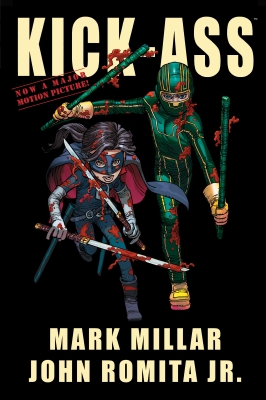
Kick Ass (comics)

Writer: Mark Millar
Artist: John Romita Jr.
Collects: Kick-Ass #1-8

So, Kick-Ass. Another of Mark Millars lovely projects that feel like they were tailor made more for the silver screen than the comic page. Hell, the film adaption of this one was actually in development while the miniseries was running; for a bit there, it looked like the film might have even released before the series finished. Millars public persona may be grating as all holy hell, but it seems to work for him.

Kick-Ass tries to use a very basic concept I'm sure a lot of us have given thought to before. "What if superheroes existed in the real world?" The main character - Dave - is a comic geek with some pretty crappy luck who decides, hey, this life is pretty boring, Imma get a wetsuit and go beat the hell out of a couple of Hispanic guys. Excess foul language and ridiculous amounts of violence ensue.

Right off the bat, we've got a problem. No matter how much he brings up things like Myspace or Youtube, Millar can't get out of his old habits. It doesn't take long - by the end of the second issue, in fact - for the perceived "realism" to vacate the premises. At first, it seems like he's going to stick with it - the consequences of Dave's hubris costs him six months of his life and requires intensive therapy to recover from - but then, fresh off his crutches, Dave suits back up and goes to pick a fight. Only this time, he wins. Right after months of healing and with no training. From there it's all downhill.

Everything is over the top here, from almost every character swearing worse than a sailor - Daves dad is literally the only character not to curse every other word - to little girls no older than ten being badass ninjas who slice people to ribbons. Literally, from the first time we see Hit-Girl, we know that any sense of realism has gone straight out the goddamn window. We're in Millars domain; the comics with the most disgusting, shocking ideas he can think of to try and appeal to the lowest common denominator.

As far as unrealistic goes, I could talk about some of the dialogue - I swear whenever Dave is in a comic shop I think Millar's contracted Whedonitis - but we won't go there.

Worse still, it often seems like there's an undercurrent of racism here. Again, not shocking, given this is Millar, but still a worry. It seems like everyone Kick-Ass fights, from street toughs on down, is a minority of some kind. From hispanics to blacks to italians, everyone offed in the course of this series is of some sort of racial stereotype.

Necessary? No. But it'll sure get some attention.

Mark Millars writing tends to come back to bite him. He is, as we all know, about as subtle as an atom bomb when it comes to pretty much anything. You pretty much know which character is going to be a traitor as soon as you see him and another characters fate is blown thanks to overuse of foreshadowing plus a flashback late in the book so blatant the narration box might as well have screamed "THIS IS CHEKHOVS GUN, PAY ATTENTION".

Then, as I briefly mentioned earlier, there's the lack of adherance to the concept. I expect the violence and the cursing; Millar does it whenever he isn't writing corporate owned superheroes. But as much of a huckster as Millar tends to be, I still expected him to stick to the "vigilantes in the real world" concept, or at least make an honest effort. Sure, superpowers are kept out of it - and Millar even makes some jokes using some superhero cliches - but the book doesn't stick to anything resembling "realistic". Considering that was the line that sold me on reading it at all, that's a legitimate disappointment. I feel like Millar could have made more of an effort, or at least been a little clearer up front.

So, with all those problems, why the hell is this goddamn book so endearing? Why is Hit Girl endearing? Most everything in this book sets off every alarm bell I've got, yet I still somehow enjoyed it. This should be a textbook case of "EWW, EWW, BURN IT, BURN IT!" Yet, despite this undeniable fact, I find myself interested in seeing where Kick-Ass and his pint-sized affront against good taste go from here. There's something crude but oddly likable here, even though our main character is a downright insulting stand-in for a typical comic reader and our breakout characters main feature is that she's a ten year old that kills everything in sight and swears like you read about.

It's fun, in an odd way. It's crude, it's tasteless, it's really ridiculous and it completely fails to uphold it's promise of showing superheroes in the "real world". But it's kind of like a roller coaster ride of gratuitous violence and numerous other negative adjectives as only Mark Millar can provide. I'm not exactly Mark Millars biggest fan - sometimes, I feel like he's a one trick pony - but he's put together enjoyable projects in the past. I think this one fits, even if it's offensive on every conceivable level.

Make no mistake, a lot of why this works despite everything against it is the artwork of John Romita Jr. He seems to revel in the hyperviolence he's tasked to draw, getting pretty gratuitous with some scenes. When someones head is chopped off, you WILL see the actual chopping. Romita's a bit more polarizing an artist than his dad ever was - he seems to have as many detractors as he does fans - but he does good work here, aside from the occasional page that just looks off. Mark Millar's kind of like Jeph Loeb in this way; while it's a crapshoot whether a given project will actually be decently written, he's pretty damn good at attracting top tier talent. In a way, it saves some of his books.

The Score: 6.5 out of 10

This one was kind of hard to grade. On the one hand, I enjoyed it in a goofy, dumb fun kind of way. But on the other hand, this book can piss you off; and really, this is not exactly premium comics. Either way, it may be worth a look, but it warrants a warning. If certain social issues tend to be your red button, skip this. It's practically designed to offend.