Showing posts with label Captain America. Show all posts

Wednesday, April 26, 2017

Captain America: Steve Rogers - Hail Hydra (comics)

Writer: Nick Spencer
Artists: Jesus Saiz, Javier Pina
Collects: Captain America: Steve Rogers #1-6 and FCBD 2016

This probably seemed like a better idea back when they pitched it in early 2016.

I'm not going to dance around any spoilers, because you already know the twist. It was all over the news. Even martians know the ending of issue one by now. Steve Rogers, Captain America, is an agent of Hydra and, thanks to the machinations of a cosmic cube, has had his memories altered so that he believes he was always a part of Hydra.

It's comic book-y as hell, but "good guy gone bad" stories are a classic trope for a reason. Even here, it's fairly well written and the story they're telling is kind of interesting. It is, after all, a story about how the most trusted, beloved figure in the Marvel universe, who everyone looks to for guidance or assistance, has been corrupted and how much damage he can do with that standing in the superhuman community. This one man could undermine the entire community, just because of who he is. That's compelling drama. Had they chosen anyone but Hydra, this story might have worked.

Unfortunately, media is not written or consumed in a political or societal vaccuum, so this book has some nasty implications that make it a difficult read.

There's the obvious issue, of course. When this was pitched, it was likely before everything blew up, but by the time the first issue actually released, we were neck deep in the primary season of 2016 and everyone knows how that went. The last issue collected here released two weeks before election day, roughly, and we all know how that went too, as well as how things spiraled downhill after that.

Marvel tries to pride itself on reflecting the real world in its spandex crime fighting, but there's a point where things can get a little too real. At the start of the last year of the Obama administration, the threat of white supremacists and fascists ending up with a foothold in the government probably felt like a remote possibility. By the time the last issue of this collection was out, it was a hairs breadth from reality. Reading this collection is an uncomfortable experience, because a symbol of America, one of the key figures to wear the colors of the country and represent it in pop culture, is running with white supremacists, with fascists, with Nazis.

Yes, Nazi's. I don't care what Marvel tries to say. They can downplay Hydras connection to Nazis all they want, but they're not fooling anyone. As a group, they've always had the mannerisms, the slogan, the actions and the atmosphere of Nazis. In the first Captain America film, they were a division of the Nazis outright. At this point in time, they're led by the Red Skull. The Red Skull. A Nazi agent since conception. There was even a miniseries where he was hanging with Hitler for a while there. There's no escaping this connection, whether they like it or not - and going by their interviews and how they've tried desperately to argue otherwise, they don't - and it means they've essentially had the symbol of America in their universe throw in with an organized, deadly, dangerous version of Neo-Nazis.

Worse still, the comic has a problem you might see occasionally in wrestling where the way everyone is written in the grand scheme of things leaves the villain correct in their gripes and motivations. When Steves thoughts turn to what a bunch of ineffectual, bickering children the other heroes are and how all they know to do is fight among themselves, it's hard to argue against, because he's absolutely correct. The last two issues of this trade are tie-ins to Civil War II, which is about the four hundredth instance of the Marvel superhero community splitting into sides and duking it out since the first Civil War. That's not really Nick Spencers fault, because it's how the greater universe is written, but it's a bitter pill when the corrupted hero working with Nazis kind of has a damn point. At this point, the heroes almost deserve to lose after going so long, in universe and out, without getting it together.

Like I said, it's uncomfortable all on its own; it's only compounded by what was happening at the time.

It's strange, because it's clear they knew they had a hard sell early and that people would not react kindly. The second issue, the one immediately after Captain America gives out a "Hail Hydra" on the last page of the first, it literally a "how it was done", almost as if to soothe fears and try to explain that no, it's not what you think it is, we know what we're doing, there's a plan. You might recall they tried a similar trick to pre-empt outrage and dampen it by having Peter the Whiny Ghost around in the early days of Superior Spider-Man, to annoying effect. That series worked out, but that has less real life baggage; it's sort of amazing to me that anyone greenlit this without someone saying "isn't this a bad idea?"

Can good writing salvage an idea like "Captain America throws in with Nazis"? I'm not convinced. But that's the conflict they have here. A decently written comic struggling against it's own ill conceived idea. It's the fact that it is decently written and somewhat compelling that I don't want to write it off. I gave Superior Spider-Man a chance, after all, and you might recall that it ended up being one of my favorite Spider-Man runs in a long time. But there's also the reality that this entire storyline is ending in an event series - because Marvel has not learned its lesson about diminishing returns, at least not when they started this - and those never end well. I think Siege was the last one I enjoyed. At least it knew to get it's shit in and get out in four issues, well before the fun wore out. I appreciated the brevity in an era when Marvel events drag on for nine plus issues.

I guess we'll see. I may see it through to the end, if only because it's not looking like a long storyline. They've got another trade before the event, Secret Empire, starts. I suspect they moved the conclusion up after things went downhill in the real world - I can't imagine they don't know full well the implications, with how things have changed since this story started - to get this out of the way, because it feels like something that might have festered a bit more in the background of the universe, in any other era. Or maybe this was always the plan and they've never met a bad idea they didn't like; they had Norman Osbourne running defense in the US for like two years worth of comics despite the fact that it made no goddamn sense, so who knows. Regardless, we'll see how it pans out. If the library stocks the rest, I might read and review it.

Now, after all that, it's worth addressing the art, because it's something I can feel good about with no reservations. It's clean, expressive and does its job well. There's an artist switch halfway through, as Javier Pina takes over for issues four through six, but he maintains visual continuity well enough that you might not notice. The only thing that stuck out for me was the depiction of Sharon Carter. She looks far older than the last time I remember seeing her. Is this a thing now? I haven't read a lot of Marvel over the past two years, so I'm not sure if something happened there. The last time I saw her show up was the Rick Remender run of Captain America. Maybe I'm just too far behind. In my defense, Marvel's kind of sucked the past couple years, in my opinion. I've had little interest in anything they were doing outside of whatever Jason Aaron is doing at any given time, which isn't much outside Thor.

The coloring in particular deserves a lot of praise. Whenever Steve Rogers goes too far or is in the midst of sinister machinations, the colors shift to a deep red background behind him - occasionally even bathing him in red light - which lends an eerie air reminding you of his true nature whenever it shows. An example is in the third issue. There's a lot of blue and other colors in each panel, but when Steve is on panel, beating the life out of Taskmaster for hitting Sharon, the deep red shows up. A page later, it's the same deal. Brighter colors while cleanup happens and Steve comforts Sharon, which switches back to red over Steve giving a sideways, troubled glance when it's announced someone he'd thought he'd killed has a pulse. It pulls back somewhat in the second half of the trade - Jesus Saiz colored his own work for the first half, which may explain it - but it's still there and still effective as a visual trick.

Flashbacks are another area the coloring excels. The tainted memories of a life led in service of Hydra are drained of every color but red, leaving the same sinister air as when the color is used in the present day. It's a nice visual tie between the two and lends a bit of flair to these warped flashbacks to Depression era New York.

All told, I'm really mixed on how I feel about this. It's an uncomfortable read from start to finish. But it's written well enough, with great art and coloring bringing it to life. I'm just not sure it can salvage an idea they probably should have thought about a little harder before they went all in. Whatever the case, it's something Marvel is going to have to live down for a while once it's over. It isn't exactly merit-less trash, so I guess it's up to you to decide whether or not you're down with reading about Hydra-Cap for a while. For me personally, it's not something I'd spend money on or have much interest in if the library didn't have it.

My Opinion: Skip It

Sunday, June 7, 2015

Captain America: Castaway in Dimension Z Book Two (comics)

Writer: Rick Remender
Artist: John Romita Jr.
Collects: Captain America (Vol. 7) #6-10


So, I wasn't a big fan of the first volume. It had some good ideas, but most of the emotional beats hit with a resounding thud. It was a rare occasion where some extra decompression might have actually helped the story. Even an extra issue or two in the story might have made it easier to swallow.

I figured that I might as well finish out the story, so I'm back for round two.

The second book isn't so much improved as it suffers from fewer issues with selling its big moments. Things ramp up immediately as Cap sets out to recover his adopted son Ian and the volume doesn't really slow down until the end, so there's less to be concerned with. Still, there are some hiccups born of the structure choice - the big moment with Steves would-be rescuer don't work if someone decided to start with issue one of this Cap volume - and the rescue attempt hinges on whether the reader could buy the father-son dynamic the first volume tried to present. I've already gone over that particular problem the first time around, so I won't repeat myself, but it didn't work that well in my opinion, so the payoff we get here falls flat.

Again, this really felt like the kind of direction you apply to fifteen or more issues, not ten.

JR Jr.'s artwork hasn't changed much since the first volume. Same strengths, same weaknesses. The weaknesses are a bit less glaring though; we have no time skips as in the first part of the arc, so we are mercifully sparred jarring moments like Ians complete lack of growth. Still, it's not something I'm super into. Plenty of others disagree, so take it as you will.

The ending does leave us with some potentially interesting tidbits for the future, so the book could easily improve. If I decide to continue it will be because the library has it, which is fairly likely. I'd recommend you do the same. Castaway in Dimension Z is far from bad, but it's not something I'd recommend purchasing.

My Opinion: Try It

Thursday, August 14, 2014

Captain America: Castaway in Dimension Z Book One (comics)

Writer: Rick Remender
Artist: John Romita Jr.
Collects: Captain America (2013) #1-5

Sad as it was to see him go, it's hard to argue it wasn't time for Ed Brubaker to take his leave. I've read most of his run and while I've enjoyed it consistently, it was clear he was running out of steam and wasn't necessarily writing the stories he felt passionate about anymore. You have to know when to step away and it seems clear Brubaker knew that. It was time for fresh blood.

Is this direction what the book needed? That I'm not so sure about.

Castaway in Dimension Z wastes no time in getting going. Cap is suckered into a train that blasts him to another dimension, one ruled by Arnim Zola, immediately finding himself in a bad way. He escapes, of course, managing to take Zolas artificially created son with him on the way out. Cap and his adopted son then fight for survival for over a decade in this harsh universe, the dream of making it home ever further with each year that passes.

There's something to be said for starting your run off with a bang, but I'm not sure how wise it was to lead off with this extended storyline. We're starting with a fresh volume not far removed from the end of one of the definitive Captain America runs. One has to assume that some people will be lapsed readers - Brubaker was on the book for eight or nine years, after all - and some may be coming in fresh. I don't think it's smart to throw the character out of his comfort zone immediately when you haven't even established that comfort zone at all in your run.

I think this has a detrimental effect on the story. It feels harder to explain than it probably is, but the simplest way I can put it is that Rick Remender never bothered to establish what it is that Cap is losing by finding himself stranded in another dimension for eleven years. If you're a long time reader, sure, you know, but for the purposes of the story, we never really met Caps friends in this run save Sharon, never got a bead on his life save one battle at the start and didn't get a feel for what he cared about back in the real world. It's like leading off with a "their personalities are different, they must be under mind control" story, which I've seen happen before; how are we supposed to have any idea they're acting off when the writer hasn't shown us what they're supposed to be like in normal circumstances? Same principle.

Worse than that, there's something about Dimension Z that doesn't strike me as particularly interesting. It's different, sure, but it feels uninspired. It's mostly a wasteland with a couple groups of weird looking creatures. It's clear we won't be there long enough to get a feel for the ecosystem or how it works - which are sort of hinted at here and there - and it's not visually dynamic enough to make you turn your brain off and forget to worry about the specifics. Dimension Z is just... there. It kind of failed to pull me in.

The timeskips aren't helping its case, either. There are two within the five issues collected. One right after the first issue, skipping a year, and another an issue or two later that skips ahead a whopping eleven years. Most of the trials and tribulations of surviving in this world aren't even touched upon. Same for any character growth for Caps adopted son Ian. Ian is kidnapped - or reclaimed, if you ask Zola - by the end of the fifth issue. He's only been twelve for maybe two and a half issues at that point. How are we supposed to care? We haven't had nearly enough time to get to know him.

It feels like this storyline is trying to pull the trick Cables series way back when did - where he hopped through time, raising Hope through the years - only skipping the character moments and compressing the hell out of it. This feels like the sort of status quo change you hinge upwards of thirty issues on, just to mine all the potential. Instead, we're halfway through, barely scratched the surface so far and only have five issues to go.

I have the distinct feeling that I'm just not getting it, but I genuinely don't know what there is here to get.

John Romita Jr.'s our regular artist. Very hit or miss artist, for me. This one lands somewhere in between. He does pretty capable work here, but at the same time, he shows a new weakness I wasn't aware of before. Apparently, JR Jr. has some difficulty with drawing varied age groups. At the start, Ian is a newborn baby; one year later, he looks like a four year old; eleven years later he still looks like a four year old. Pretty distracting and potentially confusing, especially considering this is a story that loves it some time skips.

I'm not overly impressed with the new direction. Truth be told, I was a bit bored with it. I may read book two to finish out the story, but if it doesn't do a better job of grabbing me, I may pass on following Remenders Cap run any further than that. Too many other books to spend time with.

My Opinion: Try It

Saturday, May 24, 2014

Captain America by Ed Brubaker Vol. 2 (comics)

Writer: Ed Brubaker
Artist: Alan Davis
Collects: Captain America (vol. 5) #6-10

Sometimes it's difficult to write about Ed Brubakers Captain America. Reviews are often the hardest when a series is consistently good. What do you say? It would likely be a lot easier if you could do it in bigger chunks, like two volumes of nine or ten issues as opposed to four with five issues. But then Marvel makes half the money, right? Can't have that.

Volume two picks up where the first left off and it carries the same tone. Brubakers Cap feels different now; it's focused more on superheroics than than the intricate plotting of the past. It's not a bad approach, but I'm not surprised it turned people off. I appreciate it for what it is; it's kind of fun to see something a bit more straightforward as Bru prepares to depart the character.

The story for this volume is that Caps powers are out of whack. He's changing back to the ninety pound weakling he was prior to the Super Soldier Serum seemingly at random. The timing couldn't be worse, because someone has set up some Madbombs in New York, causing dangerous riots in the midst of some highly populated areas. Cap and friends have to figure out what is going on with him and stop the villains behind it.

All told, it's an average adventure. But it does have one thing going for it. Alan Davis is the artist and his work can elevate any material. He's as good as ever and frankly I wish we saw more of him in mainstream superhero comics.

I'm not sure what else to say. This isn't a story that fosters a ton of analysis, but it's perfectly enjoyable for what it is. You wouldn't just pick this volume up in a vacuum, but if you're already this far into Ed Brubakers I imagine you're in it until the end. Just don't go in expecting something that will blow your mind and you should have a good time.

My Opinion: Read It

Monday, November 26, 2012

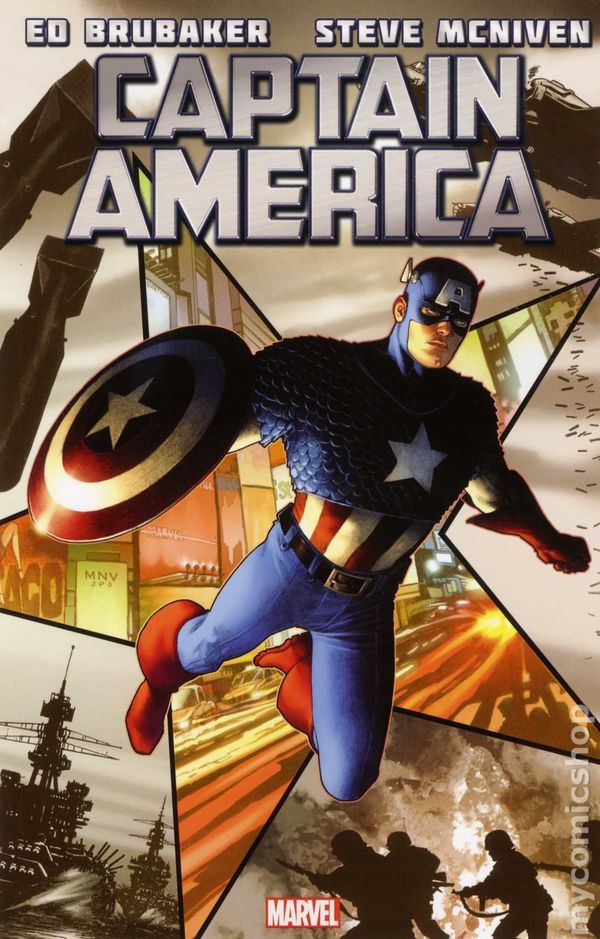
Captain America by Ed Brubaker Vol. 1 (comic)

Writer: Ed Brubaker
Artist: Steve Niven
Collects: Captain America (vol. 5) #1-5

The Marvel love affair with relaunching rolls on. The sad part being that it wasn't twenty issues before that they renumbered the last volume to legacy numbering. Then, this one lasts all of nineteen issues before they relaunch Cap again*! Unbelievable.

Steve Rogers has the mantle again and Ed Brubaker decides to lead off with an accessible story. You need no knowledge of prior volumes to read this one. Brubaker's been pretty generous in giving us an easy in between bigger storylines. "Two Americas" is similar in this regard.

This story leans on a few Captain America cliches to work. Someone from his past returns and is kind of cheesed at him. They fight. Steve then ends up wondering if he's a failure as Cap or if America has lost its way under his watch. On the plus side, Ameridroid shows up for a bit, even if we aren't likely to see him again. What we end up with is more of a straightforward action comic, which is not something Ed Brubaker has done a lot of in the past.

I mentioned Two Americas earlier; this volume has a few similarities to that book. The basic conflict is the same; someone shows up who is pretty unhappy with the way that America has gone, has a pretty concrete view on how it should be and will go to extreme methods to "fix it". The difference is in the message. The point of Two America's is that Crazy 50's Cap was essentially fighting to regain a vision of America that probably never existed. It was pretty clear that, however good the intent may have been, 50's Cap was off his rocker and definitely in the wrong. This time, it's left ambiguous; Rogers himself wonders if the jerkass had a point. Not exactly unfamiliar ground for a Captain America story**, but it's not something I recall Brubaker doing before, so I can cut him some slack here.

The ending points towards another multi-arc plot from Brubaker, but I have no idea if it's resolved. Brubaker's run finally ended - after a staggering eight years - about fourteen issues later. You'd think that would be plenty of time to wrap it up, but it depends on when exactly Bru knew he was leaving and if he got enough space.

Steve McNiven's art is nice, as expected. There's a gaffe or two in there, though. The two panels where Sharon tosses the shield from out a hole in a building immediately come to mind. I wish I could counterbalance with something other than "it was nice", but I'm far from a master art critic.

The Score: 7 out of 10

This arc doesn't hit the highs of the past, but it's solid entertainment. Not a bad place to jump on either; I wouldn't recommend it, but if you just wanted a recent Cap book without six years worth of ongoing plot driving it this is as good a choice as any.

* Because, you know, DC did it and it was pretty successful. They deny it, of course, but they're not fooling anyone. To their credit, though, they're doing a better job with the rollout; instead of the hardline "wrap your shit up before September" approach DC took, Marvel's spreading out the new number ones and allowing books time to finish. So I hesitate to give them too much of a hard time. Still, two Captain America and Uncanny X-Men relaunches within two years?

** We can thank Watergate for that.

Monday, June 18, 2012

Captain America: Prisoner of War (comics)

Writer: Ed Brubaker
Artists: Mike Deodato, Butch Guice, Chris Samnee
Collects: Captain America #616-619

This volume has the distinction of being the last before a relaunch; a new Captain America #1 came about - as I recall this was right around when the movie hit - while this book pulled an Incredible Herc and changed its mission statement whilst retaining the numbering.

Personally, I think this is stupid - just because a major run is ending and a movie is out doesn't mean you need to relaunch the goddamn book - but I can kind of understand why they're doing it in this case. The fourth volume - from Winter Soldier up to now - has been as much about Bucky as anyone, even when Steve was holding the shield. With Steve set to be the main focus of the new volume, I suppose they're looking for a clean break. Fair enough, but I don't think it's necessary.

When we last left Bucky, he'd managed to triumph in his trial, only to find himself suddenly extridited to Russia for crimes he supposedly commited as the Winter Soldier. Steve Rogers, not being a complete idiot, smells a rat - it's very likely Russia is just sore that their Cold War secrets are out in the open, after all, and are looking to dispose of that nagging loose end - but officially his hands are tied. It doesn't stop him from covert attempts to follow up. Meanwhile, Bucky is forced to survive in a Russian gulag, where everyone is out for his blood.

Everything is fine right up until we hit the end. As I noted earlier, this volume contains the last issues before the books relaunch, so you'd expect some manner of closure. It wouldn't necessarily need to be definitive or tidy, but an ending of sorts to Buckys days as Captain America is certainly in order.

Well guess what; we don't get one. For the first time since Civil War, Ed Brubakers run falls victim to a crappy event. Hell, at least that one worked to his advantage. Nope, we end on a "to be continued in Fear Itself", even if it isn't necessarily worded that way. I don't know if Brubaker was in on it or okay with it, but thanks for that regardless, Marvel. I guess it's way too much to leave a book alone to wrap it's own business. Gotta stick it in the summer event, of course.

That aside, there isn't much to say about the writing that hasn't been said before. This time, Bru splits the narrative between Bucky adventures in Russian prison and his buddies outside trying to figure out how to get him out of the mess. This is, of course, not what Bucky signed up for; he was ready to face his past before, but that was also before it involved being thrown to the wolves in Russia, where the warden and everyone employed by him are corrupt and the inmates all want to kill him. This on top of the fact that memories of his Winter Soldier days are bubbling to the surface, haunting him.

Bucky's a very compelling character under Bru. After all this time I think it's safe to say his return was a masterstroke. I'm sorry to see him leave this book, even if he is getting one of his own.

The art does a bit of mixing and matching. Each section - Bucky, Steve and Widow - has it's own artist. Not a great way to keep some visual consistency under normal circumstances, but it's clear it was designed this way. Hard to say if it's a good or bad move on Marvels part - I guess it comes down to the individual to decide - but I must say I kind of liked the effect. I don't mind assigning different artists to sections involving different characters as long as the stylistic shift isn't too jarring. There's a big difference between structuring your comic that way and having crappy fill-in art.

The Score: 7.5 out of 10

It doesn't quite provide the closure it should have to Bucky's time with the shield, but it's still a solid, entertaining book through and through. Hopefully the quality holds up when Steve Rogers is the focus.

Thursday, May 10, 2012

Captain America: The Trial of Captain America (comics)

Writer: Ed Brubaker
Artists: Daniel Acuna, Butch Guice, Mitch Breitweiser
Collects: Captain America #611-615, #615.1, Captain America 70th Anniversary Magazine

There's a real feeling of coming full circle with this volume, as the chickens have come home to roost. As you may recall, last volume ended with Baron Zemo blowing Buckys past as the Winter Soldier out of the water. Here, we realize just what that means as America turns on him and he is brought to trial for his crimes.

It is, of course, gripping stuff brought about at the perfect time. By this point - including the fifty issues of volume 5 before its numbering was switched back to volume 1's - Bucky has been the star and focus of Brubakers Captain America for longer than Steve Rogers. Hell, even when Steve was the front runner the book was at times as much about Bucky as it was him. So by now, we care about him, we've grown to like him in his new role and we've largely accepted him. Time to throw a wrench in the gears; his past - which you could be forgiven for thinking Brubaker had forgotten after so long - is the perfect tool.

It raises a few good questions as well - the kind only comics could ask - about the nature of being controlled. Obviously, such a thing would have to utterly wreck the legal system, because good grief, how do you deal with that? How can they be held responsible? If they can't, then who do you blame? Going after Russia isn't going to be pretty or productive, especially given the changes since the Cold War. It's all tricky; the closest comparison I could think of is being forced to kill someone else by threat of your own life, but at least there you have the smallest measure of control and options in the matter.

Regardless of this, the Marvel populace goes to crucify him, because they are morons easily swayed when shiny keys are dangled in front of them.

Obviously, the legal details are fudged somewhat, as they always are in fiction. I don't find this to be a real problem. Look, I'm no expert in legal matters; a lot of the time I'm generally clueless about the intricacies. I am, however, a guy who, for several years, watched CourtTV regularly. Even the cases that are full on media circuses - Michael Jackson, Phil Specter, Scott Peterson, take your pick - are nowhere near as engaging as Phoenix Wright would lead us to believe. If they were, it'd be the hottest spectator sport going.

As it is it's a lot of standing around, dully arguing minutia while talking heads argue whether the case is just during recesses. It can be interesting, but entertaining it is not. On top of that, if anything exciting happens you can catch it repeated ad nauseam on the news. So generally, I accept that fiction is not going to follow the legal system to the letter, because overall it's pretty boring. Bru manages what seems like a potent mix of legal realities and fictional ones, managing to keep our interest through them.

He also understands that a full four or five issues in a courtroom - no matter how fudged the rules are for the sake of being entertaining - is going to get dull real fast. So while all this is happening, Sin - daughter of the Red Skull - has reared her ugly head and started to cause trouble. Thus, Bucky has to struggle with the decision to stay put - when escape would be simple if he chose - and leave it to Steve Rogers or to escape and suit up as Captain America one last time to track her down and stop her, even if it means ruining his case. Guess which one he chooses?

So, the story is fine. The art kind of wavers. We've got no less than three artists working on this volume and it shows. I'm not an art expert - and it's part of why I don't talk about it much unless there's something to say - but the shift is pretty noticeable. It's not going to sink the book, of course - at this point in Brubakers run, you're probably long past the point where some rushed art will cause you to drop it - but it's unfortunate.

At the end of the volume is another one of those lovely point one issues. As usual, It's not really a great jumping on point. In this case, it acts as more of an epilogue to the trial than anything; Steve is struggling with the decision to take back the identity in lieu of Buckys legal trouble. While he angsts about that, he has to deal with a pretender to the mantle. It's a pretty decent read, but accessible? If you were to jump into this cold after watching Caps feature film, you'd probably end up wondering why Steve was out of the costume to start with.

I don't think Marvels writers really know how to handle these things. Few of them are properly structured as a place to jump on the book; either they're positioned as another chapter of it or as setup for something else entirely. I'm sure they have good intentions - and the idea of an issue being put out from time to time which will catch up new readers is a very good one - but by now I'm convinced this "point one initiative" just isn't working.

The Score: 8 out of 10

If you've been following the book all along, then this is a definite purchase. Ed Brubaker has yet to really fail on Captain America. This volume is largely payoff to long running plot threads, however, so a good point to get on board it is not. I'm sure you could get the gist of things but I don't think you would get nearly as much out of it.

Saturday, February 18, 2012

Captain America: Patriot (comics)

Writer: Karl Kesel
Artist: Mitch Breitweiser
Collects: Captain America: Patriot #1-4, All Winners Comics 70th Anniversary Special, What If #4

One of my favorite things about Captain America relates to the retcon* they did; when he came back in Avengers #4, we learned he had been encased in ice since the end of World War II. Instead of scrapping the numerous Captain America comics in the intervening years from continuity, they had a better idea. As the retcon goes, after Caps final mission - when he and Bucky were assumed dead - the government decided the spirit and symbol of Captain America needed to be kept alive. So other men wore the uniform in the years prior to Steve Rogers return.

The end result is a stretch of time where numerous men tried to live up to the legend of Steve Rogers; a concept with a lot of potential to it.

This miniseries is about the second man to wear the uniform after Rogers went missing, Jeffery Mace. Inspired by Captain America during the war, he took up his own heroic identity of The Patriot. After the war came to a close, his peers began to drift. But eventually he discovered the truth; the original Captain America had died at the end of the war and another took his place. Realizing Cap was a symbol the world needed, Jeffery Mace took on the identity of the man he patterned himself after to carry on in his name.

It's a moving, effective story; we see Mace struggle to come to grips with the uniform he wears and what it means. Unlike Steve Rogers, Mace had no Super Soldier Serum to power him up; he was a regular man trying to carry on the mission of the ultimate man. What he has is heart and a mind of his own; like Rogers would prove to be time and again, Mace is not just some government stooge. This is the story of a man who stepped into the boots of a legend and not only lived up to the legacy, but kept to the same ideals even when it might have cost him.

Generally, the stories of the replacement Captain Americas end badly. One died while the 50's Cap went insane thanks to a flawed Super Soldier Serum and would become a bit of a recurring nuisance. Jeff's the only one who got to walk away from the costume intact and it's an ending that feels earned. This is the definitive story of the third Captain America, using continuity properly as a structure for the life story of Jeffery Mace to be wrapped around.

I can't say enough about what an enjoyable read it is. It's a great story coupled with art that has that perfect balance of looking kind of old fashioned while feeling distinctly modern. On top of the four issue miniseries, the All Winners special Karl Kesel wrote - featuring an adventure with the All Winners Squad we didn't see in the mini proper - is included, as is the original What If** issue that first gave us the events that led to Mace's tenure, which we saw snippets of in the main miniseries.

Overall, a nice package.

The Score: 8.5 out of 10

I can't say enough about how much I enjoyed this. The story of a man who fought to live up to the name of Captain America is a winner. Well worth adding to your bookshelf.

* A lot of folks decry retcons, but some are for the better. This is one of them. I think it ended up adding a lot to the Cap mythos and that's a win any way you look at it.

**As you probably know, Marvel's "What If" series essentially asked the question of what might have happened had a key event in a story gone another way and then let us see how that change might have played out. Several of the ones I've read were cute but disposable - some of them tended to end up in the same place the regular story did, only going along a different sequence of events - and just about every one of them are out of continuity tales, hence the "What If". This is one of the only - and may be the only, I'm not a hundred percent sure - "What If's" to actually be rendered in continuity, since it filled in a few gaps in Caps history.Link

Thursday, February 2, 2012

Captain America: No Escape (comics)

Writer: Ed Brubaker
Artist: Butch Guice, Mitch Breitweiser
Collects: Captain America #606-610

Baron Zemo is back, only now he knows the new Captain America is none other than Bucky, the death of whom was Baron Zemo Sr's claim to fame. So Zemo is just a wee bit pissed, but as it turns out, not necessarily for the reasons you might think. Zemo then proceeds to pull Buckys life out from under him.

We've dropped the heavy political undercurrent from last volume; this time, we're back in the thick of Buckys ongoing story, which has been as central to Brus run thus far as anything involving Steve Rogers. The hook is admittedly pretty smart on its own, but Bru takes it in a direction you might not expect. The result plays off of Zemos own history as well as putting Bucky in the meat grinder over his time as the Winter Soldier.

Spoiler alert
for the following paragraph or so, so skip to the end of you don't want spoilers.

Turns out, Zemo's not upset over his fathers one accomplishment being deep sixed. No, he's a bit more pissed off about the fact that Bucky's gained something of a free ride towards redemption. While Bucky has gone through quite a few trials and tribulations, the world at large is unaware that he's still alive, not to mention his past as the Winter Soldier. So Zemo throws Buckys life in a blender, leaks EVERYTHING to the press, smacks Bucky around a bit and says "here, now earn your redemption".

Not only does it make for good drama - you just know there's going to be a reckoning now that the world at large knows his past - but it's the sort of action I can picture for Zemo. Unlike his old man, who was an unrepenant Nazi, Zemo's toed a fine line over his history, with his time in the Thunderbolts softening him into a more heroic figure, if not exactly a full white hat. He has had a lot to make up for and redemption doesn't come easy; hell, he never really was fully redeemed or trusted. Meanwhile, his fathers greatest nemesis has a past as an assassin for the Ruskies and manages to just sweep it under the rug. You can sort of see why he might be a bit pissed.

It's a bit stronger a volume than Two Americas was. We're coming full circle with Brubakers run up to this point; we started with the revelation of the Winter Soldier and now we're dealing with it once more, only this time Bucky will have to face the public as well. I'm looking forward to it.

The Score: 8 out of 10

We're closing in on the endgame of Buckys time as Captain America. Next volume will be the last. Another good volume in Brubakers extended run. Hopefully the conclusion of this stage of Bucky's life will be as strong.

Thursday, January 26, 2012

Captain America: Two Americas (comics)

Writer: Ed Brubaker
Artists: Luke Ross, Butch Guice
Collects: Captain America: Who Will Wield the Shield, Captain America #602-605

And so, with Bru's big Captain America epic out of the way - and one of those re-numberings that Marvel loves so damn much - it's time to move on to other stories, with Bucky still holding the shield for the time being.

Now, I just love those comics where the backstory is almost as interesting as what's within the pages. The main arc here caused some minor bitching from Neo-Con pundits - who of course only care about comics when an American icon goes against their shitty ideals - for showing what was essentially a Tea Party rally - complete with "Tea Bag the Dems" signs - and having Falcon remark that he - a black man - wouldn't feel comfortable among a bunch of angry white people. Why would he feel that way? It's not like there's any underlying racism at one of those gatherings, right? Marvel caved and changed the signs, sadly.

That's interesting, of course, but what makes the whole thing hilarious is that the minor alteration really didn't change a thing; while the sign was changed, that was never as big a deal as the story in question.

See, this story picked up on a prior plot thread during the Brubaker run. Anyone with a passing familiarity with Captain America knows that he was frozen in suspended animation for decades, but during the time he was gone the US decided to train replacements to keep the icon in play. The 50's Cap went crazy from the Super Soldier Serum and Bucky fought him once in recent times. Now he's back, only this time he's joined with a radical movement and trying to find the "real America".

Crazy Caps inner monologues essentially amount to a big "in my day" spiel. He's lost and confused, wondering what happened to the great America of his youth. He wants to reclaim that fleeting memory, through force if necessary. In a way, he's almost pitiable; it's not hard to relate to a feeling of your country circling the drain, having lost itself along the way. I feel that way at times, especially when I hear about the latest bill that will torpedo American rights for the interests of Big Business. But - and this should sound familiar - he's misguided, failing to realize his methods and solutions will only make matters worse. Only Crazy 50's Cap has the excuse of being insane.

The plot is dressed up with some superhero conventions, of course - talking heads debating politics would be one boring comic - but, even with the overt references removed, it boils down to kicking Tea Party/Neo-Con politics in the nuts. Maybe not to the degree of a Bioshock - which took a heaping dump on Ayn Rands entire philosophy - but it's plain as day. Remove the bombs, the spandex and the tech and you've got a fairly accurate portrayal; after all, how many times have we heard several of them talk of revolution or overthrowing the government? Hell, a fairly well known author once said as much because the government was slowly legalizing gay marriage and apparently that means that the government is corrupt. Gay Marriage: Totally destroying our country more than Wall Street, am I right?

The cherry on top is the minor theme of racism, which even ties into that whole revolution thing; after all, I'm pretty sure we fought a civil war over similarly wrongheaded ideals like, oh, I dunno, the persecution of blacks.

So it provokes thought and says something. Even with all that, though, it's not one of Bru's best Cap stories. Granted, that still places it well above most of the competition, so that's not exactly me condemning it. It's another volume of Brubakers Captain America run; that's not a bad thing. Its problem may just be a combination of being more of a straight up adventure than Bru has done in a while and the fact that the story is coming right after the end of Bru's Captain America epic, after which most things would seem unremarkable.

Oh, there's also this one shot special about whether Steve is going to take the shield back or if Bucky will keep it a while longer. It's kind of pointless. I really don't get why we had to have a special to answer that question instead of a regular issue of the Captain America comic. Anyways, it gives us our answer with minimum thrills - not Bru's fault, since I can't picture an exciting comic about who will wear a set of clothing any more than I can about talking heads discussing politics - and sets Steve Rogers up for what he'll be doing while Bucky stays in the outfit for a while.

I think at one point one issue specials were supposed to be, you know, special. Seems almost quaint now. I guess tough decisions on who will wear the flag on their spandex is the new special.

The Score: 7.5 out of 10

Another good volume of Ed Brubakers extended Captain America run. It feels a bit like a breather arc between big stories, just with bombs, fake Caps and some political underpinnings. Next volume is supposed to be pretty heavy for Bucky, so it's fitting.