Writer: Geoff Johns
Artist: Gary Frank
Original Graphic Novel
Volume One was a pretty decent start, but suffered from a weak antagonist that detracted from an otherwise compelling portrayal of Bruce Waynes extremely rocky road to basic competency as a vigilante. Volume Two builds off what the first started, but it's an upgrade in a lot of ways without sacrificing what worked the first time around.
Much like Supermans second Earth One outing, we're veering into this continuities version of classic rogues. This time, it's the Riddler taking center stage, with a subplot involving Killer Croc. Riddler basically starts giving riddles to groups of Gotham citizens. If they answer it correctly, they live. If they fail, they're dead.
On its surface, the idea of murderin' Riddler is a bit off-putting, as it seems pretty grim-dark at first glance. I've always felt his stint as a private detective, competing against Batman for fame and glory, was as good as the character has ever been. But in the context of a new continuity divorced from the main line, it works. He's tied to events in the first volume and ends up with a fairly clear motive that works for the world that has been set up so far.
Of the two, I like what they've done with Croc more. Croc is a character that, if you think about it, is easy to give a sympathetic angle given some of his varying origins, but I can't think of too many times they've gone with something other than a thug or monster. Here, Johns and Frank decide to buck trend a bit, giving us a Croc who's just the victim of a skin condition and, frankly, might not even be all that bad a guy. His role in the story is brief, but by the end he seems set to become a recurring character, which I'm actually all for.
If there's a reinvention of a rogue that poses a problem, it's the one for Two-Face. Without giving too much away, it seems JMS and Geoff Johns both had the same idea. The situation in this volume echoes what was done with a classic Superman rogue in volume three of that Earth One series pretty heavily. The two were even released but a scant three months apart. It's not a huge deal, but if you've read both series you're going to notice it.
Before moving on, I should say that I appreciate that Earth One has completely eschewed use of the Joker thus far. He is a classic villain by all counts, but it's nice to have a build-up for once and use different people. Joker's going to show up at some point, let's not even kid ourselves, but I'm hoping we make it through another volume or two before we get there. Superman only made it to the third volume before it went to the Luthor well.
A lot of the aspects I enjoyed from the first volume are back, including the new version of Alfred. As I suspected, he hasn't given up on his mindset, though we've yet to see any major fight over it quite yet. It seems inevitable, though. I enjoy the differences from classic Alfred, especially the fact that Bruce Wayne now has a test of his resolve not to use guns and not to kill coming from within his inner circle. Our Earth One version of Harvey Bullock takes a back seat this volume - a shame, as I do enjoy this iteration - but he has enough page time to advance his character arc from where we left him at the end of volume one, despite so much else going on in this volume.
As for the Geoff Johns version of Batman, I like how this version of the character seems like he has to build himself from the ground up through literal on-the-job training. It's different from the norm, where Bruce Wayne takes, like, a ten year sabbatical to ready himself for his mission. In the first volume, he barely had a single clue what he was doing. Now, he's getting the hang of the fighting, but other aspects elude him. He doesn't know the first thing about being a detective, which becomes an issue in the midst of the story, and ends up having to ask Jim Gordon to teach him.
That's an interesting take. It suggests maybe this version of Bruce Wayne should have thought about what he was getting himself into and trained beforehand, like every other version, but as a reader it's something different and a worthwhile angle to explore with the character. Even in Year One, where things get off to a rocky start, the guy at least had a general idea what he was doing in most areas.
Gary Frank does as well as ever as the artist. He understands storytelling and action well. Two volumes in, I'm still a bit unsure about leaving Batmans eyes open like that, though. It might just be that I'm so used to the white eye lenses. In fairness, it does lend itself to a bit more details in expressions on the characters end. Anyway, there is what seems to be an art hiccup early in the book - Gordon is trying to get Bullock away from booze, Bullock says no, then the next panel has Gordon pour Bullock a drink - but that may be down to a coloring mistake on the coat, since we only see the torso and the drink pouring. So it's probably not on Frank anyway.
As a whole, the second volume is an improvement on what was already a decent enough start with the first volume. Everything is pulling together a bit better and this volume doesn't have the issue of a weak antagonist like the first. If this continues, this version of the character and his world might end up a genuinely worthwhile entry in the expansive, varied Batman franchise.
My Opinion: Read It
Showing posts with label Earth One. Show all posts
Thursday, May 11, 2017
Sunday, January 10, 2016
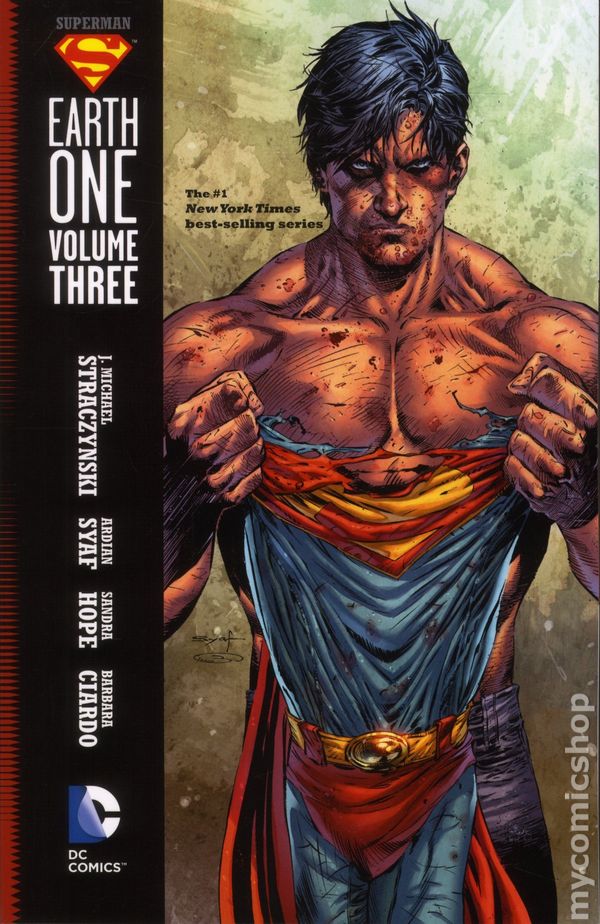
Superman: Earth One vol. 3 (comics)
Writer: J. Michael Straczynski
Artist: Ardian Syaf
Original Graphic Novel
I get the feeling JMS realized he screwed up.
When I reviewed Volume 2 of Superman: Earth One, I mentioned a bunch of story points that, to be blunt, destroyed the work and anything it was trying to do. New supporting character Lisa Lassalle working escort on the side - because of course - was one. Lois Lane going full stalker was another. Even if you could excuse that, Superman incited a full on revolution in a Middle Eastern country, one that was heavily implied to be violent. I know I've taken a sarcastic shot or two at people who have a rigid, immovable idea of Superman in the past, but there are some things you just don't do with him.
Volume 3 feels almost like an apology tour at times. The book goes out of its way to deal with the Lois Lane situation up top, addressing how screwed up her actions were - with Clark himself calling her out - while also attempting to give her some legitimate reasons for her paranoia without throwing her under the bus. I'm not sure it entirely works, but it does a fair job of letting us move on, especially considering Lois feels more like herself for the entire volume. Lisa's time as a hooker on the side is mentioned offhand at only one point and implied to be over, with any future reference relegated to vague mentions of things she regrets doing. Supermans actions in the foreign country are also central to the conflict of the book. I'm not sure that salvages what he did - that ending felt kind of sinister and acknowledged or not it's something that should not be done with the character - but addressing it goes a long way to making it easier to move forward from it, especially when Superman himself admits a couple times that while trying to do what he felt was right, he just wasn't thinking. At the very, very least, it can come off more like an impulsive action by a young adult prone to making mistakes on the way to figuring this out.
I don't think everything landed there, but at least we can try to move on.
Moving on seems like a decent idea anyway, because this book is far easier to enjoy than the last. Make no mistake, this story hits some pretty familiar beats. Zod is the main villain and the Luthors - yes, more than one - come into play. Obviously, we've seen this kind of thing before. I think the same basic Zod story has been told a solid six times now. But it works out fairly well, especially as Zods plan plays heavily into the worlds growing fear of Superman, which rightfully results in a "what the hell" from Superman himself. The odds are pretty believably stacked against Superman - and, as is acknowledged, it's kind of his own fault - but it does so without throwing humanity under the bus or undermining Supermans faith in it.
The big speech to the UN might not work for everyone - I'm sure some won't like that Superman appeals to the worlds sense of self interest rather than its more positive traits to convince them never to pull this kind of crap again - but it works in the context of the series and allows Superman to make some pretty salient points about what happens if he ever loses.
Regarding the Luthors, it's not the most amazingly different spin I've ever seen, but sometimes even the simple tweaks make for the best ones. Here, the usual, male Lex Luthor has a different set of values than we're used to seeing; while cautious regarding Superman, see's himself as purely a scientist and not a man interested in killing another being, even an alien. His wife is the one who is a bit more down with the idea, even if she has nothing against him for ninety percent of the volume. If nothing else, it plays into the climax well, with what I think might be the first time one of Supermans primary villains actually does something for selfless reasons. It didn't rock my world, but I liked it.
Ardian Syaf takes over for Shane Davis as the penciller. I'm not sure why the switch was made - maybe Shane Davis just got busy - but the book is in capable hands. I might even like Syafs work a little bit better than Davis. He's very, very good with character expressions and his sense of comic storytelling is pretty spot on. I also feel like he has a bit more varied a take on some characters and their fashion choices; Lisa Lassalle isn't always wearing form fitting clothing this time, for one. For an extra bonus, I didn't spy any panels or poses with Clark/Superman that felt... off, or sinister, as occasionally happened previously. I liked the art on previous volumes, but if Syaf's going to be the regular going forward, I'm cool with it.
All told, volume three is a marked improvement over the second, even if it doesn't necessarily redeem it, and is worth giving the series a second chance.
My Opinion: Read It
Artist: Ardian Syaf
Original Graphic Novel
I get the feeling JMS realized he screwed up.
When I reviewed Volume 2 of Superman: Earth One, I mentioned a bunch of story points that, to be blunt, destroyed the work and anything it was trying to do. New supporting character Lisa Lassalle working escort on the side - because of course - was one. Lois Lane going full stalker was another. Even if you could excuse that, Superman incited a full on revolution in a Middle Eastern country, one that was heavily implied to be violent. I know I've taken a sarcastic shot or two at people who have a rigid, immovable idea of Superman in the past, but there are some things you just don't do with him.
Volume 3 feels almost like an apology tour at times. The book goes out of its way to deal with the Lois Lane situation up top, addressing how screwed up her actions were - with Clark himself calling her out - while also attempting to give her some legitimate reasons for her paranoia without throwing her under the bus. I'm not sure it entirely works, but it does a fair job of letting us move on, especially considering Lois feels more like herself for the entire volume. Lisa's time as a hooker on the side is mentioned offhand at only one point and implied to be over, with any future reference relegated to vague mentions of things she regrets doing. Supermans actions in the foreign country are also central to the conflict of the book. I'm not sure that salvages what he did - that ending felt kind of sinister and acknowledged or not it's something that should not be done with the character - but addressing it goes a long way to making it easier to move forward from it, especially when Superman himself admits a couple times that while trying to do what he felt was right, he just wasn't thinking. At the very, very least, it can come off more like an impulsive action by a young adult prone to making mistakes on the way to figuring this out.
I don't think everything landed there, but at least we can try to move on.
Moving on seems like a decent idea anyway, because this book is far easier to enjoy than the last. Make no mistake, this story hits some pretty familiar beats. Zod is the main villain and the Luthors - yes, more than one - come into play. Obviously, we've seen this kind of thing before. I think the same basic Zod story has been told a solid six times now. But it works out fairly well, especially as Zods plan plays heavily into the worlds growing fear of Superman, which rightfully results in a "what the hell" from Superman himself. The odds are pretty believably stacked against Superman - and, as is acknowledged, it's kind of his own fault - but it does so without throwing humanity under the bus or undermining Supermans faith in it.
The big speech to the UN might not work for everyone - I'm sure some won't like that Superman appeals to the worlds sense of self interest rather than its more positive traits to convince them never to pull this kind of crap again - but it works in the context of the series and allows Superman to make some pretty salient points about what happens if he ever loses.
Regarding the Luthors, it's not the most amazingly different spin I've ever seen, but sometimes even the simple tweaks make for the best ones. Here, the usual, male Lex Luthor has a different set of values than we're used to seeing; while cautious regarding Superman, see's himself as purely a scientist and not a man interested in killing another being, even an alien. His wife is the one who is a bit more down with the idea, even if she has nothing against him for ninety percent of the volume. If nothing else, it plays into the climax well, with what I think might be the first time one of Supermans primary villains actually does something for selfless reasons. It didn't rock my world, but I liked it.
Ardian Syaf takes over for Shane Davis as the penciller. I'm not sure why the switch was made - maybe Shane Davis just got busy - but the book is in capable hands. I might even like Syafs work a little bit better than Davis. He's very, very good with character expressions and his sense of comic storytelling is pretty spot on. I also feel like he has a bit more varied a take on some characters and their fashion choices; Lisa Lassalle isn't always wearing form fitting clothing this time, for one. For an extra bonus, I didn't spy any panels or poses with Clark/Superman that felt... off, or sinister, as occasionally happened previously. I liked the art on previous volumes, but if Syaf's going to be the regular going forward, I'm cool with it.
All told, volume three is a marked improvement over the second, even if it doesn't necessarily redeem it, and is worth giving the series a second chance.
My Opinion: Read It
Labels:
Ardian Syaf,
Comics,
DC Comics,
Earth One,
JMS,
Read It,
Review,
Superman,
Trade Paperback
Tuesday, May 13, 2014
Superman: Earth One vol. 2 (comic)
Writer: J Michael Straczynski
Artist: Shane Davis
Original Graphic Novel
Well, I guess volume one was a fluke, because they already blew it with the second.
To back up for a moment, I thought the first volume of Superman: Earth One was a pretty decent effort. I enjoyed its portrayal of Clark Kent as a confused young man trying to find a place he could feel comfortable while doing the most good. So, a typical young adult. A fair bit of the Comics Internet hated it, but I noticed at the time that most of loudest detractors were often the ones who had strict, rigid ideas about who Superman is and who he should be. Flawed as it was - Tyrell is such a forgettable villain that, two years later, I can't even remember what his deal was - it had merit.
Volume Two doesn't.
Not everything about it is bad. At least this time they go with a recognizable villain in Parasite. The artwork of Shane Davis is still good. But there are some wrongheaded notions at the core of this book and they're serious enough to sink it.
One of which is its odd portrayal of women. Lois Lane has a small role in this book and every page of it concerns a downright unhealthy obsession with finding out whatever it is she thinks Clark Kent is hiding. This is not necessarily news for the franchise, but it hits an uncomfortable note fairly quick. It comes off as obsessive and occasionally downright stalkerish with little justified reason for her skepticism. It reaches a point where she basically kicks her boyfriend out so she can illegally access his information. It's clearly intentional, as Jimmy Olsen comments on it in the four or five panels he's in and all but makes dismissive wanking motions about it.
If it were the only thing going on in here, you could possibly excuse it as taking Ms. Lanes usual behavior in pre-marriage stories a bit too far. I mean, she's done worse, right? Silver Age Lois Lane took obsession to crazed heights. Actually, everyone in that era was kind of a dick, save maybe Olsen. But it's not an isolated incident.
No, new love interest Lisa Lassalle is the one that kind of solidifies it. She's likable enough, but falls into a lot of the same traps you see with most female characters. A fair bit of her behavior is overly flirtatious, which - while sadly stereotypical in most fiction - isn't in itself a bad thing, but late in the book we find out she's also a prostitute, or at least when she needs cash to pay the bills.
Look, I'm usually pretty forgiving - I get in disagreements with a friend of mine semi-regularly because I find at least some merit in things he doesn't - but when that revelation came about, I shook my head. Of course she hooks. No sexually active woman could possibly be anything else, except maybe a slut, right? It feeds right into the sort of double standards we as a society have struggled with over the past few decades. On it's own it might not seem as jarring - especially if it had a few other female characters of different mindsets - but in a book where the only other female character of note feels obsessive to the point of stalkerish, it raises a few alarms.
But this is nothing new, I can hear some say. It's hardly the first comic to have questionable portrayals of women. Nor will it be the last. What matters is whether the rest of the book holds up. How does Superman himself come off?
Well, I'm sad to say that this time I have to side with the detractors. JMS definitely screwed him up. Spoiler warning for the next paragraph.
The point volume two completely lost me came late in the book, but had its roots in an early scene. At the start of the book, we see Superman in action, doing typical Superman things, such as saving people in a foreign country from a natural disaster. His rescue mission ends prematurely when the countries leader - clearly taking cues from real life dictators like Saddam Hussein - basically tells Superman to get out of his country before he starts killing people. Superman has to make a hard choice; clearly, he could stop this mans army from killing everyone, but he can't be in two places at once. Eventually he would have to leave to help someone else.
This is fine. It's a little too close to the real world for my taste - using realistic dictators in a superhero story makes for an uncomfortable time, which is why you tend to have things like Black Adam ruling a country - but on the surface it plays into the themes of the Earth One Superman series thus far. As mentioned at the start of the review, most of the point of the last volume was seeing Clark go through different avenues to do the most good before inevitably donning the red and the blue. Now that he's hip deep in the superhero trade, it makes sense for this Superman to come face to face with his limitations; he can't punch every problem, as some are systemic and may have been easier to solve had he been in a different profession.
No, the problem is the bookend. Near the end, after the threat has been dispatched - I know, spoilers, but come on, of course he figures out a way to beat Parasite - Superman returns to that country and incites a revolution. He waltzes in, takes guns from the dictators men, gives them to the revolutionaries and allows them to violently overthrow this regime. There is no mistaking it. There is gunfire going off. Then he goes to the dictators house, tells the man what he's done and then, hearing revolutionaries coming to kill the dictator, leaves him to die. Even if the revolution is over in an hour with minimal bloodshed, people have died and Superman is directly responsible.
Look, we all have different ideas about how change should come about in the world. I'd prefer most conflicts to be solved without violence, but I can't deny that at times I think some people need to be punched in the face, at the least. That, however, is reality. This is fiction.
We're talking about Superman. Having him do things like this shows a complete lack of understanding of the character. But even if we set that aside, even if you buy that Superman could kill or leave someone to die, we're not talking about another Kryptonian with the same power set and potential for danger here. The last scene of the book shows people in the US government trying to figure out a way to kill Superman. We're supposed to feel it's paranoia, because he has supposedly been benign. We're supposed to think they're out of line. But Superman just walked into a middle eastern country and turned it into a war zone. Isn't that absolutely terrifying?
If you were a citizen in that universe and someone with the powers of a god - who is supposedly altruistic, but hasn't been around all that long - went ahead and did that, wouldn't you want some kind of assurance he could be stopped?
That I'm even asking that question brands volume two of Earth One a failure, because it couldn't misunderstand the character more. That's a damn shame. Don't even bother with this one.
My Opinion: Skip It
Artist: Shane Davis
Original Graphic Novel
Well, I guess volume one was a fluke, because they already blew it with the second.
To back up for a moment, I thought the first volume of Superman: Earth One was a pretty decent effort. I enjoyed its portrayal of Clark Kent as a confused young man trying to find a place he could feel comfortable while doing the most good. So, a typical young adult. A fair bit of the Comics Internet hated it, but I noticed at the time that most of loudest detractors were often the ones who had strict, rigid ideas about who Superman is and who he should be. Flawed as it was - Tyrell is such a forgettable villain that, two years later, I can't even remember what his deal was - it had merit.
Volume Two doesn't.
Not everything about it is bad. At least this time they go with a recognizable villain in Parasite. The artwork of Shane Davis is still good. But there are some wrongheaded notions at the core of this book and they're serious enough to sink it.
One of which is its odd portrayal of women. Lois Lane has a small role in this book and every page of it concerns a downright unhealthy obsession with finding out whatever it is she thinks Clark Kent is hiding. This is not necessarily news for the franchise, but it hits an uncomfortable note fairly quick. It comes off as obsessive and occasionally downright stalkerish with little justified reason for her skepticism. It reaches a point where she basically kicks her boyfriend out so she can illegally access his information. It's clearly intentional, as Jimmy Olsen comments on it in the four or five panels he's in and all but makes dismissive wanking motions about it.
If it were the only thing going on in here, you could possibly excuse it as taking Ms. Lanes usual behavior in pre-marriage stories a bit too far. I mean, she's done worse, right? Silver Age Lois Lane took obsession to crazed heights. Actually, everyone in that era was kind of a dick, save maybe Olsen. But it's not an isolated incident.
No, new love interest Lisa Lassalle is the one that kind of solidifies it. She's likable enough, but falls into a lot of the same traps you see with most female characters. A fair bit of her behavior is overly flirtatious, which - while sadly stereotypical in most fiction - isn't in itself a bad thing, but late in the book we find out she's also a prostitute, or at least when she needs cash to pay the bills.
Look, I'm usually pretty forgiving - I get in disagreements with a friend of mine semi-regularly because I find at least some merit in things he doesn't - but when that revelation came about, I shook my head. Of course she hooks. No sexually active woman could possibly be anything else, except maybe a slut, right? It feeds right into the sort of double standards we as a society have struggled with over the past few decades. On it's own it might not seem as jarring - especially if it had a few other female characters of different mindsets - but in a book where the only other female character of note feels obsessive to the point of stalkerish, it raises a few alarms.
But this is nothing new, I can hear some say. It's hardly the first comic to have questionable portrayals of women. Nor will it be the last. What matters is whether the rest of the book holds up. How does Superman himself come off?
Well, I'm sad to say that this time I have to side with the detractors. JMS definitely screwed him up. Spoiler warning for the next paragraph.
The point volume two completely lost me came late in the book, but had its roots in an early scene. At the start of the book, we see Superman in action, doing typical Superman things, such as saving people in a foreign country from a natural disaster. His rescue mission ends prematurely when the countries leader - clearly taking cues from real life dictators like Saddam Hussein - basically tells Superman to get out of his country before he starts killing people. Superman has to make a hard choice; clearly, he could stop this mans army from killing everyone, but he can't be in two places at once. Eventually he would have to leave to help someone else.
This is fine. It's a little too close to the real world for my taste - using realistic dictators in a superhero story makes for an uncomfortable time, which is why you tend to have things like Black Adam ruling a country - but on the surface it plays into the themes of the Earth One Superman series thus far. As mentioned at the start of the review, most of the point of the last volume was seeing Clark go through different avenues to do the most good before inevitably donning the red and the blue. Now that he's hip deep in the superhero trade, it makes sense for this Superman to come face to face with his limitations; he can't punch every problem, as some are systemic and may have been easier to solve had he been in a different profession.
No, the problem is the bookend. Near the end, after the threat has been dispatched - I know, spoilers, but come on, of course he figures out a way to beat Parasite - Superman returns to that country and incites a revolution. He waltzes in, takes guns from the dictators men, gives them to the revolutionaries and allows them to violently overthrow this regime. There is no mistaking it. There is gunfire going off. Then he goes to the dictators house, tells the man what he's done and then, hearing revolutionaries coming to kill the dictator, leaves him to die. Even if the revolution is over in an hour with minimal bloodshed, people have died and Superman is directly responsible.
Look, we all have different ideas about how change should come about in the world. I'd prefer most conflicts to be solved without violence, but I can't deny that at times I think some people need to be punched in the face, at the least. That, however, is reality. This is fiction.
We're talking about Superman. Having him do things like this shows a complete lack of understanding of the character. But even if we set that aside, even if you buy that Superman could kill or leave someone to die, we're not talking about another Kryptonian with the same power set and potential for danger here. The last scene of the book shows people in the US government trying to figure out a way to kill Superman. We're supposed to feel it's paranoia, because he has supposedly been benign. We're supposed to think they're out of line. But Superman just walked into a middle eastern country and turned it into a war zone. Isn't that absolutely terrifying?
If you were a citizen in that universe and someone with the powers of a god - who is supposedly altruistic, but hasn't been around all that long - went ahead and did that, wouldn't you want some kind of assurance he could be stopped?
That I'm even asking that question brands volume two of Earth One a failure, because it couldn't misunderstand the character more. That's a damn shame. Don't even bother with this one.
My Opinion: Skip It
Labels:
Comics,
DC Comics,
Earth One,
JMS,
Review,
Shane Davis,
Skip It,
Superman,
Trade Paperback
Monday, June 24, 2013
Batman: Earth One (comics)
Writer: Geoff Johns
Artist: Gary Frank
Original Graphic Novel
The only thing that surprises me about this is how long it took DC to put Geoff Johns on a Batman project. Teaming with him for it is Gary Frank, the artist of Geoffs all too brief run on Action Comics. It sounds good creatively, but do they manage to make a good book?
Right away, it's apparent this isn't the Batman we know. DC has done more than their fair share of stories regarding Batmans early years, but despite his inexperience or mistakes he makes, there's still a baseline level of competance there. In Earth One, Batmans first night out is an unmitigated disaster; his grapple gun backfires, he misses a jump and ends up in a trash heap. Hell, by the end of the book, it's plain to see that the legend of the Batman far outstrips the reality; Bruce Wayne will have to work hard to actually be on the level the public immediately assumes he is.
Alfred is one of the biggest changes. I remember during the hype phase when a lot was made about the characters new background as a Royal Marine. It isn't without merit, because it alters the dynamic completely; Alfreds mindset is that of a soldier, putting him at odds with Batman, who is against guns and killing. The new dynamic makes the book, providing ample fodder for an endlessly interesting take on the vigilante and his butler.
One aspect I like about the interaction is that Alfred does not understand why Bruce Wayne will not use guns as Batman. Obviously, his rule against guns is, by now, ingrained into the character. When you think a lot about him, the reasons make sense. We understand why he does not use them. But it's rare anyone ever challenges him about it. Everyone simply goes along with Batmans rules. Alfred doesn't push the matter too far here, but it does not seem like an issue he will just drop. It could be interesting to see a full scale blowout over the issue, with the mindset of a soldier clashing with the mindset of a man who wants nothing more than to keep someone else from losing their loved ones to a criminal act like he did.
Johns version of Harvey Bullock is also compelling. Essentially a glory seeking reality TV cop, Bullock comes to Gotham when his show dries up looking for new prospects. Everyone immediately writes him off, especially Gordon. But as we go on Bullocks better nature comes to the fore, his nature as an outsider shining a spotlight on just how screwed up Gotham has become.
Unfortunately, not every change works. So far the Earth One books seem intent on using original villains in their first outing. Trouble is, they're duds right from the start. Superman was saddled with a new villain who was as cookie cutter as it gets and ultimately amounted to little more than a plot device. A familiar rogue does come out to play in Batman: Earth One, but his role is minor. No, the book hinges on finding the victims of the new guy before he butchers them.
I'm talking about Birthday Boy, our "paint by the numbers" serial killer. He is ridiculous. That's not a bad thing to be, but taken in the context of what Johns and Frank have set up, he sticks out like a sore thumb. I mean, here we are with a relatively down to Earth take on the genesis of Batman and along comes this hulking behemoth with a party hat who says "make a wish, but don't tell anyone" before stabbing his victim. The only hint of motive is a throwaway line near the end and he lacks any sort of interesting facet to him. He's just there so Batman can fight someone in the third act. They could have slipped Zasz in there and I don't think anyone would know the difference.
What this leaves us with is a book without a compelling challenge for Batman, whether we're talking physical or psychological. Thankfully, the obvious challenges that face Bruce Wayne take up the slack. Johns and Frank do a fine job of showing us a Batman who might just be in over his head - who might not even be ready for the task he's set for himself - and that's where the heart of the book lies. The book could have done with saving any of the rogues gallery for the next volume and would probably have been better for it.
Luckily, what's good about Earth One is good enough to come back and see where Johns and Frank might be going with it.
My Opinion: Try It
Between this and Superman, it's clear the Earth One line is not for purists. Some people have very clear opinions about these characters and often lash out at anything that deviates. Trouble is, Earth One is all about the deviation, which puts it at a critical disadvantage. Walk in with an open mind and there's a good chance it will work for you.
Artist: Gary Frank
Original Graphic Novel
The only thing that surprises me about this is how long it took DC to put Geoff Johns on a Batman project. Teaming with him for it is Gary Frank, the artist of Geoffs all too brief run on Action Comics. It sounds good creatively, but do they manage to make a good book?
Right away, it's apparent this isn't the Batman we know. DC has done more than their fair share of stories regarding Batmans early years, but despite his inexperience or mistakes he makes, there's still a baseline level of competance there. In Earth One, Batmans first night out is an unmitigated disaster; his grapple gun backfires, he misses a jump and ends up in a trash heap. Hell, by the end of the book, it's plain to see that the legend of the Batman far outstrips the reality; Bruce Wayne will have to work hard to actually be on the level the public immediately assumes he is.
Alfred is one of the biggest changes. I remember during the hype phase when a lot was made about the characters new background as a Royal Marine. It isn't without merit, because it alters the dynamic completely; Alfreds mindset is that of a soldier, putting him at odds with Batman, who is against guns and killing. The new dynamic makes the book, providing ample fodder for an endlessly interesting take on the vigilante and his butler.
One aspect I like about the interaction is that Alfred does not understand why Bruce Wayne will not use guns as Batman. Obviously, his rule against guns is, by now, ingrained into the character. When you think a lot about him, the reasons make sense. We understand why he does not use them. But it's rare anyone ever challenges him about it. Everyone simply goes along with Batmans rules. Alfred doesn't push the matter too far here, but it does not seem like an issue he will just drop. It could be interesting to see a full scale blowout over the issue, with the mindset of a soldier clashing with the mindset of a man who wants nothing more than to keep someone else from losing their loved ones to a criminal act like he did.
Johns version of Harvey Bullock is also compelling. Essentially a glory seeking reality TV cop, Bullock comes to Gotham when his show dries up looking for new prospects. Everyone immediately writes him off, especially Gordon. But as we go on Bullocks better nature comes to the fore, his nature as an outsider shining a spotlight on just how screwed up Gotham has become.
Unfortunately, not every change works. So far the Earth One books seem intent on using original villains in their first outing. Trouble is, they're duds right from the start. Superman was saddled with a new villain who was as cookie cutter as it gets and ultimately amounted to little more than a plot device. A familiar rogue does come out to play in Batman: Earth One, but his role is minor. No, the book hinges on finding the victims of the new guy before he butchers them.
I'm talking about Birthday Boy, our "paint by the numbers" serial killer. He is ridiculous. That's not a bad thing to be, but taken in the context of what Johns and Frank have set up, he sticks out like a sore thumb. I mean, here we are with a relatively down to Earth take on the genesis of Batman and along comes this hulking behemoth with a party hat who says "make a wish, but don't tell anyone" before stabbing his victim. The only hint of motive is a throwaway line near the end and he lacks any sort of interesting facet to him. He's just there so Batman can fight someone in the third act. They could have slipped Zasz in there and I don't think anyone would know the difference.
What this leaves us with is a book without a compelling challenge for Batman, whether we're talking physical or psychological. Thankfully, the obvious challenges that face Bruce Wayne take up the slack. Johns and Frank do a fine job of showing us a Batman who might just be in over his head - who might not even be ready for the task he's set for himself - and that's where the heart of the book lies. The book could have done with saving any of the rogues gallery for the next volume and would probably have been better for it.
Luckily, what's good about Earth One is good enough to come back and see where Johns and Frank might be going with it.
My Opinion: Try It
Between this and Superman, it's clear the Earth One line is not for purists. Some people have very clear opinions about these characters and often lash out at anything that deviates. Trouble is, Earth One is all about the deviation, which puts it at a critical disadvantage. Walk in with an open mind and there's a good chance it will work for you.
Labels:
Batman,
Comics,
DC Comics,
Earth One,
Gary Frank,
Geoff Johns,
Original Graphic Novel,
Review,
Trade Paperback,
Try It
Friday, May 4, 2012
Superman: Earth One (comics)
Writer: J. Michael Straczynski
Artist: Shane Davis
Original Graphic Novel
Seems like everyone judged this one before it ever came out. I guess hoodies are an immediate sign of awful. To be fair, people took a dump on it after release too. But was it warrented?
This was a step I'd ultimately expected earlier than this. A line of original graphic novels - continuity free - with star talent on board to give an accessible take on long standing superheroes. Given how the trade market has grown, it seems like a no-brainer; but then, the realities of OGNs don't exactly work the way we imagine they do*. Regardless, DC finally got around to it, with Superman the first to get the treatment**.
This book got some flack from Snarky Comic Bloggers for its portrayal of Superman. Obviously, a lot of folks have some strong opinions on Superman. The SCB's were ultimately right with their points, but there was a difference they seemed to overlook; they were talking about the iconic one we know best.
This was meant to be a different Superman starting out his career in a different manner. The pre-Flashpoint Superman was essentially the same character no matter what part of his career you go to. This Superman is a different animal. He's not the Christ-like figure meant to inspire us and lift humanity though example.
What JMS does is give us a Clark Kent who is recognizable as a young man, not an immediate messiah. This Clark Kent is going through the difficult transition into manhood. He has all this power, but what should he do with it? His parents wish he would protect the world, but is that what he wants to do? It feels like his destiny. Does any young man want to choose a path they feel has been laid out for them? This Clark Kent wants to help the people of the world, but he wants to live a normal life as well; he wants to see if he can use his powers in another way to help the people of mankind, whether it's as a scientist or otherwise.
The whole world is ahead of him, with possibilities galore. But what does he want to do with it? What is right for him?
So, right off the bat, this is a Clark Kent who is not the same one we usually know. We've all been there; our whole life ahead of us, but no real idea what we want to do with it. It's all a big question mark. A time of self-discovery. A time period we could imagine being all the more confusing with super-powers of the sort he carries.
It's very relatable in a way that Superman typically isn't. Not saying that is a problem with vanilla Superman late in his career; by that point he knows what he wants to do and how to do it. He's not supposed to be relatable. But early on, he's a young man fresh off the farm he lived on his entire life headed to the big city, not to mention a young man with powers and an alien nature. Of course he's going to be confused. Of course he's going to need to find his way.
It's an opening that feels proper. Superman as a character is one that has always wanted nothing more than to be one of us. Here, despite being an alien, he feels like one. We all know he'll get to where he's going, but in seeing this journey it feels just a bit more natural.
So, obviously I thought it was a pretty respectable story. It's not perfect though. It has it's moments were it tries to get a bit cute. Jimmy Olsen in particular has a nice role in the story, but JMS tries a bit too hard to convince us he's cool.
Then there's the villain that coaxes Clark to his destiny. Tyrell is, frankly, the most forgettable new villain in the past decade of comic books. He's only there because the book needed a villain; not even a link to the destruction of Krypton - a dumb and entirely unnecessary twist - could make this character interesting. While I appreciate that JMS didn't go to the Lex Luthor well right away, he whiffed hard with Tyrell. Hopefully volume two will use a recognizable villain.
My Opinion: Read It
It's far from perfect, but this is a nice start to the Earth One line. It's a take that I think was worth exploring and it redeemed JMS a bit in my eyes after the mess that was Grounded. If you're a new reader, you may get even more out of it; it's a pretty good continuity-free foot in the Superman door.
* Several pros have mentioned that OGN's are longer term sellers, assuming they're a hit. They take money and time to put together; when they do get out the door, they're not the immediate cash the monthlies represent, which obviously a company needs for day to day operation. A lot of people fantasized about comics going "all OGN", but they've long been kidding themselves. It's nothing more than that; a fantasy.
** The second project is Batman: Earth One by Geoff Johns and Gary Frank. It was horribly off schedule at the time of this writing - it was supposed to hit in the fall the same year Superman did - but eventually it managed to see release. The review can be found here.
*** Some people were actually pissed about this because it adds "revenge" as the motive for Supermans interference. Only... it doesn't. By the time Clark finds out this dudes connection, he's already decided to put on the suit and help people. The reason to be pissed is because it's a worthless addition and adds nothing to the story. Definitely a misfire.
Artist: Shane Davis
Original Graphic Novel
Seems like everyone judged this one before it ever came out. I guess hoodies are an immediate sign of awful. To be fair, people took a dump on it after release too. But was it warrented?
This was a step I'd ultimately expected earlier than this. A line of original graphic novels - continuity free - with star talent on board to give an accessible take on long standing superheroes. Given how the trade market has grown, it seems like a no-brainer; but then, the realities of OGNs don't exactly work the way we imagine they do*. Regardless, DC finally got around to it, with Superman the first to get the treatment**.
This book got some flack from Snarky Comic Bloggers for its portrayal of Superman. Obviously, a lot of folks have some strong opinions on Superman. The SCB's were ultimately right with their points, but there was a difference they seemed to overlook; they were talking about the iconic one we know best.
This was meant to be a different Superman starting out his career in a different manner. The pre-Flashpoint Superman was essentially the same character no matter what part of his career you go to. This Superman is a different animal. He's not the Christ-like figure meant to inspire us and lift humanity though example.
What JMS does is give us a Clark Kent who is recognizable as a young man, not an immediate messiah. This Clark Kent is going through the difficult transition into manhood. He has all this power, but what should he do with it? His parents wish he would protect the world, but is that what he wants to do? It feels like his destiny. Does any young man want to choose a path they feel has been laid out for them? This Clark Kent wants to help the people of the world, but he wants to live a normal life as well; he wants to see if he can use his powers in another way to help the people of mankind, whether it's as a scientist or otherwise.
The whole world is ahead of him, with possibilities galore. But what does he want to do with it? What is right for him?
So, right off the bat, this is a Clark Kent who is not the same one we usually know. We've all been there; our whole life ahead of us, but no real idea what we want to do with it. It's all a big question mark. A time of self-discovery. A time period we could imagine being all the more confusing with super-powers of the sort he carries.
It's very relatable in a way that Superman typically isn't. Not saying that is a problem with vanilla Superman late in his career; by that point he knows what he wants to do and how to do it. He's not supposed to be relatable. But early on, he's a young man fresh off the farm he lived on his entire life headed to the big city, not to mention a young man with powers and an alien nature. Of course he's going to be confused. Of course he's going to need to find his way.
It's an opening that feels proper. Superman as a character is one that has always wanted nothing more than to be one of us. Here, despite being an alien, he feels like one. We all know he'll get to where he's going, but in seeing this journey it feels just a bit more natural.
So, obviously I thought it was a pretty respectable story. It's not perfect though. It has it's moments were it tries to get a bit cute. Jimmy Olsen in particular has a nice role in the story, but JMS tries a bit too hard to convince us he's cool.
Then there's the villain that coaxes Clark to his destiny. Tyrell is, frankly, the most forgettable new villain in the past decade of comic books. He's only there because the book needed a villain; not even a link to the destruction of Krypton - a dumb and entirely unnecessary twist - could make this character interesting. While I appreciate that JMS didn't go to the Lex Luthor well right away, he whiffed hard with Tyrell. Hopefully volume two will use a recognizable villain.
My Opinion: Read It
It's far from perfect, but this is a nice start to the Earth One line. It's a take that I think was worth exploring and it redeemed JMS a bit in my eyes after the mess that was Grounded. If you're a new reader, you may get even more out of it; it's a pretty good continuity-free foot in the Superman door.
* Several pros have mentioned that OGN's are longer term sellers, assuming they're a hit. They take money and time to put together; when they do get out the door, they're not the immediate cash the monthlies represent, which obviously a company needs for day to day operation. A lot of people fantasized about comics going "all OGN", but they've long been kidding themselves. It's nothing more than that; a fantasy.
** The second project is Batman: Earth One by Geoff Johns and Gary Frank. It was horribly off schedule at the time of this writing - it was supposed to hit in the fall the same year Superman did - but eventually it managed to see release. The review can be found here.
*** Some people were actually pissed about this because it adds "revenge" as the motive for Supermans interference. Only... it doesn't. By the time Clark finds out this dudes connection, he's already decided to put on the suit and help people. The reason to be pissed is because it's a worthless addition and adds nothing to the story. Definitely a misfire.
Labels:
Comics,
DC Comics,
Earth One,
JMS,
Read It,
Review,
Shane Davis,
Superman,
Trade Paperback
Subscribe to:
Posts (Atom)