Platform: Nintendo DS
Developer: imageepoch
Genre: Tactical RPG
ESRB Rating: Teen
Release Date: August 14th, 2007
The Tactical RPG genre is pretty great, but it also hasn't advanced much over the years. It feels like a lot of these games have a certain sameness that makes it so they just sort of bleed together in your mind. Take this game, for example, which is Textbook TacRPG Example 1A.
You start off as a teenage knight in service of a church, because Japanese games tend to have this odd love affair with underage heroes. Apparently, said church teaches that witches are the bane of all existence. You can see where this is going, right? Kid meets witch, kid changes his mind about them, realizes boobs are pretty great, realizes that the being the church deified is actually a monster and sides with the witches. "We're gonna give God such a pinch" twist aside, it's a by the book coming of age story, sans anything to make it stand out from the pack.
Really, there isn't much about this game that isn't by the book. The story and characters are steeped in Japanese cliche, while the gameplay could be culled from any number of games in this genre. Luminous Arc doesn't have an original bone in its body and you could be forgiven for feeling as though you've played this game before.
Unoriginal as it may be, however, it's still a solid title. The character designs are stock anime for certain, but they're still appealing enough. We get voice acting as well. The gameplay itself is, of course, tried and true. It's certainly not reinventing the wheel, but it has a certain competency that redeems it, even if it doesn't make it something you just gotta have.
The Score: 7 out of 10
I wouldn't recommend this game over any of the classics, but if you've already crushed the greats it could serve as a fair rental. Just don't expect anything unique out of it.
Showing posts with label Nintendo DS. Show all posts
Saturday, June 30, 2012
Thursday, June 28, 2012
Avalon Code (video game)
Platform: Nintendo DS
Developer: Matrix Softwares
Genre: Action RPG
ESRB Rating: E10+
Release Date: March 10, 2009
I'm one of maybe four guys in this world who couldn't give a damn about Legend of Zelda games. I liked II - you know, the one everyone hates - A Link to the Past - got bored after reaching the Dark World - and Twilight Princess. That's it.
A main complaint I've had is that while details may change, it feels like the series has never done enough to evolve or keep my attention. It feels like the same game every time, to the point that different games may have the same basic dungeon names or themes. Before you say "well Mario does it too", he kind of doesn't; the lions share of the main games change things up all the time and manage to keep from feeling stale.
Avalon Code feels like what would happen if you took some of the very basics of Zelda gameplay and did something radically different with the rest of it. The world map is done in square sections traversed by going to the edges, the view is top down, you use swords, shields and bombs, so on so forth. Hell, your character is even silent, though you occasionally choose responses to NPC's. The rest is new, building off that tried and true play style with something truly unique.
The story is that you play as a boy - or girl - plagued by vague, apocalyptic nightmares. But one day, after one such nightmare, you find yourself bequeathed with a strange book. Turns out, it's the Book of Prophecy and it only shows up when the world is about to end. When things go too far south in the world, someone is chosen to chronicle the things in the world and decide what is worth saving for the new world you will create. Guess who's the chosen one?
Much of the games uniqueness centers around the book. The bottom half of your screen is filled with the book at all times, which you may traverse at will. You scan things, people, items and weapons into the book. Each page carries its own grid, where you place the titular codes, which range from elements - fire, ice, you know, the standard stuff - to animal types - bird, dog, so on - to concepts like hope, justice and freedom. Through arrangement of the codes, you can change the properties of pretty much anything.
This is, ultimately, pretty damn cool. If you're having difficulty with an enemy or boss, you need only get behind them to scan them into your book. Then you can change their codes around at will, which effects their stats; remove things like metals from their page and both their defense and hit points will drop, then put a bunch of Ill codes on the grid to plummet their hit points, to give just one example.
Weapons and items are switched about much in the same way. You can scan "recipes" for different items all over the game world, allowing you to change, say, your broadsword into Excalibur or some other cool blade, while you're measly old hammer could become Mjolnir, the hammer of Thor. As a bonus, the different recipes have unique looks that translate into the game world, instead of only being seen in a portrait in the book or something like some games might lazily pull.
There are also some RPG elements to the game. Obviously, in changing the properties of your weapons and armor, you change its effectiveness and damage. But there are also hitpoints and MP to worry about. Plus you get along with people in the world by giving gifts. Slide your way in with some of the girls - or guys if you're playing a girl - and they might just take a hell of a liking to you. Most residents - especially the romancables - also have their own worries and sidequests to take care of.
As you can probably tell, there's plenty to do. It's a pretty hefty little beast, especially for an action RPG. I got a good twenty or thirty hours out of it, just dicking around, changing everythings codes and screwing with the Book of Prophecy. It's a pretty good time.
If there's a downside at all, it's that you can only carry four codes in your inventory at a time. That means you're going to be dumping a lot of codes on any empty spaces on different characters pages and switching codes around. That means flipping back and forth between pages while you take the codes you need out, put them where they need to go, take the unnecessary ones out of the page you're changing and so on. Most of the time it's fun to screw around in the Book of Prophecy, but occasionally, it gets just a little bit tedious. I don't think there would have been much harm in giving an extra slot or two to your code "inventory"; it would have eased the process a bit at times when you need to switch around a lot of codes without sacrificing anything.
Other than that, the game is pretty spiffy.
The Score: 8.5 out of 10
I checked this title out on a whim, mostly because it sounded interesting. What I got was a fairly unique little action RPG that stood out from the pack. I'm a little surprised it's not better known. Aside from a few issues, it's definitely worth tracking down if you can. Definitely recommended.
Developer: Matrix Softwares
Genre: Action RPG
ESRB Rating: E10+
Release Date: March 10, 2009
I'm one of maybe four guys in this world who couldn't give a damn about Legend of Zelda games. I liked II - you know, the one everyone hates - A Link to the Past - got bored after reaching the Dark World - and Twilight Princess. That's it.
A main complaint I've had is that while details may change, it feels like the series has never done enough to evolve or keep my attention. It feels like the same game every time, to the point that different games may have the same basic dungeon names or themes. Before you say "well Mario does it too", he kind of doesn't; the lions share of the main games change things up all the time and manage to keep from feeling stale.
Avalon Code feels like what would happen if you took some of the very basics of Zelda gameplay and did something radically different with the rest of it. The world map is done in square sections traversed by going to the edges, the view is top down, you use swords, shields and bombs, so on so forth. Hell, your character is even silent, though you occasionally choose responses to NPC's. The rest is new, building off that tried and true play style with something truly unique.
The story is that you play as a boy - or girl - plagued by vague, apocalyptic nightmares. But one day, after one such nightmare, you find yourself bequeathed with a strange book. Turns out, it's the Book of Prophecy and it only shows up when the world is about to end. When things go too far south in the world, someone is chosen to chronicle the things in the world and decide what is worth saving for the new world you will create. Guess who's the chosen one?
Much of the games uniqueness centers around the book. The bottom half of your screen is filled with the book at all times, which you may traverse at will. You scan things, people, items and weapons into the book. Each page carries its own grid, where you place the titular codes, which range from elements - fire, ice, you know, the standard stuff - to animal types - bird, dog, so on - to concepts like hope, justice and freedom. Through arrangement of the codes, you can change the properties of pretty much anything.
This is, ultimately, pretty damn cool. If you're having difficulty with an enemy or boss, you need only get behind them to scan them into your book. Then you can change their codes around at will, which effects their stats; remove things like metals from their page and both their defense and hit points will drop, then put a bunch of Ill codes on the grid to plummet their hit points, to give just one example.
Weapons and items are switched about much in the same way. You can scan "recipes" for different items all over the game world, allowing you to change, say, your broadsword into Excalibur or some other cool blade, while you're measly old hammer could become Mjolnir, the hammer of Thor. As a bonus, the different recipes have unique looks that translate into the game world, instead of only being seen in a portrait in the book or something like some games might lazily pull.
There are also some RPG elements to the game. Obviously, in changing the properties of your weapons and armor, you change its effectiveness and damage. But there are also hitpoints and MP to worry about. Plus you get along with people in the world by giving gifts. Slide your way in with some of the girls - or guys if you're playing a girl - and they might just take a hell of a liking to you. Most residents - especially the romancables - also have their own worries and sidequests to take care of.
As you can probably tell, there's plenty to do. It's a pretty hefty little beast, especially for an action RPG. I got a good twenty or thirty hours out of it, just dicking around, changing everythings codes and screwing with the Book of Prophecy. It's a pretty good time.
If there's a downside at all, it's that you can only carry four codes in your inventory at a time. That means you're going to be dumping a lot of codes on any empty spaces on different characters pages and switching codes around. That means flipping back and forth between pages while you take the codes you need out, put them where they need to go, take the unnecessary ones out of the page you're changing and so on. Most of the time it's fun to screw around in the Book of Prophecy, but occasionally, it gets just a little bit tedious. I don't think there would have been much harm in giving an extra slot or two to your code "inventory"; it would have eased the process a bit at times when you need to switch around a lot of codes without sacrificing anything.
Other than that, the game is pretty spiffy.
The Score: 8.5 out of 10
I checked this title out on a whim, mostly because it sounded interesting. What I got was a fairly unique little action RPG that stood out from the pack. I'm a little surprised it's not better known. Aside from a few issues, it's definitely worth tracking down if you can. Definitely recommended.
Tuesday, October 5, 2010
Sonic Rush Adventure (video game)
Developers: Dimps, Sonic Team
Genre: Action, Platformer
ESRB Rating: Everyone
Release Date: September 18th, 2007
I'll be honest; I almost didn't play this game at all. I played and reviewed Sonic Rush a ways back and the short version is that I hated it. A friend assured me Rush Adventure was better, but Rush classic was so tedious, so unfair and so crushingly boring that I ended up putting off Rush Adventure for well over a year and a half. Despite saying I'd play it, it was kind of a question mark for a while there. I may be a big Sonic fan, but I'm not looking to suffer any crappy games just because of that.
Well, I did eventually end up playing this and thankfully my friend was right. Sonic Rush Adventure is a better game than Sonic Rush. But while there's significant improvement to the formula here, some of the old problems from Rush just haven't gone away.
Visually, the game looks about the same as Rush. There hasn't really been a jump in overall graphics quality. Really, the most significant change is the stage themes. For the most part, it sticks to a more nature-y, islands feel; so you won't find any city levels, carnivals or casino levels here. The most non-natural the levels get is a machine labyrinth island and some ruins. That's actually rather fitting since, you know, the entire game takes place on a chain of islands. It does make for a more muted impression though; there's a decent chance the look of any given stage isn't really going to stick with you.
The sound is similarly unimpressive. None of it is actually bad, but you won't remember any of the themes either. It's kind of sad, but Dimps really hasn't put enough effort into the music for it to really resonate. The classics had catchy, great music that stuck with you long after. Dimps Sonic hasn't really had that. Just kind of samey. That doesn't change here. Thankfully, the worst offender from the sound last time is mostly gone; the voice clips that were so plentiful in Rush are pared down so far that there really aren't that many at all. Considering it got so bad in Rush that I wanted to inflict bodily harm on Tails, I'd say that's a good thing.
The story is nothing to write home about. Sonic and Tails somehow manage to find themselves transported to Blaze the Cats world. They meet a hyperactive, Australian raccoon named Marine who likes to think of herself as the captain of your crew. Said raccoon quickly grates on your nerves and causes trouble. Meanwhile, some pirates decide it would be a great idea to steal some precious treasures. Naturally, you're tasked with stopping them and getting back home. Blaze also shows up a quarter of the way through.
It's... well, it's passable. On the one hand, it creates a new "friend"; she may be in a different dimension and thus may never appear again, but still. She's also annoying in a way most of Sonics cast is not. On the OTHER hand, for most of the game you're actually fighting against a new villain instead of Eggman. While I love a classic Eggman confrontation, Sonic desperately needs more bad guys to fight against. In fact, I wish Sega would spend as much time trying to make new villains for him as they do trying to make new friends. So it all kind of balances itself out and the story's not offensively bad. It's just not really great either.
Of course, Eggman eventually shows up along with his Nega counterpart to be revealed as the ultimate mastermind for the "Last Story" of this game. I know this is technically a spoiler but come on; don't even pretend you didn't see that coming. This really doesn't work. He literally shows up out of nowhere for the last stage after next to no set-up or involvement, exposits his plan and is then swiftly defeated by you. There was no point to it other than to try and get Eggman involved in some way because he's the classic villain. They should have just left him out.
The gameplay is where things have improved the most; which is fortunate because that's the area that sank the last game. To get the bad out of the way first, the general way the game is played hasn't really changed. It's still less a platformer and more a runaway train of speed and fury. There's no rhyme or reason to the level design; it's simply sheer madness whizzing by at mach three. This has long been a problem with Sonic since Dimps got a hold of him; there's such a massive emphasis on the speed that levels have become both longer, barren and boring to compensate for it. The games idea of platforming is hopping from platform to platform over a death pit every now and then after long stretches of hitting speed boosters and springs. It's uninteresting; there's nothing to see or do and even if there was you're racing through the level too fast to see or experience it.
Where the level design has improved is in less reliance on nasty tricks. Rush was teeming with unfair death pits, horrid enemy placement and poor structure in general; it was common to be flying by and suddenly there's an enemy in the way with no time to react, run right into a spot where something crushed you with no time to react or to run right into a death pit with, you guessed it, no time to react. For the most part, this has either been toned down or removed.
For their part, Dimps seems to have lessened the ease with which level gimmicks can catch you unaware; back in Rush there were times I'd be going fast, hit a wall and a moving platform would crush me from above before I could do something. There aren't many instances of that here, if any. Enemy placement is still problematic, but things have at least been toned down enough so that you're usually doing something that's slow enough of a pace to notice them ahead of time. You're still going to have instances where you unfairly run into an enemy, but to fix the problem entirely they'd have to either remove enemies entirely from speed sections or completely change the engine. Obviously, neither option is really attractive - and this is the fault of the engine design's reliance on speed over platforming and physics - so at least they struck more of a middle ground.
Where the most improvement lies is with the death pits. That crap was everywhere last time. This time, they're still around, but are less plentiful. There aren't occurrences like in Rush where you'd go flying off a ramp, hit a wall, start falling, see a platform pass to the left, find yourself unable to react and hit a pit. So, they're really less of a factor this go around and Dimps wisely saves any levels with numerous death pits for either optional levels or ones very, very late in the game. I'd rather they were nixed in general, but at least you're not likely to find yourself killed for something that isn't your fault.
All this doesn't fix the engines problems, the over-reliance on speed or the iffy design of the levels in general, but it does kill enough of the frustration that you may actually end up pulling some enjoyment out of the game instead of wanting to toss the DS across the room.
On a final note, it's worth mentioning that for all the games flaws, Dimps did put in efforts to give variety to the overall package. Getting from island to island is a matter of playing a different minigame for each of the four vehicles; and they're all fun enough to keep from dragging things down. Chaos Emeralds are typically garnered from waterbike races, as well, which is a fun enough twist on the old formula as opposed to adding some poorly conceived special stages. There are even missions to undertake for Sol Emeralds or customizations to the home island.
On top of that, there's a feeling of exploration to the world map; since you're exploring the seas for islands, there's plenty to run across, including close to twenty hidden islands that are extra one act levels. They reuse art resources from the main levels - this would have REALLY been something else if they all had slightly unique art, even if it was only a matter of palette changes - but it's still more levels to race through on top of the core game. It's a great idea, just one I wish had been implemented back during the era of the classics, when level design was top notch, instead of here where it's just a bit of a diversion. But, alas.
The Score: 6.5 out of 10
This wasn't anywhere near as bad as I thought it would be. There were still issues with the game - mostly stemming from how the Rush series is done in general - but there were enough improvements that some enjoyment could actually be dug from it. There are worse ways to spend an afternoon, like playing the original. Now if only they would stop focusing on speed and put more attention on how the classics did things, we'd be in business.
Wednesday, April 22, 2009
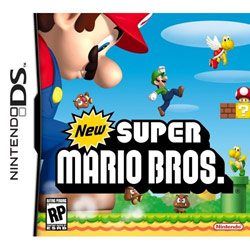
New Super Mario Bros. (video game)
Developers: Nintendo
Genre: Platforming
ESRB Rating: E
Release Date: May 15th, 2006
Prior to the release of this game, there was something of a drought in relation to Mario games. The last main entry in the franchise had landed four years earlier with Super Mario Sunshine. To top it off, this was the first 2D Mario entry in a staggering fourteen years after Super Mario Land 2, thanks largely in part to Nintendo switching the franchise to 3D and never looking back. Needless to say there were high expectations.
I couldn't help thinking as I played the game, however, that it was something of a step back for the 2D Mario titles, much less the franchise itself.
As usual, the story is the same as any other Mario title; Princess Peach is kidnapped once again and it's up to our favorite plump plumber to save her. The only difference is that this time, gasp, it's not Bowser, but Bowser Jr.! Oh yeah, with all the sarcasm I can possibly muster, I can say Nintendo really went for broke on the story this go around.
The look of the game is something that surprised me right off the bat. If you wanted to split hairs, this game is really a 2.5D game, or 3D models in a side scrolling fashion. Usually 3D in a sidescroller has a nasty habit of looking downright awful, especially if the game uses a combination of traditional 2D sprites and 3D models in any fashion. Thankfully this game is not one of those. The graphics are one of the most impressive displays of 3D sidescrollers this side of Bionic Commando: Rearmed; lush and colorful with little to no clashing. If nothing else, the game certainly looks better than just about anything that came before it.
The sound doesn't suffer either here. The sound effects and music all sound great for a portable title, much less a Nintendo DS game. It's rare for portable titles to sound this good; all too often the sound comes off as muted and tiny due in large part to the systems small speakers. Mario leap frogs the competitions standards yet again.
The gameplay is something that really doesn't even need explanation. You run, jump, wall kick, eat mushrooms to grow big and throw fireballs to get through the levels. There's a new wrinkle or two, however, in Mario's new ability to swing on ropes and shimmy across narrow ledges. There are also three collectible coins per level, which is more or less the games currency, but they're not used to buy anything interesting like unlockables; just powerups. Just about all of this plays as well as you'd expect, bringing back the classic core 2D platforming goodness that made Mario a household name in the first place.
Unfortunately, many of the entertaining powers brought forth in previous 2D games have vanished, as is par the course for modern Mario games which have all but dropped most of the old powers. The only one retained is the classic fire flower. There is a new power, however, in the blue shell suit, which allows you to duck into the shell and bowl over your enemies like your typical thrown koopa shell. There are also two new flavors of mushroom; giant and tiny. As you can guess, they both affect your size, making you either a screen encompassing Mario that destroys aything in his path for a limited time or a teeny tiny Mario that can be felled in one hit but can fit through special places.
The game is, unfortunately, not without it's flaws. Some like to call this a second coming of Super Mario 3 thanks to the return of several different elements lost since then. Truth be told, it's more like the original Super Mario but with a new coat of paint and borrowed features from 3. Arguably a bit too much like the original.
While the graphics and sound are excellent, there's way too much "sameness" to them. Levels will look generally like one another far more than I would have liked. If you've seen one water level, you've literally seen them all sans layout; this is one of those instances where it's a bit too much like the original. Also, there aren't enough different themes in levels; all too often will you hear a music theme you heard not two levels ago and what songs are different blend in with one another way too much, lacking a distinctive pop you usually get in these sort of games.
Another relatively large problem is that the game is simply way too simplistic. For all the people who want to compare this favorably to the mother of all Mario games, Super Mario 3, there is surprisingly little complexity to the levels; a complete shift from the short but layered levels of Super Mario 3 and the even better structure of Super Mario World. You move along your designated path, only to occasionally drop down a pipe into a small area before quickly being pumped back into the main track. At times this leaves some levels feeling bland and rather boring because of it; while the throwback to the general structure of the original is nice, it doesn't quite work in modern day Mario games, which are much easier than the original and Lost Levels and thusly harder to really grab you.
The world maps share in this simplicity, lacking much of the branching paths that populated the previous 2D outings. It's a straight shot through the main levels with a seperate path once in a blue moon and signs you can spend star coins to knock over to reach the mushroom house they usually block the path to. There are also only two instances where you have a choice which world you can go to, on the path, but taking the alternate world through often requires you defeat a boss in the castle with a tiny mushroom, something you rarely realize until it's way too late. Not exactly inspired.
Then there's the new powerup, the blue shell. This thing is a complete nightmare of a powerup. Whenever you reach running speed Mario automatically ducks into the shell, going off at a steady pace in that direction. Not only is it way too easy to do this when you really don't want to, thanks to the automatic activation, but it's not horribly easy to go off in a pit and have it cost you a life. Even after you learn that letting go of the run button will make it stop, it still won't help you. The shell moves at a quick pace, which means you'll either go off into a pit or, if you're unlucky enough to have it for a fortress level, bounce off the walls and right back into a hazard before you can even think to let go. This leaves the powerup as quite literally worthless as it's a hindrance nine times out of ten; it'll get to the point where you'll actively avoid it or if you do pick it up immediately leap into an enemy to get rid of it.
Then there's the save system, which is a very large annoyance. You will only be given the option to save after either defeating a fortress or spending five star coins to gain access to a mushroom house; you're not allowed to save at will until you've beaten the game. For a game that is perfect for the pick up, play a bit and put it down style of portable titles, this is an odd choice. You can't just pop it in, play a quick level and be done; you either need a plethora of star coins and a post you haven't knocked over yet, be forced to sit there and get through the three some odd levels it takes to get to a fortress and then beat that or simply turn off the game and waste any progress you made.
The add on stuff isn't much better. Multiplayer in portable Mario's has never really been all that engrossing. Don't expect that to have changed here or you'll be disappointed. Also, the minigames are nothing more than a dozen or so cherry picked games from previous DS Mario's. Nothing new here. They didn't even have the courtesy to just pack in all of them.
This is a very enjoyable game, but there are far too many little things that add up.
The Score: Dramatic Thumbs Up
Some people say this game is like Super Mario 3; I'm here to tell you that ain't the case. In fact, I suspect far too many people were too starstruck by new 2D Mario to really look at it for what it really is. Unfairly compared to the pinnacle of the franchise, this game looks like a chump. The truth is that it's not. There are several niggling flaws to this game and a good deal of curious choices were made, but the gameplay is very solid and it's a worthwhile purchase for the DS. It's not going to be hailed as the best Mario game ever, but you simply cannot go wrong with it. It comes with my recommendation no matter how you manage to get a hold of it, from a cartridge to a download from the DSi's store.
Labels:
Dramatic Thumbs Up,
Nintendo DS,
Review,
Super Mario,
Video Games
Thursday, January 29, 2009
Castlevania Dawn of Sorrow (video game)
Developers: Konami
Genre: Action/Adventure
ESRB Rating: Teen
Release Date: October 4th, 2005
The "Sorrow" games of the Castlevnia series have been, in my experience, relatively popular. I've known several friends to have enjoyed the game - my ex-girlfriend particularly enjoyed them and was the person who gave me the itch to play them - and it's gotten good reviews in general. I had mostly ignored the portable Castlevania's until around this game, the last I'd played was Symphony; when I went away from this game I was pleased in general. But when it came time to review, keeping the entire franchise in mind, Aria's direct sequel isn't really all that remarkable.
Just about any Castlevania that uses the Metroideque gameplay and isn't 3D is eventually going to draw comparison to Symphony of the Night, the 1997 Playstation classic. It's completely unavoidable; Symphony was truly a part of the period where the series was at it's highest, being a direct sequel to the greatest game of the classic formula, Chi No Rondo. When compared, no game since has managed to reach those lofty heights again and with good reason; the number of items, areas to explore, paths to take and just things to discover in general was at an asinine level.
With that in mind, Dawn of Sorrow is a good effort and takes the higher tier of all the games that have followed Symphony. Is it the best since? That's debateable, one could argue that Aria, it's direct predecessor, was at a bit higher level.
We'll start with the story. In general, the story is rather simple as expected. Actually, it's even simpler than Portrait of Ruins; or at least it came off that way to me. The characters themselves, if you were to isolate this game, are relatively dry; even Arikado, the civilian identity of Symphony frontrunner Alucard and the son of Dracula, really doesn't have a whole lot interesting to say or do other than "we can't risk you becoming the dark lord, leave this to us. They don't even actually say his real name in game; the only place it's mentioned is in the specific entry dedicated to Alucard that is given after the scene alluding to Arikado's true identity. Motives of the villains are simple as well; gain more power and become the new Dark Lord.
Even the dialogue isn't all that great. There isn't really a whole lot of wit to the dialogue, something the series has actually somewhat lacked in general since Symphony first game the series games with much of a story beyond destroying Dracula. It's dry and mostly there to service and move the plot forward with a little villain evilness for good measure; all they were really missing was a good bwa-ha-ha, to be honest.
But this isn't something to be held against the game too much; in fairness, it's predecessors in the portable realm were really no better in this regard.
The graphics are a bit of a mixed bag. The good outweighs the bad, but there are odd design choices. The staple enemies often seen since Symphony are generally here in full force, but there isn't a lot of originality this go around. If you've played a previous title, you're going to run into a lot of old friends. For once, we do find ourselves outside of Dracula's castle, but the place we traverse, with the exception of the section called "The Lost Village", is a castle anyways. There are some different locals here and there, but little is different enough to distinguish it from Drac's castle, of which we've traversed dozens of times in one form or another. This one even has a Clocktower, for goodness sakes.
Also, other touches are relatively questionable. The character portraits and overall look has ditched the usual beautiful artwork that the games have held since Symphony for an extremely generic style you could likely see in any random saturday morning anime. It's a choice that leaves you scratching your head, especially when you consider that this is a game immediatly following a game that still used the old portrait style. In another realm, the game does use some 3D for the backgrounds, which was welcome to see considering it helps convey movement with the background moving with you; but it lacks polish. They definitely look like the 3D models they are, which often looks kinda weird against 2D sprites and such.
All of this may sound negative, but the overall look of the game in action looks as good as any other Castlevania; being servicable in every respect, so it's not all bad at all.
Music is probably a bit better this go around. I particularly enjoyed some of the themes we got in this game, along with remixes of some classic themes from previous games. It thankfully wasn't all remixes of classic Castlevania themes, thankfully, with some new music that I felt stands well amongst the general quality this series has always provided. The soundtrack is a bit more memorable this go around.
Controls are, for the most part, as good as any other "Metroidvania" Castlevania title; on a handheld anyways. There are more buttons on the DS than the Game Boy Advance, which was the platform it's predecessor was put out on, but they're not used for anything particularly interesting. The X button can switch your equipment sets and the A button does a slightly more powerful standard attack with a little visual effect. Gameplay is spiced up by the Soul system, wheras you can use different abilities depending on the souls you equip, but this is a carryover from Aria and thus not really a plus unless you've never played that title.
The new perks that come from the DS's features are hit and miss. The dual screens are used well enough. The bottom screen is used for the action, while the top screen can shift between two functions using the select button; a general castle map and a stats screen. The map is exactly what you'd expect and is rather useful to have always there with you instead of needing to obsessively pause the game to check where you are. The stat's screen allows you to see your own stat's, along with affects that may happen from an enemy attack or item as they happen, and an entry on the enemy you're facing, including weaknesses, strengths, item drops and the number of souls you have collected of that monsters.
The touch screen controls, however, are far less intuitive. In essence, they're a product of the time when this game was released; when the DS was a relatively new system and developers felt they had to use the different features to justify their inclusion, often to less than stellar effect. For every game like Kirby Canvas Curse, which made the touch screen a fun and vital part of the experience, there were three or four other games that basically threw in hackneyed touch screen capability that was generally sparse and unnecesary in an attempt to utilize everything and justify it. Dawn unfortunately falls under the second.
There are two main things that will require your stylus. One soul allows you the ability to tap special blocks which you can shatter through the touch screen. The number of area's you will need to use this on could probably be counted on one hand. The other is the outright frustrating Magic Seal system, where to actually defeat a boss, you must first draw out some weird pattern; if you mess up or don't draw it in time, the boss regains something like half it's health which you must deplete again before you get another crack at the pattern. You can probably see how this might be frustrating; especially when the time limits become more restrictive and the patterns more intricate. Now picture it in battle, where you have to use the buttons to beat the boss, then rush to get your stylus ready to draw that pattern lest you have to continue the fight; needless to say it's not for the uncoordinated. It's unnecesary and more frustrating than interesting; making me wish it had either been left out entirely or given a bit more thought so it was a bit more intuitive. I had only one or two problems with it in the end, but I've been playing videp games since damn near coming out of the womb; anyone less attuned to video games will probably have trouble with it as the systems somewhat unforgiving.
The extra stuff is generally alright. You have Julius Mode, unlocked after you get one of two of the three different endings. This mode is more or less a precusor to the team system slightly expanded upon in the next title to come, Portrait of Ruin. You can recruit a couple characters and switch between them with the X button. The only thing really missing are the team up attacks and the ability to equip the characters with things; an experience which truly makes you realize just how little Portrait of Ruin actually innovated. The requisite Sound Test is here as well, which should come to no surprise to anyone.
The Score: Dramatic Thumbs Up
Overall, this entry to the Castlevania is just fine, if not quite as strong as it could have been. It's nice to hang with Soma and company if you play a lot of Castlevania's and it's a good entry if you're new to the series as well, considering the library entry's will catch you up to speed on the very basics. Would I reccomend it above any other entries in the series? Not really. Is it a good portable Castlevania? Yes. Time, and me getting my hands on a copy, will tell if Order of Ecclesia has managed to be a better game than it's DS Castlevania brethren.
Labels:
Castlevania,
Dramatic Thumbs Up,
Nintendo DS,
Review,
Video Games
Thursday, January 22, 2009
Sonic Rush (video game)
Developers: Dimps, Sonic Team
Genre: Action, Platformer
ESRB Rating: Everyone
Release Date: November 15th, 2005
Sonic's been a strange beast to watch this past decade. He's gone from prominence as a premier icon of video games to a mid carder at best and a relic of a bygone era in games at worst. All on the strength, or lack thereof, of many of his games this decade, with the exception of the first two Sonic Adventures. A lot had been riding on this title around it's release, considering many were clamoring for a Sonic experience that was decent at the very least.
Personally, I don't think we got it. This game really does highlight some of the just plain bad choices that have been thrust upon this former icon over the years in a striking bold, even if it's not quite as bad as Sonic Advance 2's particular atrocities. It's not a good showing for the speedy blue hedgehog.
The story is rather simplistic, which is probably the one thing this game did I was glad for. Generally, trying to shove a plot in Sonic games hasn't quite worked out over the years, making me wish for the day's when it was as simple as fighting Eggman through stages to a final battle with no dialogue present. The days when any character interactions were done within the stages and you'd get all you needed to know right there.
Still, there is some semblance of a story here. It generally revolves around a cat named Blaze from another dimension, complete with her own alternate universe Eggman and emeralds, trying to stop her Eggman, who has invaded Sonic's world. This wouldn't be so terrible if the dialogue wasn't so laughably bad; it's honestly even worse than some of the most glaring offenders in the series of late, with generally bad lines and cheesy writing. Then there's Sonic, who, upon defeating a boss, watches as the Eggman flies away and snaps his fingers in an "oh darn" sort of way. Umm, hello? Maybe you should try chasing him?
The sound is generally just okay. There are some voice clips here and there, thankfully only for four or five characters. I say thankfully because the voices are just plain gratingly bad. It was enough to make you wish you could reach through the screen and strangle Tails after about the eighteenth time he spoke during a boss fight, saying the same damn thing. Music was a bit better, but overall I thought it was rather forgettable. Which is a shame, as usually Sonic games, at the least, have had some memorable music.
The graphics fared a bit better. The surroundings are suitably bright and pleasing to the eye, if nothing really special. The game literally goes right to the most basic tropes of the series levels with little real deviance from them, which makes them a bit more forgettable. It's almost as though the designers aren't even trying anymore in regards to differentiating them. In the old days, you had your opening green level, but they looked different. Sonic had a grasslands vibe, Sonic 2's was a bit more tropical, Sonic 3 had something of a tropical jungle, Sonic and Knuckles had a thick forest. These days they seem to just slap a jungle theme and be done with it. If there was one level that stood out, however, it was the carnival-esque level.
The gameplay, however, is where this game completely falls apart. Much of the Sonic series problems since Sonic Adventure 2 lie largely in level design, or bad level design, as it were. Sonic Rush is as bad as any of them. The level designs themselves are quite frankly boring. Most of it is a bunch of loops and dashing from place to place. There is none of the complexity of the Genesis era Sonic games or even any of the interesting gimmicks. It's a lot of "hold right to win" gameplay, which is about the biggest possible snoozefest of gameplay you could ever have. There are maybe one or two paths in each stage, sure, which is something I fully welcome the return of; but none of the paths are in the least bit interesting or unique. The paths are basically the same bland levels, just with more options to get through the level, which misses the point of them entirely.
Even just the facets of level design here are poor. Enemy and hazard placement in this game is just a cruel joke; you'll be cruising along in the blandly designed levels when suddenly "BAM MUTHAFUCKA", there's a bunch of enemies right in your path. No time to react, no time to dodge, just unfairly placed in the worst possible spots. In the old days, they were placed in good positions that were far from unfair; if you got hit, it was your fault and not the games. Not so from Adventure 2 on. This goes for the hazards too.
This is not to mention the horrid amount of endless pits in every damn level, which is the worst addition to the franchise I could possibly think of. They come out of absolutely nowhere with no damn warning and are everywhere in the levels of this game. You'll cruise along and hit a ramp, go flying, then hit a wall. You'll start to fall, only to see a platform pass to your left. You miss it, because you couldn't freaking see it, only to be greeted not by solid ground below, but by a pit. There goes one of your lives. Modern Sonic games love punishing you for things that aren't your fault. Probably why the character has gone from video game hero to a joke as far as peoples opinions here in America go.
Bosses and enemies are, as usual lately, uninspired. Like most modern Sonic games, this portable entry has a habit of recycling enemy and boss designs because Sega is too cheap to put money into producing more than the handful they do. You'll literally fight the same boss on a later level with nothing more than a vague change of scenery, which is positively boring. Enemies are reused through levels with little more than a palette swap.
Then there's Blaze, the new second playable character in this game. Anyone that was hoping for an experience similar to the days of old where you had Sonic and another character like Knuckles or Tails, each with their own play experience, is going to be sorely disappointed. Playing as either character literally gives you the exact same game, just with a different level order. Blaze doesn't even have the courtesy to play differently, giving you the exact same play experience and moves that Sonic does. What's the point in having another playable character if they're not different from the first in any way except visually?
This game is bad. I mean, really, really bad. It doesn't even have the decency to use the touch screen in any interesting way; not that being able to even see more around you helps much when you're going so fast through poor level design that it doesn't help you. As a game experience, this game fails to be fun in any fashion, to the point where I literally had to force myself to finish it after having put it down several times. I'm going to play its sequel only because a friend says it's better, but if that one fails to be of any sort of fun I'm going to write off the era of Sonic games between Sonic Adventure 2 and SatSR (Sonic and the Secret Rings) completely without feeling an ounce of regret.
Avoid this one if you can for the sake of your blood pressure.
My Opinion: Burn It
Wednesday, January 21, 2009
Kirby Squeak Squad (video game)
Developers: HAL Laboratory
Genre: Platformer
ESRB Rating: Everyone
Release Date: December 4th, 2006
With Kirby games, you tend to know what you're gonna get going in. Which is probably why they tend to be so popular. You can walk into any installment you want and find a fun, if light and fluffy, gaming experience. No mad gaming skills required, just the ability to have a good time and the lack of an aversion to bright colors, especially pink.
With every game, there tends to be a bit of innovation snuck in there as well though, mostly for variety. The previous installment, Kirby and the Amazing Mirror, did this with it's Metroid-esque interconnected world and the ability to call on four other Kirby's to help you. Kirby Squeak Squad isn't any different, though as with almost every Kirby game it has forgone the additions in the previous game; we're back to one Kirby and back to the more traditional stage based level structure. Which is fine considering the series never keeps the changes.
Before we get to that, we'll start with the story. Yes, the story. Kirby games never have much of a plot aside from the most threadbare you could possibly find, more as an excuse to get in there and eat things. This games plot is probably even more threadbare than usual. It literally boils down to "MMM STRAWBERRY SHORTCAKE OMNOMNOM OMFGWTF THOSE RATS STOLE MY CAKE MUST KILL RATS MUST RESCUE CAKE". No, really; that's it. But like with every game, do we really need any more? Not really.
So, the additions for this particular game are certainly different, as usual. Much of the game will revolve around collecting treasure, which you need to grab before the members of the Squeak Squad, who stole the Strawberry Shortcake that set the game into motion. This treasure is kept in your stomach. You can hold up to five bubble coated powers, items or treasure in your stomach at a time. The trick is to know what to keep and when to use something, considering each stage has up to three treasures to find and they each take up a spot in your gut.
The other "innovation" of sorts, and I put quotations because we've seen a variation of this before, is something I would have liked to have seen more of. You can combine two items in your stomach to create a new item. For instance, if you do this with three small Kirby powerups, it turns into a 1-up. After you get a powerup scroll for your sword power, you can combine a fireball ability item with a sword ability item to create the Fire Sword ability. This really, really had the potential to add a great deal to the overall gameplay with different ways to get new powers, but the problem is that it is unfortunately not used much. You're really not going to have too many times where combining things will be beneficial; doing it with most items just gives you a bubble of the returning Hi-Jump powerup. That this gimmick was so underused kind of stuck with me, considering I'm never a fan of good ideas going unfulfilled.
The only returning "gimmick" from the last one, Kirby and the Amazing Mirror, is the collection of treasure; one of the few that's returned for another game and in it's third game so far (after The Great Cave Offensive in Kirby Super Star Deluxe/Ultra and Kirby and the Amazing Mirror, respectively). Theres a good deal to collect in this game, with up to a hundred and twenty different treasures to find and collect scattered about the many stages. The prizes to be found can range anywhere from spray paint to recolor Kirby to meddalions for unlocking a new mode once the game is completed to pieces of graphics you can view from the collection to pieces of a map that will lead to someplace new. It does add replay to the game after the main quest, for certain; especially for anyone like me who has a habit of trying to collect everything possible.
Gameplay is otherwise as simple as usual. You float, skip, jump and eat enemies through a bunch of colorful stages of Dream Land. Most of your basic powerups return this go around, with one or two actually returning after a good deal of time being unused; and some treasures will actually upgrade these powers, which is a welcome addition. Unfortunately, you're still not going to find as much to do with these powers as before. While Kirby Super Star Deluxe gave you a lot of things you could do with each particular powerup, to much amusement and enjoyment, no game since has ever given you as many move options. But an old time fan will be used to that by now and anyone who played Kirby Super Star Ultra to experience Deluxe for the first time probably understands by now that each Kirby game has it's own quirks.
The Score: Dramatic Thumbs Up
This is a fine game, for certain, but I felt like there were areas that really needed to be expanded upon to make this entry truly unique. Kirby and the Amazing Mirror had a good deal of replay value thanks to the level of exploring you did and the recent upgrade of Kirby Super star Deluxe, Kirby Super Star Ultra, has several different games packed in each with their own unique gimmick. Given that, it's hard to really reccomend this game considering there are other easily available Kirby games to buy with more to do. Still, if you're a Kirby fan and you have money to burn, there's no reason not to pick it up. Reccomended.
Labels:
Dramatic Thumbs Up,
Kirby,
Nintendo DS,
Review,
Video Games
Monday, January 19, 2009
Castlevania Portrait of Ruin (video game)
Developers: Konami
Genre: Action/Adventure, Platformer
ESRB Rating: Teen
Release Date: December 5th, 2006
Seems like every year or two a new portable Castlevania comes out, doesn't it? That really isn't all that far from the truth. Honestly, being a long time fan of the franchise, I really haven't been of the opinion that any of the portable Castlevania's lived up to the epic Playstation classic; Symphony of the Night. Hell, most of them can't top Chi No Rondo - or Rondo of Blood, as the english translation goes. That includes the Sorrow games. Though admittedly, that's a tall order to fill anyways.
That said, each of them have been enjoyable, if a lot of the same. With Portrait of Ruin, this isn't really a change from that. This is still the basic formula first popularized in Symphony of the Night, or the mix of Castlevania settings with Metroid playstyle. Still a relatively overused plot with someone else taking over Dracula's castle and all that; to the Sorrow games credit, they did at least deviate from this a bit. But there are a few wrinkles here and there.
One of the more welcome changes is the portrait worlds gimmick added that this game generally focuses around. Each painting will take you to a world inside of it, with varying locals of sorts; from an egyptian landscape to a small town to a decrepit, warped circus. It gives some more variety to the locals in addition to your usual foyer/gallery/underground/clocktower standby castle locals. Which certainly helps, considering the fact that despite it warping each incarnation, it's hard to escape the fact that we've gone through the castle god knows how many times by now.
The biggest change to the whole thing, aside from the continuation of the cheap saturday morning anime style designs that started cropping up with Dawn of Sorrow, is that a team system has been implemented. It's really the biggest real change to the overall gameplay, which is tried and true Castlevania through and through. I'd love to tell you that this is implemented brilliantly and a perfect addition to things, but unfortunately if I were to say that I'd be a liar. Though I must admit right now that I would take this, as much as it needs work, over Dawns at times frustrating glyph business.
The sad truth of the team gameplay is that you're probably going to stick with Johnathan Morris for most of the game unless you're forced to do otherwise. The other member that you may switch to at any time, a witch named Charolette, is relatively useless in comparison. She has poor range with almost everything, including most of her spells, not to mention some grating charge times for her spells, assuming you want to do more damage than a mosquito bite. The most useful aspect of this team system are the team attacks, which you can execute for some MP, how much being determined by the strength of the attack. Other than that, it really does not live up to the fun you would have expected.
While the new team system may have been disappointing, the story held water, if just barely. The game in itself is a continuation of the Sega Genesis entry, Castlevania Bloodlines, overall lineage and storyline. The main character is the son of the first hero of Bloodlines, John Morris, and there are references to that adventure littered about. A few nice cameos pop up here and there as well. Added on to that, we finally get some semblance of an answer to why the Belmonts dropped out of the picture until 1999 only for the Morris family to take up the whip; a bit of a dangling plotline for quite a while now.
Unfortunately, the latest Morris is rather bland; he hates his father for dying and leaving them, is overly bitter and that's pretty much it. If it was added to it could have worked, but as it is, it was pretty basic; Charollete is not much better, acting more as a nanny than a best friend at times with a bit of a temper if you call her a kid. If it weren't for some of the neat throwbacks and surprising little easter egg type things, like finding out once and for all who was the last Belmont to weild the Vampire Killer until 1999 was, the story probably would have soured me a bit on this entry. Johnathan ain't no Alucard, that much is certain.
The sound is fitting, as usual, with a few remixes of classic themes in the game. One of my favorites actually came with one of my personal favorite fights in the game, which it's hard not to spoil, but suffice to say you'll know the fight when you see it. This isn't exactly anything new; as the Castlevania franchise has always had good music. But it's always comforting to realize when you jump into one of the games.
Like most previous games, there is replay to be had here, considering the very nature of the game. Anyone familiar with the Sorrows and Julius mode will find a similar mode here, with two new teams that can be used instead of Johnathan and Charolette. Oddly enough, one of the two teams in particular for this mode is more of a balanced experience than the main games duo. The Castlevania fanboy in me loved the extra duo. There's also a Boss Rush mode, if you're into that, which I know some are. Other requisite extra's are there as well, such as the Sound Test.
The Score: Dramatic Thumbs Up
Overall, it's a decent Castlevania entry. It never really rises above the pack to really distinguish itself from it's predecessors and that's probably the games biggest shortcoming. Aside from locals more varied than in the past, there's only the team gimmick, which didn't pan out as well as would have been expected due largely to an imbalance in usefullness. Which is frustrating, because I'm convinced that with some proper tuning, it would have worked well. Otherwise it's just another Castlevania game, so while I enjoyed myself I really cannot give this game a better rating. Even if this is an improvement over some previous installments since Symphony, it doesn't change the fact that they still have not reached those heights again and that we've seen most of this before. Reccomended.
Labels:
Castlevania,
Dramatic Thumbs Up,
Nintendo DS,
Review,
Video Games
Wednesday, January 14, 2009
Kirby Super Star Ultra (video game)
Platform: Nintendo DS
Developers: HAL Laboratory
Genre: Platformer
ESRB Rating: Everyone
Release Date: September 22nd, 2008
Ah, the DS remake. We've been seeing a lot of these lately. This time, Kirby's in on the action with a remake of Kirby Super Star Deluxe. Though I admittedly think of this game more as an upgrade than a remake; new quests and minigames have been added, but otherwise the game hasn't changed much.
Anyone familiar with Kirby, much less the original Super Star Deluxe, likely already knows what to expect from this title. A fun, colorful romp through Dreamland starring our favorite pink puff. For the most part, you'd be right. In other's, not so much.
This game in particular shakes up the usual Kirby formula in different ways at times. There are seven or eight small games packed into Super Star Deluxe which have translated to Ultra, each giving a different play mechanic to your powers or what-have-you. For instance, the opener, Spring Breeze, is a light romp through Dreamland with your classic Kirby gameplay. In actuality, this particular subgame is a full blown remake of the original Kirby adventure, Kirby's Dream Land. It retains your classic Kirby gameplay with no hitches and is probably the easiest of the games included. In contrast, there is The Great Cave Offensive, which is a trek through a sweeping cave with different areas, not unlike Kirby and the Amazing Mirror, on a treasure hunt for different treasures; some even from other Nintendo games. Then again in contrast is Milky Way Wishes. The gameplay hitch in this one is that you cannot swallow most enemies to gain their powers. Instead, you are forced to find statues of each individual power in the collection scattered about the planets; but the catch is that once you find a statue of a power, you may call upon it at any time, making up for the lack of power swallowing and giving you options to explore areas in previous levels.
But this is all old news for anyone who has played the Super Nintendo original. What is new are about four or five new games, two full adventures and two of the Arena sort. They come with their own gameplay hitches like all the other games in the collection, of course. Meta Knightmare Ultra, for instance, has you play as Meta Knight, complete with his own playstyle and a power/point system to replace the ability to swallow enemies to gain their powers. The other main adventure, however, is in effect just a palette swapped and harder Spring Breeze, which is an unfortunate disappointment. The Arena games can be fun though, if you enjoy Boss Rush style modes. The new minigames aren't enough of a draw to mention.
In the end, if comes down to the question of if you should buy it, which is kind of a divide. Some people elsewhere have brought up a decent point that they shouldn't have to pay thirty dollars for a game they had on the Super Nintendo years ago with a new mode or two and that it should have been a ten dollar SNES Virtual Console title downloadable to the Wii system. If you're the sort who feel's this way, this upgrade may not have enough new elements to be worth your time; there are four new modes, but two are only Boss Rush modes and one of the new adventures is kind of a copout. You'd be better served playing the old Super Nintendo cartridge if you still have it.
While the caveat above does apply, I must say that I would wholly reccomend this game to anyone who either does not mind the above much or has never played this fine game before. There is a lot to see and do in this cartridge and enough varying experiences to make a nice portable title for whatever road trips you still make. This is a great game for any gamer, young or old.
Developers: HAL Laboratory
Genre: Platformer
ESRB Rating: Everyone
Release Date: September 22nd, 2008
Ah, the DS remake. We've been seeing a lot of these lately. This time, Kirby's in on the action with a remake of Kirby Super Star Deluxe. Though I admittedly think of this game more as an upgrade than a remake; new quests and minigames have been added, but otherwise the game hasn't changed much.
Anyone familiar with Kirby, much less the original Super Star Deluxe, likely already knows what to expect from this title. A fun, colorful romp through Dreamland starring our favorite pink puff. For the most part, you'd be right. In other's, not so much.
This game in particular shakes up the usual Kirby formula in different ways at times. There are seven or eight small games packed into Super Star Deluxe which have translated to Ultra, each giving a different play mechanic to your powers or what-have-you. For instance, the opener, Spring Breeze, is a light romp through Dreamland with your classic Kirby gameplay. In actuality, this particular subgame is a full blown remake of the original Kirby adventure, Kirby's Dream Land. It retains your classic Kirby gameplay with no hitches and is probably the easiest of the games included. In contrast, there is The Great Cave Offensive, which is a trek through a sweeping cave with different areas, not unlike Kirby and the Amazing Mirror, on a treasure hunt for different treasures; some even from other Nintendo games. Then again in contrast is Milky Way Wishes. The gameplay hitch in this one is that you cannot swallow most enemies to gain their powers. Instead, you are forced to find statues of each individual power in the collection scattered about the planets; but the catch is that once you find a statue of a power, you may call upon it at any time, making up for the lack of power swallowing and giving you options to explore areas in previous levels.
But this is all old news for anyone who has played the Super Nintendo original. What is new are about four or five new games, two full adventures and two of the Arena sort. They come with their own gameplay hitches like all the other games in the collection, of course. Meta Knightmare Ultra, for instance, has you play as Meta Knight, complete with his own playstyle and a power/point system to replace the ability to swallow enemies to gain their powers. The other main adventure, however, is in effect just a palette swapped and harder Spring Breeze, which is an unfortunate disappointment. The Arena games can be fun though, if you enjoy Boss Rush style modes. The new minigames aren't enough of a draw to mention.
In the end, if comes down to the question of if you should buy it, which is kind of a divide. Some people elsewhere have brought up a decent point that they shouldn't have to pay thirty dollars for a game they had on the Super Nintendo years ago with a new mode or two and that it should have been a ten dollar SNES Virtual Console title downloadable to the Wii system. If you're the sort who feel's this way, this upgrade may not have enough new elements to be worth your time; there are four new modes, but two are only Boss Rush modes and one of the new adventures is kind of a copout. You'd be better served playing the old Super Nintendo cartridge if you still have it.
While the caveat above does apply, I must say that I would wholly reccomend this game to anyone who either does not mind the above much or has never played this fine game before. There is a lot to see and do in this cartridge and enough varying experiences to make a nice portable title for whatever road trips you still make. This is a great game for any gamer, young or old.
My Opinion: Play It
Subscribe to:
Posts (Atom)