Sunday, September 19, 2010

Op/Ed: Event After Event, Event After Event, We Stuck No Breath or Motion

Are we ever truly free from events? Sometimes, it really doesn't feel like it, especially right now. After Siege, Marvel said "we're not doing major events for a while, but you might see smaller scale events among families of titles". At the time, it sounded relatively appealing, as long as it wasn't a constant thing, but it quickly became apparent that things were actually the same as ever and arguably much worse.

At the moment, Shadowland currently has the street level heroes wrapped up in an event, one that I hear isn't exactly all that hot. Chaos War is on the way. Both have a plethora of tie-ins; and from the sound of it, more is on the way. No, we're not dealing with major scale events at the moment, but things are about as bad as ever and I'm starting to have the feeling that the folks at Marvel just don't get it.

It was asked what fans thought about the smaller scale events; surprise, surprise, the fans pretty much felt that things were worse than ever with several different events. Well, Marvel responded and pretty much went on the defensive, bringing up that they didn't feel that the smaller events equaled the large ones they used to do and so on. Also, it's again pointed out that you don't need to read all the tie-ins and that part of fans problem is that they feel like they have to get them all. Not only did said answers kind of make asking the fans their opinion seem pointless - as did the later to come "vote with your wallets instead of your mouths" bit elsewhere - but it felt like they didn't really grasp what they were doing or why it was as bad. Not to mention there seemed to be a disconnect with what exactly constitutes an "event"; they may be big stories, but I'm pretty sure the "Punishment" storyline with Punisher and Daken or "Three" in Fantastic Four aren't events. If anything, big stories in the ongoings is probably what they should be doing to start with.

Even if you look at it from a basic standpoint, the problems pretty obvious. Sure, it ain't one huge event, but two to three smaller ones will add up to that level. So here we have Shadowland, which has multiple tie-ins and has taken over more than a few events. That ends the same month Chaos War starts, which embroils a whole new sect of Marvel in a crossover. So on, so forth. It perpetuates an event mode for certain parts of the line; and honestly, there's a lot of potential for this to get out of hand. Besides which, I'm pretty sure neither needed to be a big crossover with eight or nine tie-ins. It just seems like it never ends.

But the big trouble, to me, is that it feels like it hurts otherwise excellent ideas in the long run.

Look, I'll level here. I don't do events, for the most part. Especially not Marvel events. I've felt like they've been terrible for the better part of this decade. Hell, the only event with a spot for the trade on my bookshelf is Infinity Gauntlet, an event from over twenty years ago. I've gotten excited for my fair share, sure, but one of the best parts about being a tradewaiter is that I'll have a pretty good idea way ahead of time as to whether something is a pile of crap or not. As you've likely guessed, with Marvel events, this is all the time, pretty much. So I end up not buying them; if I read them, it'll be because of the library on down in the city and nine times out of ten I find I made the right choice in skipping it.

So the events suck; so what, right? Well here's the problem. The tie-ins? Never gonna escape them. They've got the branding, they often have big references or ties to things in the event and - for better or worse - they're not going to escape it. If an event sucks, who the hell is really going to want to read the tie-ins, good or not? You see the problem; and no matter how good a tie-in story may be, it's in service to the larger story. If that larger story is a dud, it's screwed.

I can only speak for myself - I'm only one guy, after all, and not representative of the entire readership - but event branding can be an outright turn-off. Especially if the associated event is a pile of crap. For example, I've not read a lick of Incredible Hercules, at least not yet. It's gotten gobs of praise, the scans I've seen have made me want it and it sounds like a good time. But those goddamn tie-ins have kept me away; I'm only now considering sucking it up and just diving in. Literally every other story arc of Incredible Hercules is a tie-in to some larger event. The launch was a tie-in to World War Hulk, then after one story arc there was a Secret Invasion tie-in, then after one more it was Dark Reign, then after one more the series closed out with the Assault on New Olympus mini-event, before we had a story arc in mini form before the coming Chaos War event. Maybe it's just me, but that is not very attractive to me as a reader and it's a lot of why I've skipped Incredible Herc thus far; I want to read about Herc's adventures, but it seems like every other one is roped into some event.

Can you imagine if Walt Simonsons Thor run had an event tie-in every other story? That's another thing. I don't think it's coincidence that it's the great runs on ongoings that are remembered far into the future. Someone is probably going to talk about something like Peter David's Hulk down the road more than most events. Hell, can anyone even fondly remember most events? Say the 90's for example. Didn't think so. So in favor of runs that are like building blocks - like how Daredevil's had ten years solid of long runs by creators before Shadowland derailed him - we go to lots of events, only on a small scale. Great plan guys; I'll be over here reading something else.

The sames likely to go for other projects. There's a Power Man mini tying into Shadowland. Whereas I might otherwise be interested in it, if only because of the creative team, I doubt I'm going to try it. Jeff Parkers Thunderbolts sounds like a good read, but come trade time, I'm going to be wary, because it seems like it's always either crossing over with something or tying into an event (hello, Shadowland tie-in). Probably going to pass on Dead Avengers (Chaos War). This is just what I can think of. It's even more ridiculous when you see Thanos Imperitive has the right idea and is running alongside these events.

Street signs read anywhere, anytime. Can you stop the bus? This is where I wanna get off.

To tell the truth, this is also part of why I don't read much Marvel. Seems like whenever I see something interesting to me over there, it's tied into something. Pretty annoying. Though it's not like DC doesn't do it; I'm convinced the overt ties to Infinite Crisis in the latter half of Batman: Under the Hood are why it's not a modern classic of a Batman story.

I think another problem with it is that the readership in general starts to become ever more reliant on events. After all, they're these big blockbuster storylines designed to at least try and thrill. When you've got big hyped events left, right and center, it's kind of hard to see that the regular titles might have a story just as big and probably even better, only with a difference in scope. Then comes the question of "what's next". After all, if you do big, then you need to do bigger and bigger. Eventually, going back to just stories in ongoings without the huge stakes seems less exciting.

Unfortunately, you can probably argue that this has already happened. Imagine my dismay when IGN's Comics crew made it pretty clear they wanted major events back. Something they mentioned that was damn near depressing was apathy for things that were going on, which mirrored a lack of a huge event. Of course, they then went on to argue their case, but that was the point that stuck with me. Despite quality books left, right and center, the lack of a huge event hit their enthusiasm for comics. Granted, when done well, an event comic is a beautiful thing, but how often does that happen?

Is that what we've come to now? Is that what comics have come to? If there isn't a huge event, it feels slow and nothing is exciting? Jesus Christ guys. How absolutely friggin' depressing. It's like comics have become the movie industry; if there isn't a huge, blockbuster event at the center of the summer, no one cares and everything's a failure.

This is what event comics have slowly done to the market and the higher ups just don't get it. So it's probably a matter of time before they come back; and really, the only change will be it going back to one big one instead of a couple smaller ones. Sales have slipped and as Tom Breevort points out, fans are idiots who talk a good game but get roped into the events every time while ignoring most of the other stuff unless it has a nifty banner. He's right to point it out; fans, after all, often have little sense come time to cash out but big mouths. Meantime, come trade time a lot of interesting series are saddled with tie-ins that lose relevance over time.

What a god damn shame.

Tuesday, September 14, 2010

Flash: Rebirth (comics)

Writer: Geoff Johns
Artist: Ethan Van Sciver
Collects: Flash Rebirth #1-6, extras

Going into this story, I wasn't much of a Flash fan. I knew nothing of Barry Allen, little of Wally West outside of the JLU cartoon - though I did love the cartoons version of him - and only ever knew Bart Allen as Kid Flash. I'm probably about as new to reading Flash comics as it gets; I don't really have the history that many do with the character and preferences, so I don't have a horse in the race when it comes to the stupid "WALLY IS THE BEST/NO BARRY IS" arguments. I looked into this story mostly because of Geoff Johns, of whom I'm a fan, rather than because of any real affection for the Flash.

So that's where I was at coming into this story. If anything, I guess I'm probably the sort of fan they were hoping to get with this project to start with. Now, as far as the content itself goes, I have to give credit; after this story, I'm genuinely interested in the Flash and by the end I'm interested in where things may be going. But this story is not without it's problems.

Unlike it's Green Lantern counterpart, Flash: Rebirth starts with the titular hero already back from the dead. He came back in Final Crisis, but you don't really need to have read that story, as you get the important bits. But while Barry is alive again, he doesn't seem all too pleased about it. To him, something feels wrong, but he can't pin down what. Meanwhile, the whole of the superhero community is celebrating his return. But the celebrations won't last long; something is seriously wrong with Barry and by the end of it all, new facts about the Speed Force will be revealed and his greatest foe will have returned.

First off, I'd like to mention that I enjoyed the story playing with the idea of how your life is often romanticized after your death. This is largely a fact of life; someone may hate your guts when you're alive, but drop into a six foot hole and they'll have nothing but the best to say about you. But with Barry it's taken to the extreme; he's not just romanticized, the time dead has seen his legend turn into one of sainthood and martyrdom. He doesn't quite get it; it feels like an honest reaction and I could imagine it happening if the impossible happened and someone returned from the dead in real life.

Anyways, if there's one thing I noticed with this story, it's that it laid a lot of groundwork for what I assume are future stories. The Speed Force in particular finally sees some kind of explanation in that there's a positive and a negative, Barry is re-centered as even more central to the Flash name - kind of like how when Hal came back he was summarily toted as the greatest Green Lantern - the Flash Family is both rebuilt and expanded and a couple characters have both their codenames and costumes repositioned to get things in place for the future. There's a fair bit of ground covered.

On the same token, this story is probably a bit too concerned with laying that groundwork at the expense of the title character. Whereas there's a fair bit of exciting things teased, I didn't feel like I truly "got to know" Barry Allen. Sure, I liked him well enough and had an inkling or two by the end of the story - and I felt like there were a fair amount of places to go with him - but this was Barry Allens return story. This is my first exposure to the character and I didn't feel like the story truly presented who he was to me. Sure, it presented facts and backstory of his life before his death, but his personality did not really shine through. He's emotionally distant for most of the story - which is not how he is, according to his closest friends, but we don't get much indication here - so by the time the story actually wants to get around to showing us who he's supposed to be, it's already way too late in the story to do anything significant. I got a great primer on the Flash legacy, the changes and some track laying for the future, but I didn't walk away feeling like I'd truly met Barry Allen and it's probably this stories greatest flaw.

On the other hand, the story sets up the new Flash series rather well and left me ready to see more. I'm interested in the Flash for the first time, so I suppose that the story did it's job to some extent. Still, I don't think it's quite the slam dunk everyone probably expected. I just hope the ongoing takes time to delve into the character a bit more.

As far as the art goes, I like it a fair amount. It's no secret that Ethan Van Sciver is the reason this series saw atrocious delays. But DC soldiered on and I'm glad they did. I think part of why this story worked despite it's flaws is that it's a visually consistent book. Van Sciver seems to have drawing motion down pretty well and the work is solid throughout. If there had been a jarring artist change midway through the book, there would have been a very real risk of the book falling apart. Few things can truly compound a stories problems quite like jarring art shifts, so kudos to DC for not bowing to the pressure and howling from fans incensed by the delay. It will likely serve this collection better in the long term.

This is also a very colorful book, which is another plus for me; there's a lot of color here, there and everywhere during fights and as a result it feels more visually engaging as a result. I can see this being a fun element moving forward with Flash stories; I like it when stories are colorful, especially because it feels very "comics" to me. That's a good thing, by the way.

The Score: 7.5 out of 10

On the whole, I felt this story did it's job. I'm interested in seeing what comes next and I'll be checking out the new Flash series in trade. Still, I think it dropped the ball in regards to Barry Allen himself and it hurt everything overall, at least enough to keep Rebirth from being truly "great". Still, it seems like a pretty good launching pad for what's to come and I don't feel like I wasn't given the tools I needed as a new reader, which is key in a jumping on point. On the whole, I feel it's worth a read; but it may end up being more important for what it sets up for the future than for the "Rebirth" of the hero in particular, which is indeed somewhat unfortunate.

Sunday, September 5, 2010

Batman: Face the Face (comics)

Writer: James Robinson
Artists: Don Kramer, Leonard Kirk
Collects: Detective Comics #817-820, Batman #651-654

Much like Supermans "Up, Up and Away" storyline, the first Batman story taking place after Infinite Crisis and during the One Year Later initiative is a crossover built to serve the purpose of a reintroduction, jumping on point and a general reset of the status quo. Prior to One Year Later, the Batman franchise had become impossibly bogged down with a series of bad decisions meant to change the game that only ended up hindering the character and his world. Face the Face changes that, in effect bringing back many important pieces that had been removed from the puzzle entirely.

In effect, this is probably the most important thing the story does on the whole. It re-establishes the Batman and Robin team - actually, it probably tries a bit too hard to convince us of their effectiveness - brings Gordon back to his spot of Commissioner, returns Bullock to the force, brings back the Bat signal, re-establishes some characters that had strayed back to villainy and other smaller things. The status quo becomes something much more familiar, rinsing itself of the crust that had accumulated, which is only a good thing, really.

As a story, however, it has it's problems.

After a year away to find himself, Batman has returned to Gotham. Before too long, it's business as usual, but with a catch. Someone using the familiar MO of Two-Face is offing Z list Batman rogues. But Harvey Dent had been cured, right? Batman had even put him in charge of Gotham while he was away. Something doesn't quite add up and Batman knows it; but still, there is the nagging doubt in his mind, one that just might cost him.

It's a decent hook for a basic Batman story and Robinson writes it rather well. James Robinson has a reputation for his writing being purple as hell and this story doesn't do much to dispel that notion. But he does seem to have a decent handle on Gotham in general. This was my first true exposure to James Robinson, so I came away with a decently favorable impression of his writing.

Also, the story continues a loose "fathers and sons" theme that seems to have run through Batman since Under the Hood. Much is made of Tim Drakes lost family and friends, including his father. All of which culminates in the last few pages. It's a nice scene, really; and a pretty decent set-up for what would begin a month or so later. Another appreciated bit is a new officer introduced, who is a relative of an old superhero; we get Batmans outlook on the "legacy hero" and a bit of a knock towards it, which in some ways is overdue.

Unfortunately, that's where the praise ends. I've already established that the entire point of the story seems to be resetting Batman back to a better status quo. Technically, the story gets the job done and it's an admirable goal, as I'm no fan of the direction Batman was headed before IC and OYL. However, the trouble is that the story does nothing to convince you that it's anything but that; and while it's technically a success if your story accomplishes it's general status changing goals, if it doesn't build an engaging story around it, you're in trouble as far as anyone remembering it or giving a damn a couple of years down the road.

This is the central issue Face the Face has and it's one it can't really overcome. Robinson never really builds a story here that convinces you that this is anything but a status quo cleaning exercise and it eats up eight comic issues to do it. If you can't really convince the audience you're doing anything but franchise spring cleaning, you may as well just do it in two to four issues. This story really isn't much more than a slate cleaner for coming writers Grant Morrison and Paul Dini.

So that's an issue to be sure, but the story also has narrative failings. The story seems to want to position itself as a mystery. Typically, you're meant to follow along with the characters and be able to piece it all together yourself. Good luck with that here; it doesn't even reach a Scooby-Doo level of mystery competency. Against the piles of evidence that Two-Face is back, you get one measly clue deep into the story; and unless you're a goddamn expert in Batman villains, it's not going to be enough to figure it out. Hell, even if you are you may not guess it. There isn't even a way to realize or connect the new Tally Man to the ultimate mastermind until Batman lays it all out.

In the old days, this would sometimes be how you'd see a stories mystery played out; the hero figures it all out by some obscure piece of knowledge you'd never have thought of, the answers ridiculous and so on. But back then it took one issue, usually half of it, actually; or in the case of television cartoons, everything wrapped in half an hour. It didn't cost much. Face the Face's mystery operates at about the same level and takes eight issues. Plus it costs fifteen dollars SRP. Not sure I need to say much more.

The choice of villains used in this "re-introduction" story is also rather questionable. Most of the villains Robinson lays focus to in the story are practically Z list nobodies and he ends up killing most of them (which I hear is actually common in Robinson stories). Aside from Two-Face, the biggest name in here is Poison Ivy; who is reintroduced rather well, but shows up only to be smacked around a bit so Gotham knows Batman is back. Killer Croc shows up to eat somebody, get a few hits and then vanish, accomplishing little other than a bit of mid-story action. Other than that we're dealing with villains on the level of Magpie, a character created by John Byrne in an early Man of Steel issue to get Batman and Superman to meet who did a whole lot of nothing after that. While it's appreciated that Robinson didn't immediately go to the old Joker well, I'm not sure he chose the best lineup for such a story (nor am I sure he needed to kill several of them, though admittedly I kind of doubt anyone gives a crap about Magpie and her triple mohawk).

The art is pretty good though. I'll admit it, I'm not as much of an art critic as writing when it comes to this. For me to truly take notice, it needs to either be really good or really bad. One of the two - Don Kramer, I think - is pretty good with facial expressions, while the other holds up their end of the bargain, but doesn't do anything special I can think of. I'd talk more about the art, the similarities and the differences - I think one artist was doing 'Tec and one was doing Batman issues of this crossover, which alternated titles - but DC didn't see fit to put art breakdowns in the credits, so I couldn't tell you who did what.

The Score: 6.5 out of 10

Face the Face, in all, is a decently drawn story that kind of screws up narattively. It doesn't do much other than clean the slate; it's pretty much just a stopgap that follows Judd Winicks "Under the Hood" and sets up both Grant Morrison and Paul Dinis books. It can be skipped without worry, unless you've just absolutely gotta know what happened for there to be a new female Ventriloquist. It's serviceable, but never really rises up to be a genuinely good Batman story; and I hesitate to recommend it when so many legitimately great Batman stories immediately follow it that are far more worth your coin. Recommended only for completists or those who care about "bridging the gap".

Sunday, August 22, 2010

Random Trains of Thought 8/23/10

- So, FrankenCastle is ending. We're going back to the standard Punisher. Who, you know, no one can accept put into outlandish situations despite the fact that he is all the freaking time. Rick Remender talked about having two years of stories with FrankenCastle back in the spring of this year. Looks like that won't happen now.

Some days I wake up and absolutely hate my fellow comic fans.

- Comic fans sometimes amuse me in a "my god you're all focusing on THAT" sort of way. Take the cover by Yanick Paquette for Batman, Inc. #1. It's a very well drawn cover - actually, so is the Andy Kubert variant and I hope Kubert's on tap for Batman, Inc. after Yanicks five issues - but the one thing people focus on? Batmans junk.

An artist draws a superhero outside of the norm - the norm being drawn like the heroes have no genitalia - and everyone immediately focuses on that like a bunch of tittering kids.

Here I was thinking the attention and furor over Wonder Womans new costume was ridiculous and people trump the whole thing by focusing on whether that's really Batman's junk or a codpiece.

- I've recently been replaying Resident Evil 4 since I picked up the Wii version for dirt cheap. As you may know, I'd played and reviewed RE5 about a month back - short version is that I was massively disappointed in the sequel - but as I play through RE4 again I'm starting to get almost mad at Capcom. The number of things they tossed from RE4 in developing RE5 is just absolutely ridiculous; Playing RE4 again makes it feel like Capcom wasn't even truly trying with RE5.

I think I mentioned before in the review how RE5 felt like Capcom was bored with the franchise and just wanted to end the current continuity. Now I'm all but sure of it. Maybe they were bored and couldn't even keep their original continuity straight anymore - a friend of mine notes that they had at least one retcon per game after RE3 - maybe they're just sick of the whole original universe they'd created. Maybe RE4 was such a radical shift so as to inject more life and love for making RE games into the mix instead of doing the same old thing. Regardless, I don't think it's too much of a coincidence that RE 1-3 had a pretty tight continuity, everything after held together alright and suddenly RE5 seems in a rush to wrap the most important stuff up.

Either way I hope they are considering a reboot; RE5 was so lackluster I'm not sure I could muster much excitement for a 6 anymore unless they REALLY wowed me.

- I swear, I'm not going to be surprised if Gotham City Sirens and/or Batman: Streets of Gotham is on it's way towards cancellation. Paul Dini seems busy as hell. No one - not even DC - seems to know what is going to happen at a given time with either book, as well. Literally, the plans and solicitations are so screwed on these titles that no one - retailers or readers - seems to know what's going to happen in any given issue until previews are distributed the week of release. See Paul Dini being mentioned in the solicits, but then suddenly a co-feature will be taking up the entire issue or he'll be nowhere to be found.

Honestly, Sirens should just be canceled or handed off to someone else while Dini continues to work on Streets and Zatanna; I can't see the situation getting any better with the workload he's been having lately.

- Man, people are really jumping on the "superhero movies are on their way out", huh?

Which is funny, because the movies that prompt these remarks are... Scott Pilgrim and Kick-Ass, two properties no one knows a bloody thing about unless they've read the comic, which is less likely considering both are indies. Scott Pilgrim isn't even a superhero flick. Kick-Ass has little star power; much as I like Nicholas Cage, he's not near the draw Angelina Jolie was for Wanted, at least not these days.

Oh, yeah, and Iron Man 2 made double the money the first one did - and that's more of a straight-up superhero flick than either of those - and say what you want about Wolverine Origins as far as quality goes, but it made some decent money.

If anythings likely to screech to a halt, it's probably companies throwing money at people to acquire any old indy comic (or something by Mark Millar), hoping to stumble upon box office gold like in the past. DC had a decent amount of success with comic adaption films, but a lot of the ones done from their non superhero imprints had modest budgets and very little marketing. Meanwhile some company out there is figuring that if they spend sixty million on production and a small fortune on marketing, an indy comic like Scott Pilgrim is going to strike gold in the box office. Not to mention putting its opening weekend up against something with the ridiculously star studded cast of The Expendables when the only thing you've got is Michael Cera, who's polarizing to say the least. As cool as the Scott Pilgrim film looks, I think the results speak for themselves; I'm pretty sure I could have guessed way beforehand which film people were going to see.

Everybody loves a little doom and gloom, so I guess that's where bloggers are at right now. Whatever, I guess. If Captain America or the Avengers flops, then yeah, there's cause to be worried about the future of superhero flicks, but at the moment it feels like Chicken Little braying that the sky is falling.

- Batman: Return of Bruce Wayne #4 had Georges Jeanty instead of Cameron Stewart on art. Apparently said art was mediocre. I bring it up mostly because I wish DC would have bit the bullet and moved the books schedule back so Cameron Stewart could have drawn the issue while keeping the rest of the line rolling along. Sure, you'd end up with a situation like Captain America Reborn where the character is back and interacting with the universe again before the mini itself is finished. But honestly? We knew what will happen by the end from the start. It's in the freaking name.

Obviously this wouldn't go over well with DC's usual "fans" - hell, Marvel was the brunt of jokes for a bit for Steve Rogers chilling in other books before Reborn was finished - but they'd get over it. In the end the product would be better off for it; no offense to Georges Jeanty, but he was clearly on a tight deadline. But I guess DC's been scared off doing that since the debacle that was the "Last Son" arc of Superman.

- In a shockingly abrupt change from about a year ago, I'm actually looking into reading comics fronted by female heroes. Honestly, gender isn't a factor in what I read, but to tell the truth quite a few of them in the past have sounded about as exciting as a wet brick. But something good must be going around the DC offices, because I'm seriously considering dropping change on a bunch of the female fronted series because they sound awesome. I'm already nabbing Power Girl in trade, but now I'm looking at Batgirl, Supergirl (which was a monthly 22 page atrocity for the longest time), Batwoman and Birds of Prey.

Unless JMS weaves magic I'm still unlikely to touch Wonder Woman, however; outside of team settings she's always been good for putting me to sleep.

- My X-Box 360 is starting to give me problems. Second one I've had. Warranty's gone. I'm not going to be too shocked when it suddenly doesn't turn on anymore.

I'm reminded of how much I hate Microsoft.

- Watching some people talk about their love of the Spider-Marriage is kind of like watching someone say they really loved the 90's in comics.

- Sometimes I feel like I'm the only person not on Twitter.

- Iron Maiden's got a new album out. The Final Frontier. Naturally, it's completely awesome and should be bought post-haste.

- So everyone knows the story of Jason Todd's death, right? DC held a phone vote and the votes barely came in favor of killing him. Well, what I didn't know that Denny O'Neil later admitted was that a fan had set up their computer to dial in the thumbs down repeatedly, skewing the vote by hundreds of numbers (see the "Death of Robin" section at the bottom of the link). If they hadn't been there, apparently Jason Todd would have lived. DC went through with it anyways, knowing this, so as not to seem like they were copping out.

Also, Pipeline shows the internet circa 1991 and it's reaction to Infinity Gauntlet.

The point? Well, there isn't one, I guess. I just think it's nice to have the occasional reminder that fans online and off were always assholes and that it's not just a recent phenomenon.

Friday, August 6, 2010

Batman: Hush Returns (comics)

Writer: A.J. Lieberman
Artists: Al Barrionuevo, Javier Pina
Collects: Gotham Knights #50-55, 66

It was only a matter of time. The merits of the Hush storyline can be debated - and whether you like it or loathe it I think everyone can agree it has flawed - but the fact of the matter is that Loeb and Lee had a runaway hit in that story. No way was Hush going to fade into the ether. It was more a matter of when he'd be brought back.

Didn't take too long, as it turns out, and unlike the first round the quality isn't really up for debate.

So basically, it's like this; Hush is back and he's pretty pissed. Mostly at the Riddler. So he decides to track Nigma down and smack him around a little bit. Naturally, ol' Eddie doesn't really care much for this plan, she he decides to jump through a few windows and beg the Joker to protect him. Riddler tempts him with something he wants, so Joker takes Nigma in. Hush comes after Nigma anyways. Joker frowns a lot, because that's clearly a thing we should see Joker doing all the time. Prometheus shows up for some goddamn reason and ends up looking like a big joke. Hush finally manages to get his hands on Nigma and punches Joker a few times. Naturally the Jokers reaction to a good shellacking is to strip naked and run to the carnival from The Killing Joke.

You know, as one does.

Hush Returns is all over the place. I'm not entirely sure what the point of anything was, because we don't see one. Hush shows up and pays lip service to killing Batman, but he doesn't really do anything about it aside from recruiting Prometheus - who does a grand total of nothing except bleed out after Green Arrow puts a few arrows through him - and antagonizing Riddler. Batman muses a bit about Hush and how he's scared of him - Batman's not in this much, by the way - ultimately accomplishing little. Hush tries - and fails for about the third time - to get his hands on Nigma and at that point the story just ends after Joker streaks through some farmland to his broken down carnival. Then, inexplicably, the trade jumps forward a full ten issues to show us Hush beating Prometheus down for no reason we have any insight into and the Society shows up and it's all just a goddamn mess.

Why Prometheus? Why frowny Joker? What purpose does any of the events serve? Who the hell knows. I'm not even sure the writer did.

I'm serious about that, because things simply happen with no conclusion or purpose. Take Prometheus, for example; Hush talks about needing a partner and recruits him, but Prometheus doesn't do anything aside from shoot a couple people late in the trade. Robin visits some guy who claims to have the best quality... whatever, but we never find out what he sells, why Robin was there or what bearing it has on anything. We also learn that Jokers wife was murdered - an obvious attempt to definitively place the Killing Joke version of Jokers origin in continuity - but when Joker has the name of the cop responsible he does absolutely nothing with it before his beatdown and decision to go au naturale.

The characterization is just way, way off. Joker is probably the biggest example. Dude looks like someone just killed his puppy for the entire thing. He frowns for almost the entire duration of the trade - come on, laugh clown laugh - and seems completely, inexplicably sane. It's like someone threw Joker facepaint on a random guy. Then there's Green Arrow, who's mostly there to yell at Batman for not telling him Hush was going to Star City, despite the fact that Batman himself didn't even know the reason why. Then the writer tries to sell us on the tidbit that Batman's afraid of Hush; of course, he does a piss poor job of it, because Hush does little in this trade that would make a seasoned crime fighter shake in his boots. Even Penguin feels off the the short time he appears.

So the story and writing's a mess; how's the art? Workmanlike. It reminds me a lot of the general art style that was in use during these years. It's okay work, but nothing I'd actually enjoy; and certainly not solid enough to make up for the stories screw-ups. So what we end up with in the end is a story that bounces through plots like a pinball and resolves none of them coupled with okay art that certainly doesn't wow. Not exactly a winning combination.

I cannot in good conscience recommend this trade. It just isn't good. I don't exactly know anyone who would call the original Hush storyline top shelf comics, but it's practically Shakespeare compared to this. Avoid; there are far, far better Batman stories to spend your money on.

My Opinion: Burn It

Thursday, August 5, 2010

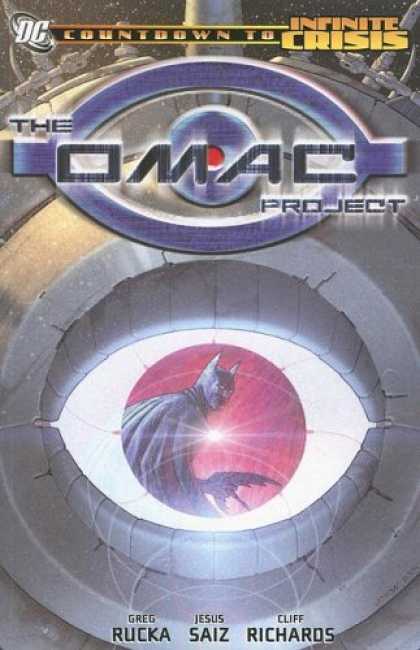
The OMAC Project (comics)

Writers: Greg Rucka, Geoff Johns, Judd Winick
Artists: Jesus Saiz, Rags Morales, Ed Benes, Phil Jimenez
Collects: Countdown to Infinite Crisis #1, The OMAC Project #1-6, Wonder Woman #219

The fourth trade of the Infinite Crisis buildup mini's is the one I saved for last. It's arguably the most relevant trade of the four. The effects of the OMAC Project as a whole actually had the most impact on Infinite Crisis on the whole; as such, if you were going to pick one of the mini's to pick up in expectation of it being followed up on in IC, this would be the one to get.

After the events of Identity Crisis, Batman has become more paranoid than ever. In that story it was revealed that the Justice League had been mindwiping villains, but had also done so to Batman when he furiously tried to stop them from doing it to Doctor Light. Since Identity Crisis, Batman has figured it all out. Feeling utterly betrayed by those he called friends, he constructed a satellite to spy on all meta-humans, feeling unable to trust them. But now that satellite is under someone elses control, bringing about a very real chance that all meta-humans could die. Batman's mistakes have come home to roost; but this time, it could come with a heavy cost for more than just him.

I've always been divided on the subject matter of this trade. This is arguably where the "Batjerk" portrayal of Batman had it's last hurrah - as it was intended to, really - but I think it borders on going too far. Batman really screws up this time on a level far beyond when Ra's Al Ghul took his plans to take down the Justice League if they went rogue; with the spy satellite comes files on every meta-human and it's not really all that hard to see the potential for the plan to just go horribly wrong. Had the death toll been any higher, would the superhero community ever have been able to forgive him? Should they anyway?

It's easy to see where they were going with this, painting a portrait of the fact that Batman had gone too far and needed to rehabilitate, but throughout this story I can't help but think they were cutting it close with Batman's overall culpability.

Those reservations aside, the story is quite well written. This really doesn't come as any surprise - I don't think I've read a Greg Rucka penned comic that was outright bad - but still, this could have gone very wrong. It was treading a fine line with Batman; it could have easily done the kind of damage to Batman that Civil War did to the character of Iron Man. Thankfully, Rucka is a better writer than that. Also worth noting is the writing in the Countdown to Infinite Crisis comic at the start; I think it's a testament to Geoff Johns, Greg Rucka and Judd Winick that the first time I read it I went in not caring about Ted Kord and walked out appreciating him.

If I had a real reservation, it was that midway through the mini proper it becomes evident that important events to the mini happened in another book; thankfully, that comic is included here and placed where it should be, but I've never been a fan of important plot points to one story being in something elsewhere regardless.

This mini is as much about Checkmate - DC's most established spy organization - as it is Batman. Easy to see why, as this mini is as much about breaking down Checkmate to be built back up again for the Checkmate series. Rucka definitely has a knack for those kind of stories and balances it well with the plight of the superheroes. However, as much as this mini is a primer for the Checkmate organization, it doesn't do as much to show how the organization works. We are told the gist of it through the course of the story, but for most of it the organization is little more than a dictatorship run by the Black King, who had maneuvered his way into total control. We could have done with actually seeing a bit of how it usually operates - through flashbacks or whatever - but thankfully it's a small blip on an otherwise well written story.

The art is good, solid work as well. While Countdown to Infinite Crisis is something of a hodgepodge - each of the five parts of that one comic was done by a different art team - most of the rest of the volume is done by him. Rags Morales does the art of the included Wonder Woman issue though and it's pretty good work. Otherwise, I'm not sure what else to say about it. It's good work, but I guess I wasn't wowed by it?

On a final note, this is also another pretty thick trade. Much like Day of Vengeance, this trade also includes a good amount of other stuff in it, some of it necessary. The kickoff to the buildup - Countdown to Infinite Crisis, which in itself is eighty pages or so - is included, along with the climax issue of the Sacrifice crossover of Superman and Wonder Woman, which is a necessary inclusion. In all, it makes for another thickish trade that goes right up to IC, with an allusion here or there to things going on in the other minis. Good value for the money, I think.

The Score: 7.5 out of 10

On the whole, it's an enjoyable read and worth the money. In general, the Infinite Crisis mini's have been worth the change. Pretty good when you consider a lot of events have tie-ins or buildup of very questionable quality. Recommended.

Wednesday, August 4, 2010

Rann-Thanagar War (comics)

Writer: Dave Gibbons
Artist: Ivan Reis
Collects: Rann-Thanagar War #1-6

This is, as you may have guessed, the third of four Infinite Crisis lead-in mini's. The theme for this one is similarly grand. Cosmic war involving many of the DCU's alien races and cosmic concepts from the Tamaranians right on down to the Dominators. Add in the still rebuilding Green Lantern Corps, stir well and serve.

At the start of the story, we find out that a prior conflict has found Rann sent directly into Thanagars orbit through the machinations of an enemy. This destabilized Thanagars orbit, sending it closer to the sun until the atmosphere ignited, killing most everything on the planet. The Rannians evacuated as many as they could; but a Thanagarian cult amidst the survivors drives forward unrest until the rescued Thanagarians revolt against their rescuers, inciting all out war.

The war starts up quickly and there's a good bit going on. I'm not as versed in the cosmic DC as I am other parts of it, but if this series didn't bring in all of the established races in the DC Universe it made a damn good go of it. Most everything from LEGION to the Omega Men to the Tamaraneans show up to throw punches and laser bolts at one another, so the scale's big on par with the other mini's at the very least. There are betrayals, alliances and long forgotten heroes in the mix. On top of that there's a cult and it's zombie summoning god figure taking it to Rann, so needless to say this story isn't spoiled for lack of things going on. Dave Gibbons makes it all work relatively well too; and despite the fact that this mini builds off a previous story, he knows enough to get you caught up to speed on past events within a few pages. He may be best known for his work as the artist of Watchmen, but he can write a pretty decent space story too.

Now normally I haven't been as interested in the cosmic sector. To tell the truth, this is probably my first real exposure to it in DC. This mini makes a pretty good first impression, like the others, and is something of a crash course in cosmic DCU. I'd argue that this is one of the greatest successes of the Infinite Crisis buildup, as many different facets of the DC Universe not always explored have been given time to shine in quality mini's. That's good strategy, really.

The art is ably handled by Ivan Reis, who would go on to achieve more renown by penciling the Blackest Night event. This is where you could say he really cut his teeth with grand stories and scope. The very nature of the story means that he has a multitude of things to draw, all wildly different from each other, so when I say that he pulls it off with aplomb, it's no mean feat. There's some panels and pages just rife with detail, giving the sense of scope something like this needs. In some ways, his work reminds me of Alan Davis; if there's an artist you could ever want to echo, he's definitely one of them.

If there's one issue I have with the mini, it's that it feels like a bit too much is left for Infinite Crisis to sort through. The zombie summoning god situation is dealt with by the end, so I suppose you could argue there's some measure of closure. But for the most part, we end the story with the war heating up and a gigantic tear in reality opening, at which point the mini pretty much ends. Pretty good cliffhanger, not too good for the mini's ability to stand alone.

The Score: 8 out of 10

On the whole, this is an enjoyable story of the cosmic DCU going to war. I tend to find space based stories to be a polarizing subject matter for fans - some like them and some could easily go without ever reading any - but I felt this was strong on the whole. It feels grand and is well put together. I'd recommend it if you've an affinity for cosmic comics.