Thursday, May 19, 2011

X-Men: Nation X (comics)

Writer: Matt Fraction
Artists: Greg Land, Terry Dodson, Alan Davis
Collects: Dark Reign - The List: X-Men, Uncanny X-Men #515-522, Nation X #1-4

There's a question regarding where the X-Men franchise has been going in recent years that bears asking. If the X-Men have turned their back on Xaviers dream and what they stood for - mainly striving for peaceful co-existence with normal humans, understanding, an end to fear of differences and other points - are they still the X-Men? As they go further and further down the rabbit hole, I find the answer to be a resounding no; and it makes the adventures of the team even less appealing than before.

Here's the thing, I don't really care about the main adventures of the X-Men anymore. A couple years ago, I came to a realization that the only two runs on the flagship books I've ever truly cared about were the legendary Claremont run and Grant Morrisons game changing run on New X-Men. Anything else I find interesting tends to be the side books, the occasional arc in a major book that doesn't connect to the status quo much or the ones off doing their own thing with next to nothing to do with the core book.

There are numerous reasons I borderline hate the current status quo and unfortunately this volume is a pretty good encapsulation of why.

First, lets get the general overview of the plots out of the way. Opening the book is the Dark Reign - The List one shot. You may recall that I had a few choice words to say about the collection of the numerous one shots, but in the X-Men collection this fits much better. It feels like more of an epilogue to the conflict in the last volume, when the Dark Avengers and X-Men squared off, which led to Namor and Emma basically telling Osborn to take a hike. Osborn didn't take too kindly to that, so he sends a big monster to presumably eat Namor. This goes about as well as you'd expect. It's a pretty okay one shot, though there's no mistaking the fact that the vast majority of what makes it worth the time is the art by Alan Davis.

Then there's the main arc, Nation X, which eats up about eight issues of Uncanny X-Men. Basically, after the events of last volume, the X-Men have set up their "Utopia" on top of the floating Asteroid M. Now they have to figure out the nuances of how to survive. This goes on for eight issues, with a few flashes of interesting conflict with in but largely decompressed nonsense.

The back third of the book is dedicated to the Nation X anthology series, which focuses on characters acclimating to the new situations or just little vignettes; some are bad, some are good, a few are even pretty great, but that's par for the course for any anthology series of any kind. You can't really review this kind of thing, but I can at least vouch for a pretty decent batting average of good to bad.

First off, the Nation X arc is horribly decompressed and not terribly interesting. For eight issues we find our cast dealing with various problems on the island nation, from things like fresh water and food to where to put the result of a hundred plus mutants who presumably need to take a dump from time to time. Some of this is fine, but it's the focus of over half the arc. It's not exactly the most interesting reading. Fraction tries to keep things exciting with a few conflicts - and a hint or two at future arcs - but he doesn't necessarily succeed. This isn't the most riveting stuff ever put to paper.

Second, the art is pretty yuck. Greg Land is far from the worst artist to ever grace the pages of comics, but he isn't exactly good either. Some poses just look outright ridiculous, characters will look off, a character will be drawn as if their suddenly screaming out of nowhere when a second ago they had the calmest face imaginable. Land has his problems and he illustrates six of the eight issues in this collection.

The Dodsons are far better, but their contribution to the collection as a whole is a drop in the bucket. Even they aren't without their issues. I'm not sure how much of this was called for in the script - Cyclops even has a line describing it - but when we go into Emmas mindscape, it's the dullest thing ever. It's all just white. We've seen characters psychically traverse another characters head in the past and it usually reveals something about them. Apparently Emmas mind is nothing but white space. It makes a two issue conflict within a larger story blander than it should have been.

Worse than the dullness, however, is the fact that we're treading even further into territory that makes the X-Men almost unrecognizable. There's obviously potential to be mined in the whole "M-Day" scenario, but it was patently flubbed most of the time. A lot of what we see ends up turning the X-Men into a group so far removed from what the X-Men always stood for that the editors themselves feel it necessary to come out and defend the direction every interview or so.

It starts with Cyclops. I've never been a huge fan; even back in the Claremont era he was as dull as a block of wood. This is an obvious problem, since he's frequently a key player in X stories. The one time he became remotely interesting was during Morrisons X-Men run. Almost immediately afterwards he became a dick, which has been the norm since.

Ever since the X offices went out of their way to try and demonize Professor X, Cyclops has been portrayed as superior and this perfect leader. But here's the thing; he's not. It's just that no one who ever questions him lately is taken seriously. He's basically a Jerkass Stu, to go with a TV Tropes term.

Here's the thing though; no matter how much the writers try to portray him as cool or the bestest leader ever, it ends up backfiring on them because Cyclops is, long story short, a douchebag who makes questionable moves. In what reality is publicly locating just about every goddamn mutant left on a small, sinking asteroid a good idea? One orbital bombardment later and barring Colossus and Armor, the mutant race is dead. Letting Magneto on the island? Yeah, sure, he puts on a nice face, but the guy is a goddamn rattlesnake; he is going to bite you eventually. How many times has he pulled this? Professor X even states this outright. Nope, let's let the genocidal, terrorist maniac on the island, that'll be great for morale.

But this is all okay, because Cyclops has a plan. He admits he's kind of making it up as he goes along, but you have a dream Professor X and he has a plan. Except, you know, that's the exact goddamn opposite of a plan. But he's not called out on this because he's friggin Cyclops.

I'm not even joking. No one really dissents. He's like King Cyclops and almost all of his little subjects fall in line. It's kind of striking when Wolverine - the guy who would basically question every move Cyclops or Professor X made - basically says "he's making tough choices and he's right".

There are people who speak up, but they're written like they're heels for doing it. Professor X immediately suspects a trap when Magneto arrives, but his outburst is treated as if it's unnecessary and over the top. Despite the fact that, you know, Magneto has pulled this "I'm good now, really" business before. Even Beast isn't wild about some changes, like Magneto being on the island, and gets a lecture from Iceman for his trouble. He - and his departure - is written to come off as a whiny douche instead of a fair portrayal of someone disillusioned with the choices the fearless leader has made. Half the island barely even notices he left.

Beast himself even brings up how he was left to be tortured until the "time was right" for a rescue, presumably for the greater good of the mutant race. This is spliced between scenes where Cyclops has dropped everything to perform "psychic surgery" on Emma Frost once it's been deemed a viable option. No one questions this hypocrisy or pats Beast on the back. The mutant race comes first, except when it doesn't.

So many things about this arc just come off as false because of it. Magnetos sudden, practically out of nowhere change of heart just doesn't jive with how he was even a short time ago. He even goes so far as to say he was wrong about mutants being the future. The X-Men themselves have basically become a glorified military group and represent everything the group has ever fought against, yet it's handwaved away as necessary and made in the midst of tough choices.

All this and the fact that Cyclops is content to put all of his eggs in one basket with the "mutant messiah". Then there's something that isn't brought up in this arc in particular, but is an important bit; the fact that Cyclops - leader of the X-Men - has personally sanctioned a kill squad. So what we're reading is another step in the destruction of everything the X-Men ever stood for; they've essentially turned their back on Xaviers dream because times got tough and the only people who care are Professor X himself, Beast and Nightcrawler.

As it stands, the way mutants have been acting under Cyclops stewardship, there's plenty of reason for regular humans to be scared of them. Hell, they now have Magneto chilling with them on their island. The guy that's committed numerous terrorist acts and wanted to wipe humans out if they didn't go with his demands a time or two. Add this with them declaring their own nation of super powered mutants just off the coast of San Francisco and it's a miracle missiles aren't headed their way.

Worse still, the status quo this book begins to explore not only hurts their appeal, but it unwittingly sends several bad messages. It's no secret that the X-Men have long been a concept following the general theme of fighting against hate. Racism, homophobia, all that stuff. The editors and writers freely admit it. But now, mutants are segregating themselves because the government doesn't agree with them, they have kill squads, they stop caring about advancing their standing in the world and they generally start acting like a military group.

So what message is this sending? Should the blacks all be congregating on their own island nation? Should gays have a kill squad to take out their enemies because they might be harmful to them? Should hispanics form themselves into a military group? You can't have it both ways, but Marvel wants to take this team in a darker, grittier, the-end-justifies-the-means direction while still trying to make the team a metaphor for race relations. I don't think I need to tell you it doesn't work and this volume does nothing but make it worse.

Matt Fraction is a talented writer. He is. He's deservedly a big star in comics. But the X-Men do not seem to be gelling with him. I don't know if it's the direction not agreeing with him or what. But this is not his best work. Which isn't a big deal - even the greats have off days - but it's disappointing. He is unable to make any of this work, if only because of the fact that this status quo he's working with - and advancing - is anathema to what the X-Men have always stood for.

As you can tell, the writing is completely unable to make this work on several levels. But at the core of it all, it all comes back to the point I made earlier; this arc is just dull, dull, dull. There's always the chance this could be made to work by using action to keep you from thinking too hard on it, but there are maybe two real action beats in the whole eight issues that are relatively short. The subplot that contains said action scenes ends up having nothing to do with the rest of the arc. It's just overlong, doesn't seem to go anywhere and if anything seems to just be buying time until Second Coming, the crossover that sees the "mutant messiah" return.

On the plus side, Second Coming doesn't have to do much to be more interesting than this, that's for sure.

Obviously, I don't like where the franchise is - and has been - going. I don't think that's all of this volumes problem - I've tried to list everything I find wrong with it here, but I'm sure I've rambled way too much for it to be concise - as the writing in general isn't up to snuff, but it is an issue. But if you like where the X-Men have been going, you may like this more than I did; it's still very dull and bland on a writing level and the arts not that great on six of the eight issues, but it does advance the status quo, for good or ill.

There's definitely a positive or two here though. One very good thing about this - whether you like the direction or material or not - is that this is a thick, thick volume. It contains, after all, the eight issues of the arc, The List one shot and the four Nation X anthology issues. That's thirteen issues total for thirty dollars SRP; you can even get it much cheaper online. Considering Marvel's really annoyed me with their habit of four issue trades lately, I feel I must applaud them when they give us a volume with good value for the money.

Now if they'd just do it more than once in a while, we'd be set.

Some of the various short stories that make up the Nation X anthology are pretty good too. Though, as expected, the quality varies. But there aren't many that are outright bad, which is kind of a win for any anthology.

Another good thing is, well... uhh... did I mention the one shot was drawn by Alan Davis? That's always a plus. I think I'm about out of good things to say already.

The Score: 5.5 out of 10

Skip it. For the love of everything good, just skip it. Matt Fraction just couldn't pull this one off. It's inoffensive reading, but it's also pretty bland and dull. Not worth the time or money unless you really, really like where the franchise is going. I don't, which makes the volumes problems even worse for me.LinkLink

Saturday, May 14, 2011

Dark Reign: The List (comics)

Writers: Brian Bendis, Jason Aaron, Greg Pak, Rick Remender and numerous others
Artists: John Romita Jr., Alan Davis, Adam Kubert and too many others to count
Collects: Dark Reign: The List - Avengers, Daredevil, X-Men, Punisher, Secret Warriors, Hulk, Wolverine, Amazing Spider-Man

Hoo boy. This book. There are so many problems with doing something like this. Let's you and me talk about why.

Essentially seven or eight one shots with an over-arching narrative, the conceit is that Norman Osborn is making a list. He's checking it twice. He doesn't really care who's been naughty or nice. He's just gonna shoot you in the face. Or more likely have you shot by someone else, since he employs a bunch of murderers as a team of Avengers.

I'm not really going to get into the individual quality of each one shot; as you'd expect, some are better than others and this really isn't the point of the exercise. There are about three different ways you can try and run something like this. The first option is to have the overarching storyline take precedence; this is the approach that would have actually necessitated a collection like this. The other way is to be light on the connective tissue and have each writer treat it as an extra chapter of whatever ongoing they presumably work on. The final option is to try and do both; this route very rarely works out, becoming a jack of all trades, but master of none.

This book takes the second approach, which results in a scattershot group of one shots that barely connect.

Talked up as an important part of the overall Dark Reign status quo, they try to tie everything together with the overall plot of Osborns list. It doesn't necessarily work, because only about three chapters actually involve the list itself or Norman actively going after his target. Each issue does involve him, but as mentioned earlier they're all basically extra chapters of different books across the Marvel line. Different vibes and tones follow, with the overall series not feeling like a cohesive whole. There are a few important scenes to affect the status quo, but it doesn't really work as it's own story, which is a big, big problem.

Since what we're left with here are extra tales of the given character or team, we're left with about what you'd expect for most of them. Quite a few of them involve the ongoing events of a given book, which means that divorced from said context they mean little. Why is Norman pissed at Namor? Who knows, but he's damn sure going to throw a hungry monster at him. What's Osborns beef with the Punisher? You might be able to take a guess, but if you haven't read the events of his ongoing at the time, you won't have the concrete answer. Why the hell is Hulk not the Hulk? Same deal.

In short, most of the one shots assume familiarity with the ongoing events at the time. The hope is to get your readers hooked and want to read those books. But without a given context, what we get is going to mean little to most of the people who read it. Even with people who are reading several of the given ongoings, few of them will have been invested in all of them.

Worse still, the entire exercise - and even this collection - is unnecessary. While we could have been in for an interesting story if Osborns downfall came from the fallout of the last one shot, Spider-Mans, it's ultimately inconsequential. The Siege event would come soon after, which led to Osborns downfall in a way that had nothing to do with the events portrayed here. Sure, Peter damn sure screwed up Osborns PR, but things would have come to the same conclusion with or without him. Which leaves the appeal to the writing and art, which are both admittedly pretty great.

As for the collection itself, as you can guess, each individual one-shot is also collected in the collections of the associated book. They fit in much better there and the events are separate enough that removing them from the rest doesn't hurt them. So, with the one shots all available elsewhere and the overall story remarkably flimsy... the point of this collection is what again? Aside from the obvious goal of a little extra money coming in from the sales of this too.

Really pointless volume overall.

The Score: 5 out of 10

Let me be very, very clear here; this score is for this volume as a whole. As a separate entity, this collection fails to be worth the time or money in every way. Many of the individual one shots themselves, however, are very good; several well written and several very, very well drawn by some of comics best. But you're better off reading them in the associated collections. There's absolutely no point in wasting the money on this thing. It means absolutely nothing if you're not already reading the given comics; and if you are, that means buying this volume would have you paying for the same comics twice.

By all means, skip this; you'll get them when you get around to the volumes of the ongoings they're collected in.

Friday, May 13, 2011

Astonishing X-Men: Exogenetic (comics)

Writer: Warren Ellis
Artist: Phil Jimenez
Collects: Astonishing X-Men #31-35

It's funny how in the back, Astonishing X-Men is referred to as Grant Morrisons legacy. Really, the only reason for that is because Whedon was the only one who didn't seem to wipe the slate clean of what Morrison did; you know, considering Marvel shat on Morrisons run immediately after it finished. He kept the characterization of several characters, but it was a far more conventional book than what Morrison did. Which isn't a knock; Astonishing is generally good and one of the few X books worth reading.

Then Warren Ellis came on board; thankfully, the good times have kept rolling with this one.

After M Day, there was that whole "No More Mutants" thing going on, so most of what followed that was a bunch of "mutants band together" stories, dark secrets from long standing characters and so on. After a while, someone figured, hey, the mutants are in one place now and no one has tried to commit genocide in the past three months. Why not take a crack at it?

Except this time, said genocidal maniac is pretty good at manipulating genetics. Expert at raising the dead is apparently on his resume as well. Thus, we have dead X-Men returning to try and kill the ones that are still breathing and somewhere along the way the villain decides it would be a slammin' idea to drop a clone of a living island on them. As you can probably guess, the X-Men find all this to be in really bad taste, so it's time to give the villain a stern talking to!

If all this sounds familiar, congratulations, you've read a few X-Men stories. Typically, a plot like this would be a sign of trouble; it's been done so many times before that it can be pretty difficult to imagine anyone wringing anything new out of it. How many times have the X-Men faced a foe who wanted nothing more than to wipe them from the face of the Earth? I lost count a long time ago.

Apparently, there's still things to do with the concept and Ellis opts for subversion of the typical way this kind of thing plays out. There's no high minded validation for this, no excuses or delusions of protecting humans or the like. This attempt - this complex, planned attempt on their lives - stems from nothing more than sheer pettiness from a source close to home. It's a very human reaction, when you strip away the flesh and blood sentinels and the zombified islands. Jealousy and spite leading to unreasonable backlash.

In the midst of it, the notion of just how outside they really are is tackled. As pointed out, the X-Men aren't exactly wanting. Most of them are beautiful or handsome specimens in colorful spandex with fantastic powers. As much as they bemoan being freaks, do they truly even know what it means? It's an interesting question, despite how far the villain took things. But it's one that's even arguable from both sides. Cyclops himself asks Wolverine, bemused, "There are people who hate us because we're not outcast enough?"

As for the dialogue and writing, you know what you're getting into with a Warren Ellis scripted comic. Somehow, some way, he's going to get in his traditional brand of snark. To varying degrees, he manages it across most of the cast here, but unlike other writers, he manages to work it so they still feel in character. That's something some writers struggle with, even popular ones.

The scripts obviously tailored to give the artist plenty to draw, as well. The hook of the story - dead mutants being reanimated and controlled - allows for a bevy of typically unavailable foes. This is played to the hilt, with Jimenez getting to draw the Brood, Krakoa, flesh based Sentinels and more. There's even a crazy rescue from the wreckage of a ship in the midst of atmospheric re-entry from space.

Do I really need to say Phil Jimenez does well with it? Oh, alright. Seriously, he's fantastic. Great at illustrating the large scale, the small and everything in between. Seeing him tackle things like the Brood is a treat and overall a fair amount of what makes the whole thing worthwhile. Oh, did I mention he's good at facial expressions, too? Jimenez was a perfect fit for the arc; overall, Ellis writes a sharp script, but it's the artwork that helps push the book that much further.

All this in mind, I must grant that this volume isn't exactly going to shake the Earth or anything. This is a solid, enjoyable read, for sure. Still, many seem to see Astonishing as a strictly marquee, high tier title. It comes with high expectations for some. Personally, I enjoy Astonishing in that it gives me a relatively self contained fix of the X-Men, away from all the bull the franchise is frequently embedded in. It hasn't really done me wrong yet. But some seem to view it different - hell, some think it should have ended with Whedons departure, which is retarded, because could you imagine if Thor ended when Jack Kirby left? - and it's worth bearing in mind.

The Score: 7.5 out of 10

I doubt it will win any awards, but as a continuity light, contained dose of the X-Men, this is hard to go wrong with. Worth a read if you're sick of all that mutant messiah mumbo jumbo and just want to see the team fight a bunch of superpowered zombies. Even if you're not, it might be worth it just to see Cyclops get a bit of a verbal smackdown.

Tuesday, May 10, 2011

Marvel Zombies 3 (comics)

Writer: Fred Van Lente
Artist: Kevin Walker
Collects: Marvel Zombies 3 #1-4

So did you hear the one about those wacky Marvel Zombies?

Here's the problem with Marvel Zombies; in some ways it's essentially a joke in comic form. It's popularity was borderline ridiculous for a while there and they've since turned it into a franchise. The original appeal, however, rested largely on the novelty and giggles gained from seeing a bunch of zombified heroes eat things.

But the reality of comedy is that if you keep telling the same joke over and over, eventually it's just not funny anymore. How many jokes do you know with sequels? Even the second volume seemed almost cognizant of this; the dark humor was dialed down and while it was generally more of a real story, it also seemed to make it quite clear this concept couldn't sustain itself forever without an overhaul.

So overhaul it they did. This time, the regular Marvel 616 Universe is involved*. The result leaves me thinking that just maybe there's a little life left in this quickly rotting husk.

The last volume pretty much picked up where the first left off and it ended on a cliffhanger, presumably for this volume to pick up on. It doesn't. Actually, this volumes story doesn't even take place after the events of volume 2**. The 616 universe we all know and love is clearly set in present continuity while the time period of the Zombieverse they encounter is actually the time between the cosmic seven leaving and returning. This takes a bit of retconning, really***, but whatever, I can roll with it.

The story opens with a mission gone horribly wrong. Floridas Initiative team, the Command, combs the swamps of Citrusville after a distress call, quickly finding themselves confronted with a grisly scene. Before they can realize what's happened, they're wiped out; only one survives, while another goes into hibernation for an uncertain amount of time to try and purge the virus. One of the zombies from that troublesome universe managed to make it over using the Nexus of All Realities; no one knows how many infected are roaming the swamp, which is, of course, a problem, especially if they make it out of the swamp. Before you know it, the "fleshy" hating Machine Man is sent into the zombie universe to get a sample to help come up with some manner of vaccine.

You can probably guess how smoothly that mission goes.

The new approach actually does wonders for extending the life of the flagging franchise. For the first time, we've got a pretty distinct set of characters for our main cast. It feels more like they're trying to tell an actual story - with, of course, the dark humor - instead of constantly trying to outgross themselves. The zombies are now an element, not the sole driving force of the series, and it makes a bigger difference than you'd think.

Van Lente's style is a fair amount of why this works. He brings back the comedy elements that had been toned down last time, but it's no longer about the joke or hearing about Daredevils blood bloated ankles needing to be punctured. The chief character, Machine Man, actually shows character growth over the course of the volume.

Starting as the distinct NEXTWAVE version Warren Ellis introduced us to, he changes a bit as the volume goes on, especially when confronted about his dickery by an old robot flame. By the end, he's even accepting of a name he long denied. That's a pretty big jump in actual storytelling for a series that mostly subsided on things like Hulk eating a human and then having the bones explode through his stomach when he reverts to zombie Banner.

We even get a pretty decent addition to the Marvel universe out of ARMOR, an organization dedicated to handling inter-dimensional threats. In a way, it completes the circle in some way. It's not just the acronyms - you know, armor goes with sword goes with shield - but the fact that it makes sense that the Marvel world would have an organization each dedicated to different threats. With SHIELD handling most Earth based problems, SWORD dealing with space and ARMOR handling threats from other dimensions, they're pretty much covered.

I hope this is the last of these though. If I see HELMET or BOOTS, I'll be unable to keep from laughing uncontrollably. As it is, we still have HAMMER lingering around as a villain organization when it really should have dissolved entirely at the end of Osborns time at the top.

This time, we have Kevin Walker on art. His work is a bit cleaner, but when it comes time to illustrate the yuck, he doesn't shy away. Check out the image of the zombie Kingpin, champagne glass full of blood and eyeballs, bloody human bones on the table behind him. It's ridiculous, but a fun ridiculous. I wonder how much of the little touches were Walkers idea and how much was actually in the script. Either way, a good job all around.

One last thing to note. This volume does come complete with a cover gallery, one that goes the whole nine and collects all the zombie variants that were on books while this series ran. I'm always happy to see a full cover gallery in volumes, but good grief these zombie variants. Can we nix these whenever a Marvel Zombies miniseries shambles around? I'm tired of them. The joke - you know, taking iconic covers and zombifying them to disgusting effect - is just not funny anymore. See above about telling the same joke too many times.

The Score: 8 out of 10

I actually really enjoyed this one. Moreso than both of the preceding volumes. Van Lente and Walker revitilize a concept that was withering on the vine. Worth checking out; hell, despite the number three on the cover, you don't need to read the previous ones. Skip 'em, if you're so inclined. Originally I thought this would be the last volume for me, but I'm going to stick around, especially considering the next one is going to have Man-Thing and the Midnight Sons.

I am always down for teams of ridiculous super movie monsters.


* Interestingly, this is probably the first time there's been any kind of actual link between the Main universe and the Ultimate universe. Both have come into conflict with the Zombieverse by now, which is the closest the two ever came to crossing over. Whether Marvel will stick to their guns on the determination not to let the two directly meet remains to be seen.

** I don't believe the story and characters of the first two Marvel Zombies are wrapped up within the numbered line. MZ4 is apparently a direct sequel to the events of this volume. I'm pretty sure they got around to tying the original plots off in one of the numerous offshoots.

*** The end of the first volume had the remaining members of the main zombie crew we followed assert dominance over the right to eat Galactus. They were, quite simply, the alpha zombies. I recall it being pretty clearly implied they wiped out the rest of the zombies who tried to get in the way of their cosmic meal. The events of volume 2 - where aside from the docile Hawkeye, Wasp and Colonel America there isn't a zombie to be found on Earth - backed it up. As you can probably guess, this volume shows us that there's still a pretty damn big contingent of zombies floating around after the cosmic zombies left. Doesn't make much sense, but the first two miniseries were riddled with odd contradictory moments, so it's not worth thinking on too much.

Thursday, April 28, 2011

Shin Megami Tensei: Persona (video game)

Platform: PSP
Developer: Atlus
Genre: RPG
ESRB Rating: T
Release Date: September 22nd, 2009

Can we all agree that the Playstation era was a bitchin' time for RPG's? Seems like that system had a truckload of classics in the genre. Many of them hold up pretty well to this day, despite now antiquated graphics*.

Today, I'm going to talk about one that hasn't aged gracefully; this game's the equivalent of a hundred year old man who's nothing but skin and bones kept alive through an IV drip and an oxygen mask.

The story is that you're a group of students at a local high school. In this school rumors about gaining magical powers by circling a room are apparently taken at face value, so you find yourself goaded into doing this by the class jerkoff. Shockingly, it works and each student finds themselves with a "Persona", or basically some spirit thing that gives them abilities and determines their strengths and weaknesses.

Because this is clearly not something to be overly concerned with, they then proceed to a hospital to check on a friend. Then demons invade because what the hell else were you going to use your Persona for, cooking? Clearly, this must be stopped, so off you go to find some baddies to stomp.

This PSP port is billed as a remake, but the truth is that it's really more of an upgrade. When I think remake, I think rebuilt from the ground up. When you look at screenshots of the original and this, however, it's obvious that little has really changed. The graphics are essentially the same - even the neat first person dungeon crawling view has it's early Playstation pixelation intact - the gameplay hasn't really changed - which is the real shame - and the music seems the same. That's... a lot of things left as is for a "remake".

So what has changed? The script, mostly; while I haven't played the original localization, what I've seen makes it clear the new translation is leagues ahead of it. There's less Americanization as well. Hell, they even kept Mark as a goofy white graffiti artist instead of randomly changing his race. There's an entirely separate quest line available that was never localized in the original edition. Cut scenes were apparently touched up too, switched over to more of a cel shaded look - they still look like really bad early CG animation with a new coat of paint though.

The graphics are... well, dated. The isometric view for rooms with NPC's and battle scenes look alright for their age, but the first person dungeon crawling definitely retains that old "early Playstation" look. Oh, have I mentioned the cutscenes? I really do not get why, if they were serious about the "remake" aspect, they didn't give it a facelift or redo this stuff entirely. Say what you want about Square, but if this was one of their projects the visuals would have been rebuilt from the ground up.

The gameplay is where this old game just falls apart. It's clear the developers were going for something different with this game, but clearly forgot that different doesn't necessarily mean good. Each character has different weapons and skills, all of which have attack ranges. You place your characters anywhere on a grid on your side. Neat idea, but far from practical; if a character doesn't have an enemy in range of any of his attacks, he's going to sit there like a doofus unless you waste a turn switching the positions up.

The result is a combat system that feels boring. Mix with the fact that this is one of those "two or three steps before a random encounter" games and you've got a recipe for trouble. The battle system wears out its welcome before the halfway mark. I'm usually not averse to level grinding, but games like this make the process extremely tedious.

Speaking of leveling, that's another problem. This game went with the lovely idea of having experience for each party member depend on how much damage they've done. You probably know where I'm going with this. Eventually, a party member is going to lag behind the others in level pretty significantly. This party member is usually Mark, who sucks. So they end up being little more than canon fodder for a turn or two. This is not the best leveling system I've ever encountered.

Oh, there's the phases of the moon thing, too. As you play the game, it cycles through the different phases. In theory, this is supposed to give different advantages and disadvantages depending on the phase. In practice, it does little of value. Aside from giving you a bit of a head start on negotiations with the monsters during a certain phase, it really doesn't affect the game much at all, or at least not in a way that's very apparent, making it a worthless feature.

It's not all bad though; occasionally there's a good idea hidden in the rough. In this game, you're able to contact your enemies and try to befriend them, with the rewards ranging from spell cards used to conjure up new personas to items. Each characters has different ways of interacting with monsters and not all of them will appreciate the same responses. Obviously, if you fail, there are drawbacks, but it adds an interesting wrinkle. Why not just talk your way out of a situation from time to time, right?

I also liked the fact that, depending on your choices, you can basically pick your fifth party member. Unfortunately, you can't mix and match your party with the available options - otherwise, Mark would be the first to go given his general uselessness - but the option is nice to have and was still relatively novel in RPG's back in '96. It just didn't happen very often - in the RPG's people actually played, at least - barring a notable exception or two.

A lot of other mechanics are kind of confusing, though. The game does allow you to have guided creation of personas, but manual is like an odd puzzle without a clear solution. You really don't know what will affect what and the possibility of creating fusion accidents is frustrating. There are so many variables involved with it that even the basic instructions given to you don't help much, leaving guided fusion as the preferable option.

Mechanics like this seem to come with the expectation that you were probably going to drop a twenty on a strategy guide - remember those days? - to help you grasp it. Even with free game FAQs readily available online, I still don't care for needlessly obtuse things like this. The kind of guesswork required by things like the manual fusion of this game is not the fun kind.

Sounds a bit iffy as well. The voiceovers are pretty iffy for an upgrade made about a year ago - I assume they didn't bother redubbing - and sometimes some of the music can get a bit grating. Usually video game music is fantastic and easy to listen to over and over again. This game uses some ambient scores with plenty of j-pop. Listening to a battle song over and over every time you have a random battle is much easier when there aren't vocals.

The Score: 6 out of 10

I'm afraid I can't really recommend it. I'm interested in some of the ideas put forth here, so I'll be back for the sequels, but this game doesn't really stand the test of time. Why Atlus didn't just go the full remake route, I haven't a clue, because this game has aged badly. It's very easy to find yourself bored around the halfway mark. It's probably only worth it if you're a die-hard Persona fan; otherwise it's a relic that was probably better left buried.

* Antiquated is my way of being nice. Seriously, I cannot believe the crap we used to think was stunning back in the late nineties. Back then 3D models were the new, shiny thing, so it was a big step forward, but good lord do some of those games look like ass. I suppose time's affected my opinion on this though; I'm used to the HD era, which is a stark contrast to the blockiness of early 3D modeled games. They just don't hold up like 2D sprites do, but back then it was an exciting new frontier. Ah well.

Saturday, April 16, 2011

Marvel Zombies 2 (comics)

Writer: Robert Kirkman
Artist: Sean Phillips
Collects: Marvel Zombies 2 #1-5

As with all things uber popular, Marvel Zombies eventually found itself with a sequel by the originals creative team. They teased it being kind of a "Marvel Zombies Civil War", to which I responded "oh really now? This I gotta see!" Because, you know, how do you really do that, much less follow up with a sequel? There weren't even enough zombies left by the end - somewhere around seven, I recall - for much more than a minor skirmish, much less a war.

Besides which, for all its goofy stupidity, the first series had a relatively solid conclusion; the remaining zombies took the place of Galactus in the galaxy while the remaining humans arrived back on Earth to take back their planet.

Turns out you do it by twisting things a bit. The zombies didn't really take the place of Galactus. They end up being worse than Galactus, literally devouring the universe within the space of forty years. Once they run out of food, they remember, hey, Reed Richards had a dimensional portal, so lets use that and go to a universe with fresh meat. Back on Earth, the survivors have etched out a respectable living for themselves, but of course, political strife is evident. These two things colliding spells trouble for the surviving humans.

This go around, the dark humor is toned down. The sequel isn't as darkly comic as the original was, which I'm unsure is a good thing. It's played a bit more straight this time, with even a hint of redemption for the zombies afoot. All this means that there's more of a real story here this time, but there aren't as many "moments" that stick in your mind like the first go around had.

I mentioned in my review of the first volume that I lamented the lack of different perspective on the overall zombie infection of the heroes. Kirkman wisely avoids the pitfalls this time, as we find ourselves with focus split between the survivors and the former heroes. It actually made for a better story, I think, because the last time the humans weren't much more than meat. There was no way to get attached to the two or three left barring Magneto, which was a bit of a problem.

Everything isn't a bed of roses here, though. Kirkman even tries to make the zombies a bit more likable this go around - a real problem last time - but whether he succeeds or not is debateable. He elaborates on the concept he introduced at the end of the first volume; mainly, the zombies lose their hunger the longer they go without eating. Spider-Man has noticed this too and starts to relate it to Luke Cage. Seems simple enough, right?

Here's the problem. With the hunger gone, their heads are clearer, but it was established last time that their thoughts were clear right after they ate as well. Spider-Man was the only one who felt any real remorse. So they've turned into these gigantic pricks thanks to the zombie virus, but once the hunger is gone, hey, please forgive us, right? A bit hard for me to buy; even in their most lucid moments prior they still didn't have much problem with hunting down survivors for their next meal.

Also, how would this only just happen in such a short span of time after forty years of hunting the galaxy. It seems like it's only a couple weeks at best before they get to Earth again. They even stop to snack on Ego the Living Planet along the way. But in the forty years they spent in space, they didn't realize this until just now? Even with the time spent between worlds, traveling the stars?

So, as you can tell, there are still logic problems here. Like the first miniseries, you can't think about this one too much, otherwise too many unanswered questions and plotholes crop up. This is, again, stupid fun comics. Just with a bit more of a real story this time around. I'd say it holds up around the same as the first series, maybe just a bit weaker.

I won't spoil the ending, but there is a cliffhanger at the end. One that may not even be resolved. Kirkman didn't return for a third round - there's an entirely different creative team for three on - so what he had planned for the rather obvious second sequel is a mystery. There's overall resolution to the volumes events, but if he wasn't sure he'd be coming back, Kirkman probably shouldn't have had a cliffhanger epilogue.

As for the art, Sean Phillips is back and everything I said last time applies here too. His work is still good and he does well with providing a squick factor to the dark proceedings. There isn't as much dark comedy for him to work with as in the original miniseries, but he makes due regardless. I hope to see more or his art outside of this context, though, as it's hard to judge how he'd do on a more traditional story.

The Score: 7 out of 10

I still don't get why this was such a phenomenon, but at least they turned out to be solid comics so far. How long it can hold up as legitimate stories, I'm not so sure. Even Kirkman seems to realize the joke has a shelf life, because he mixed more of the same in with something new. I guess I'll have to find out, won't I? Worth it if you just really like Marvel Zombies, even if the novelty's started wearing off.

Friday, April 15, 2011

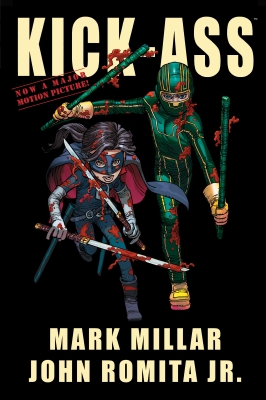
Kick Ass (comics)

Writer: Mark Millar
Artist: John Romita Jr.
Collects: Kick-Ass #1-8

So, Kick-Ass. Another of Mark Millars lovely projects that feel like they were tailor made more for the silver screen than the comic page. Hell, the film adaption of this one was actually in development while the miniseries was running; for a bit there, it looked like the film might have even released before the series finished. Millars public persona may be grating as all holy hell, but it seems to work for him.

Kick-Ass tries to use a very basic concept I'm sure a lot of us have given thought to before. "What if superheroes existed in the real world?" The main character - Dave - is a comic geek with some pretty crappy luck who decides, hey, this life is pretty boring, Imma get a wetsuit and go beat the hell out of a couple of Hispanic guys. Excess foul language and ridiculous amounts of violence ensue.

Right off the bat, we've got a problem. No matter how much he brings up things like Myspace or Youtube, Millar can't get out of his old habits. It doesn't take long - by the end of the second issue, in fact - for the perceived "realism" to vacate the premises. At first, it seems like he's going to stick with it - the consequences of Dave's hubris costs him six months of his life and requires intensive therapy to recover from - but then, fresh off his crutches, Dave suits back up and goes to pick a fight. Only this time, he wins. Right after months of healing and with no training. From there it's all downhill.

Everything is over the top here, from almost every character swearing worse than a sailor - Daves dad is literally the only character not to curse every other word - to little girls no older than ten being badass ninjas who slice people to ribbons. Literally, from the first time we see Hit-Girl, we know that any sense of realism has gone straight out the goddamn window. We're in Millars domain; the comics with the most disgusting, shocking ideas he can think of to try and appeal to the lowest common denominator.

As far as unrealistic goes, I could talk about some of the dialogue - I swear whenever Dave is in a comic shop I think Millar's contracted Whedonitis - but we won't go there.

Worse still, it often seems like there's an undercurrent of racism here. Again, not shocking, given this is Millar, but still a worry. It seems like everyone Kick-Ass fights, from street toughs on down, is a minority of some kind. From hispanics to blacks to italians, everyone offed in the course of this series is of some sort of racial stereotype.

Necessary? No. But it'll sure get some attention.

Mark Millars writing tends to come back to bite him. He is, as we all know, about as subtle as an atom bomb when it comes to pretty much anything. You pretty much know which character is going to be a traitor as soon as you see him and another characters fate is blown thanks to overuse of foreshadowing plus a flashback late in the book so blatant the narration box might as well have screamed "THIS IS CHEKHOVS GUN, PAY ATTENTION".

Then, as I briefly mentioned earlier, there's the lack of adherance to the concept. I expect the violence and the cursing; Millar does it whenever he isn't writing corporate owned superheroes. But as much of a huckster as Millar tends to be, I still expected him to stick to the "vigilantes in the real world" concept, or at least make an honest effort. Sure, superpowers are kept out of it - and Millar even makes some jokes using some superhero cliches - but the book doesn't stick to anything resembling "realistic". Considering that was the line that sold me on reading it at all, that's a legitimate disappointment. I feel like Millar could have made more of an effort, or at least been a little clearer up front.

So, with all those problems, why the hell is this goddamn book so endearing? Why is Hit Girl endearing? Most everything in this book sets off every alarm bell I've got, yet I still somehow enjoyed it. This should be a textbook case of "EWW, EWW, BURN IT, BURN IT!" Yet, despite this undeniable fact, I find myself interested in seeing where Kick-Ass and his pint-sized affront against good taste go from here. There's something crude but oddly likable here, even though our main character is a downright insulting stand-in for a typical comic reader and our breakout characters main feature is that she's a ten year old that kills everything in sight and swears like you read about.

It's fun, in an odd way. It's crude, it's tasteless, it's really ridiculous and it completely fails to uphold it's promise of showing superheroes in the "real world". But it's kind of like a roller coaster ride of gratuitous violence and numerous other negative adjectives as only Mark Millar can provide. I'm not exactly Mark Millars biggest fan - sometimes, I feel like he's a one trick pony - but he's put together enjoyable projects in the past. I think this one fits, even if it's offensive on every conceivable level.

Make no mistake, a lot of why this works despite everything against it is the artwork of John Romita Jr. He seems to revel in the hyperviolence he's tasked to draw, getting pretty gratuitous with some scenes. When someones head is chopped off, you WILL see the actual chopping. Romita's a bit more polarizing an artist than his dad ever was - he seems to have as many detractors as he does fans - but he does good work here, aside from the occasional page that just looks off. Mark Millar's kind of like Jeph Loeb in this way; while it's a crapshoot whether a given project will actually be decently written, he's pretty damn good at attracting top tier talent. In a way, it saves some of his books.

The Score: 6.5 out of 10

This one was kind of hard to grade. On the one hand, I enjoyed it in a goofy, dumb fun kind of way. But on the other hand, this book can piss you off; and really, this is not exactly premium comics. Either way, it may be worth a look, but it warrants a warning. If certain social issues tend to be your red button, skip this. It's practically designed to offend.