Monday, October 10, 2011

X-Men Legacy: Collision (comics)

Writer: Mike Carey
Artist: Clay Mann
Collects: X-Men Legacy #238-241

I'm just going to preface this review by saying that it's kind of nice to actually read a recent X book that was - shock of shocks - fairly enjoyable, even if it's not really remarkable.

This is pretty much Mike Careys book at this point. As I understand it he's been on it for something like six or seven years (jumping on somewhere in the 180's, I think). It's changed focus a few times, initially having Careys pet character Rogue take over the book - at the time leading a motley crew of mutants - then focusing on Professor X and now back to the southern belle. Nobody seems to talk about it, but most everyone seems able to at least enjoy it.

I jumped into this one cold, which I thought was a bad decision at first because it quickly becomes clear we're dealing with old plotlines from way back in Careys run. Shockingly, aside from the fact that I had no clue what the powers of the kids were supposed to be, I managed to get through without much confusion.

To keep a long story short, one of the young mutants Rogue currently mentors is called back to his homeland, which is besieged by electrical storms of some sort. Magneto - currently an X-Man because Cyclops is a raging moron - finds this particularly interesting, so he tags along. Rogue - who has control of her powers now, it seems, after about twenty freaking years of the no touch thing - is sent as a chauffeur. They quickly find themselves neck deep in trouble.

Apparently, the villains, The Children of the Vault, were stopped by Rogue at some point in the past. This apparently lead to the deaths of some of their own. They're not the forgiving sort, it seems, as it seems they would prefer she stop breathing. If you know anything about Rogue at all, you know her response will probably be a few broken jaws.

Carey offers no help to anyone who may just be jumping on - one thing the other X books have actually done right recently are providing quick captions that run down power sets and who a character is when they show up - but despite that he manages to keep things moving*. His Rogue actually feels like a strong woman; able to take care of herself and get the job done herself. Maybe I just haven't been reading the right books, but it feels like it's been a while since she's been that way.

But, to be blunt, there's really nothing else of note here**. It's a fairly competant, enjoyable read in an era where that seems to be in short supply for the X-Men. It's really not something that's going to grab you so much you'll remember fine details years down the road, but in an era where dumping an entire race on a rock that everyone who hates them knows they're on is treated as a smart, logical thing to do, I'll claim victory just for not having to sigh heavily and wonder why I keep trying.

Oddly, I didn't have as much of a problem with Magnetos presence, either. Carey at least keeps Magnetos terrorist past at the fore and Mags even comments on things hes done himself at times. In other words, he's still a collosal dick, which is kind of refreshing instead of "I'm totally a good guy now, really!" I still felt like he was trying a bit too hard to make him cool, however, but that may just be me. Oh, and going by an exchange midway through the book between the two, apparently Magneto suddenly wants to bone Rogue. This felt kind of random - mostly Rogues comment about it - but I'm going to just assume this is something that Carey's been working in prior to this.

Rogue at least says there's nothing between them, but even the idea is kind of an "ick" moment.

As for the art, it gets the job done. Clay Mann turns out pretty clean and detailed work here. It's not going to reinvent the business, but it doesn't need to. Fairly clear storytelling and some eye pleasing work round off the most enjoyable recent X arc that wasn't a one shot.

The Score: 7 out of 10

So hey, this is pretty decent. If you're not particularly happy with the X books these days, this is a pretty safe bet. Aside from a glimpse of Utopia and Cyclops, there's little to do with the then current status quo. I may check out some future volumes, who knows.

*There are bios of the characters, but they're way in the back. This might just be me, but that would have been great info to have before I started the story. An indicator at the front maybe?

** Well, for me anyways. It DOES work on it's own well enough. But it's another one of those books that I imagine would mean a lot more to someone who'd read the other story where Carey created them. But hey, it happens; you can't go into a television show halfway through a season and expect the revelations to have as much weight for you either.

Tuesday, October 4, 2011

X-Men: Second Coming - Revelations (comics)

Writers: Christopher Yost, Peter David and others
Artists: Steve Dillon, Harvey Tolibao and others
Collects: X-Men: Hope, X-Men: Blind Science, X-Men: Hellbound #1-3, X-Factor #204-206

I kind of like companion volumes to crossovers or small scale events. They tend to have everything as far as the tie-ins go. Small scale, remember. Sadly, Marvel frequently disappears so far up it's own ass with events that you can't really read anything from the time period without a tie-in. It's not a huge secret why I don't read much Marvel.

This volume collects the tie-ins for Second Coming, which was the X lines big crossover event that was meant to wrap up a bunch of simmering plotlines. How that whole shebang went, I'll probably get to someday. Word of warning, you're not going to want to read this volume without having read Second Coming itself; it's got a major spoiler or two, though you probably know of them by now anyways.

By the way, what's with that title, huh? Revelations? Trust me, there are no revelations in this. It's just a volume collecting some side dishes to complement the main course. Yeah, yeah, I know, biblical allusion to go along with Second Coming, but it still doesn't fit. Ah well.

I'm going to format this review a bit differently, one I'll probably continue whenever I do a diverse collection like this. Each story will have its own section with my comments on it. It just seems more organized, given the fact that there's about four different stories to discuss.

X-Men: Hope | This one shot feels more like a prequel than a side story, which makes its inclusion a bit awkward. One thing I hate is flipping back and forth between books, so starting this collection with this and then reading Second Coming before the rest of it feels dumb. But then again, where the hell else could they have put it? Whatever, personal preference on my part, I guess. It's a turn-off, though.

It generally serves the purpose of giving some backstory to Cable and Hopes jaunts through time post-Messiah Complex. There was an entire volume of Cable devoted to those adventures, but I didn't read it because Cable is one of those lingering elements of 90's excess I tend to avoid. So it's nice of Marvel to have put out a one shot to give some context for those of us who don't care about Cable.

It's fairly well written and inoffensive, giving a few vignettes to show us Hope at different ages through the time travel shenanigans. It's written by Duane Swierczynski, who I believe wrote the Cable ongoing in question as well, so I imagine this is a lot what that series was like. It's not bad - fairly enjoyable for a one shot that centers around a 90s leftover - so kudos for that. Not enough to make me read a series about Cable; I felt like I got enough context from this anyways.

As for the art, if I have to sit here and tell you why Steve Dillons art is awesome, you've either never seen it, never read "Punisher: Welcome Back Frank" or your taste just sucks.

X-Men: Blind Science | I didn't expect to enjoy this one as much as I did. It centers around Utopias science division, the X-Club, whom I gather rarely do anything that, you know, solves any problems on the floating asteroid the mutant race decided it would be cool to chill on for a while. But who cares, this was a lot of fun; Dr. Nemesis is exactly the kind of prick I like reading.

We pick up with the X-Club in the midst of some major screw-up on their part, ending with them seemingly shot forward in time to one of the X franchises patented post-apocalyptic futures. Seriously, the future always blows with the X-Men around. One of the X-Club is the person who made that cure for mutants way back when and this particular future seems to require it to save everyone. Moral dilemma, engage!

It too is written fairly well, barring a half-assed Hitler comparison two thirds of the way in that's used to counter Dr. Nemesis. The write is Simon Spurrier, who I've never seen before in comics. He does alright, though. Dr. Nemesis is written as a hilarious, smug prick and frankly if that's not his normal characterization I'm going to be very disappointed. The one shot zips along and has the requisite twist - because of course they're not going to just wipe out the mutants - and overall it was a good time. I'd read more of this.

The art's by Paul Davidson. Another name I've never encountered. His work is simple but detailed, though, so feel free to put him on a regular book, Marvel.

X-Men: Hellbound | To me, this one is the meat of the book and I'm not entirely sure how I feel about it. It features Gambit, whom I may have once mentioned is one of my favorite mutants, and early on he actually comes off as fairly intelligent. He's one of the few I've seen in this period of X continuity that isn't buying the line of BS Cyclops is spewing and knows full well putting all the mutants in one place is a good way to send the race straight to extinction.

On the other hand, he's just there to be corrupted by Limbo so the Death personality can come out (that's a can of worms I don't feel like explaining right now). Not to mention it also focuses on some of the New X-Men or New Mutants or whoever they are this week, whom aside from Pixie and maybe Cannonball seem rather lame. Perhaps I'm just not giving them a fair shot. Maybe someday.

Illyana, Colossus' sister, is 'ported to Limbo in the midst of a large scale battle in Second Coming. Rather than be smashed into red paste by her brother, Cyclops makes the decision to send a bunch of third stringers he doesn't care about to fetch her from Limbo. This goes about as well as you'd expect. I mean, how useful is Dazzler going to be against a bunch of demons? Is she going to go all disco on them?

It's also not a shabby story, as far as the writing goes, but it's also fairly inconsequential. There are ties to some previous adventure I didn't read, which means the impact of the main conflict is kind of lost. I don't know where this adventure occured and the issue makes no attempt at all to tell me - can we have the damn editors notes back please? - so I'm just going to assume the whole thing would mean more to someone whose read the backstory. It's still readable, though - and we at least get a good idea of what happened in it through the dialogue, which is good - but overall it feels a bit like filler to give some D list mutants something to do.

The art's by Harvey Tolibao. It's very nice and fitting of the story. He makes a gaffe or two that's rather glaring, however. One page in the first issue is split up into four vertical panels, for instance, but when you look at it, they all form one image. So what was the point of splitting the full page splash into four panels? Couldn't tell you. Then on the next page, it's divided into a series of panels that don't seem to flow very well.

X-Factor #204-206 | This one's kind of unfortunate. This is apparently the only tie-in to an ongoing not involved in Second Coming directly. Now, the purpose of a tie-in, traditionally, is to boost a series readership by tying it into something everyones reading. The best way to do it is a mix of the tie-in elements and ongoing plots to hook the reader into the ongoing past the crossover. This, however, is a fairly contained story that begins and ends; which is great for a miniseries, but not so much for an ongoing, where the tie-in serves a different purpose.

Worse still, I was a little bored; could be my expectations working against me, as X-Factor is one of those books that is constantly praised by the small group of readers it has, so I think I expected more.

The story is pretty standard fare. The baddies from the main storyline try and assassinate the affiliated group and, of course, fail in the end. There isn't much else going on and not many running plots I could pick up on here. The lead cast struck me as fairly alright characters, but I wasn't given much of a hook to care about their fates. It's well written, as I expected, I just didn't find myself overly interested, which is a shame.

The art is by Valentine De Landro. It's pretty spiffy. Minimal lines, great color, pleasing to the eye. It's a shame I didn't find the story as interesting.

The Score: 6.5 out of 10

Everything contained is perfectly servicable fare. There isn't anything outright bad in here, but not much in the way of standouts either. If you're looking for some side dishes to the main course of Second Coming, it does the job nicely.

Sunday, September 11, 2011

Out of the Wheelchair and into the Flames: The Less Than Stellar Reaction to Barbara Gordons Return as Batgirl

You've probably heard of Batgirl before. If you're paying attention at all, you're probably aware that DC is in the midst of a linewide relaunch aimed at solidifying the companies comics into the digital sphere with day and date releases. You probably know Barbara Gordon is back as Batgirl, as well.

If you know all of that, you must know about the less than stellar reaction in some areas of fandom.

There are a lot of reasons why. One being the fact that Oracle's been a positive portrayal of disability in a medium sorely lacking in them for over twenty years now. Stephanie Browns dismissal as Batgirl is another that has some folks annoyed. They're all valid. But how often is a rational argument for the other side really given? So that's what I'm here to give, along with some perspective, if I can.

As you can guess, I'm actually okay with the return of Babs as Batgirl. I have my own reasons and I understand DC's. A fair amount of folks, predictably, are upset at the loss of Stephanie Brown as Batgirl; somewhat hypocritical, I might add, if you're at all aware of the sheer outrage that followed her original announcement as Batgirl. Of course, there's also the reality that the comic sold like shit despite massive amounts of critical acclaim, but that's always glossed over in situations like this. No one really wants to hear the "recognizability" argument, of course, but that's just what the company is going for by returning the "iconic" version. It's a bit different for me.

Am I the only one who was just completely bored with the Oracle identity? It's been around for twenty years and frankly, it got to the point where she was just there. I can't think of a lot of what was done with her outside of Birds of Prey and her being the "handler" for Steph Browns time as Batgirl. She was a strong handicapped character, but after twenty years, I honestly felt like the whole deal was well and truly spent.

Compared to Oracle, how many good, definitive stories do we have of Barbara Gordon as Batgirl? Three, max; and one of them, fun as it was, caused a bit of stir. Most of her time in the cowl is from the Silver Age, which was... well, a different time; and by different I mean she put on makeup in the midst of a fight, which is not exactly the definition of a positive portrayal of a female hero.

For all the talk of how it's "regressing" to have her go back, I never really got to experience Babs as Batgirl much in the comics. You may recall that on the scant occasions I did, I had a blast. I think this was compounded by my boredom with Oracle, which is the main role I've seen her in for as long as I've been reading. Now, part of this is on DC, as they could always put out more stories of Babs as Batgirl in the past. But then, they couldn't really ever show us the ongoing adventures.

Not to mention the stories set in the past always have those little allusions to her legs and future handicap when the writers feel like being cute. I hate that so much I could spew acid; I sit there thinking "ha ha, real funny writer, you're so clever with your allusion to The Killing Joke, I'm in awe". It kind of devalues her time as Batgirl, as it's though the injury is now her entire character and even her damn past now revolves around the fact that it's in her future. It's as though being Batgirl wasn't as important as being Oracle; and while there's definitely a case to be made that she became more important as an positive role model after the injury, it shouldn't necessarily devalue her previous role.

Then comes the reality that Oracle became a tool for storytellers not named Gail Simone and not much else. An easy one to use at that; for several years ninety percent of her appearances outside of Birds of Prey consisted of her being used as an info dump disguised as a character. She was a tool to point the hero in the right direction at a given time or explain a backstory with ease. It's not bad to have an information broker - and it can be made interesting - but she was used as a shortcut.

It kind of needed to stop. Remember how often Batman used her for info or direction on a case? Batman, the Worlds Greatest Detective. Instead of us seeing him do some, you know, detecting, some writers would use the shortcut. Even the Bat offices realized it, since they cut Batman off from her and the line in Under the Hood about how the Bat family had "come to rely on her too much".

Despite that, I feel kind of bad to have this opinion. I feel for the handicapped readers who are rather crushed by the loss of Oracle. The number of characters to take her place is a low one. I've read quite a few blogs or articles on the whole thing and it kind of makes me feel bad for them. At the same time, don't most characters mean something to somebody? Is that a reason to keep them locked in one position? Or is it a bit too much like those readers who want a regression to the Silver Age iterations for their own personal reasons? That's not an easy question to answer.

But what's done is done. There are good arguments to be made on both sides. It's tough to say any stance - such as my own - is better than the others. Ultimately, we'll have to see where it goes; Gail Simone's about as good a choice for this as anyone. How many years has she handled Barbara Gordon?

Hopefully it pans out, because man, how freaking embarrassing would it be for DC to cave and have Babs re-crippled in some contrived way? That's Professor X's gig over at Marvel; and as much as I like that character, that shit was ridiculous. Just stick with one already.

Tuesday, September 6, 2011

Thor: The Trials of Loki (comics)

Writer: Roberto Aguirre-Sacasa
Artist: Sebastian Fiumara
Collects: Loki #1-4

It's always kind of funny when a character centric miniseries - like the Loki miniseries this collects - has the trade branded with the franchise they come from. It's mostly Marvel that does this; anyone remember the completely redundant name that was "Hulk: Skaar - Son of Hulk"? Now this. How many people out there don't already know Loki is a Thor villain? Hell, who couldn't get that just from the back covers description?

DC doesn't do it - Luthor and Joker kept their names - so why Marvel does it is kind of beyond me.

Anyways, there's that old saying about how a hero is only as good as his villains. I'd argue it's not a hundred percent accurate - take Batman, who works in whatever the hell you put him in regardless of who he's fighting - but for the most part it's true. Lets face it, the villains are just damn interesting; and if they're particularly well written you'll like them anyways despite their deeds.

Loki can be like this, depending on who's writing him. This tale in particular plays up his ambiguity. It's part origin story, part "the world through Lokis eyes". We see the events that lead to his destiny; to bring about Ragnarok and the fall of the gods.

His version of events, anyways.

Everyone is the hero of their own story and Loki is no exception. Thor confronts him in his hiding place, demanding answers for the actions prior to where we start. So Loki tells the story as only he can. He's cast in a sympathetic light, to say the least; his tale is one of jealousy and inadequacy, a lesser among gods. All of his actions in this tale are born from this jealousy; of his half brother Thor, of the love and attention Thor receives, his bond with Sif and more. In a way, his plight and actions become a bit more understandable, though not excusable. You can see how he got there.

Ahh, but there's an unspoken reality in that we're never quite sure just how much of his tale is true.

Loki is, if you're somehow unaware, a trickster god. He deals in lies, deceit and mayhem. It's in his nature. As such, even as we're reading there's a doubt. What parts of the tale are lies? What parts are fact? Is any of it true? Or is the trick that this time, he really is telling the truth, but his very nature leads us to wonder otherwise?

We don't know. Not even Thor knows. He even muses to himself that he's not a hundred percent sure of the details, even those that revolve around him. He is, of course, an immortal god. Time tends to swallow memories, leaving details to fade. In this respect, the very nature of the character is a strength for this story.

You know what else is a strength? The bitchin' art. It's absolutely perfect, especially for the heavy fantasy vibe something like Thor needs. From dragons to rainbow bridges to nine realms. Sebastian Flumara beautifully illustrates them all. It's only amplified by the bright, bold coloring.

Honestly, I can't even think of anything negative to say about this comic. The only thing really keeping it from going higher is perhaps as simple at not quite pushing the envelope like some classics might. But that's just a matter of opinion on my part; I still cannot say enough kind words about this trade. I was engrossed and enjoyed it a great deal.

The Score: 9 out of 10

This is a book that, honestly, has very few flaws. Offhand, I really cannot think of one. It's a great comic, one that can easily be read no matter your knowledge of Thor. It provides all the basic information you need while providing a great story that does not bond itself to any specific time period. It's as easily accessible as they come and well worth picking up, in my opinion.

Sunday, August 21, 2011

Sonic Retrospective: The Classic Era Spinoffs

Continuing my retrospective of the Blue Blur and his games, this time we're venturing into spinoff territory.

Like Mario, Sonic has had plenty of spinoffs. Make no mistake, back when I was a kid and Sonic was red hot, I salivated for more of my favorite blue hedgehog. That's, of course, what they were counting on, because what's better than a kid wanting more of your franchise - regardless of quality - and getting the parents - who don't know any better and just want to make the kid happy - picking it up?

Luckily, it was hardly all bad in the classic era. He had some clunkers, for sure, but I often got enjoyment out of them. Make no mistake, however; the track record in the spinoff department was hardly as sterling as the core titles.

For the purposes of this one, I'm counting all the spinoffs straight up to 1999. As you're probably aware, the classic series essentially ended in 1994 with the release of Sonic & Knuckles. For one reason or another - like the dissolution of STI or the storied train wreck that was Sonic Xtremes development - a core Sonic title did not see release between 1994 and 1999. Segas mascot all but didn't show up for one console generation. For five years, spinoffs were all we had of Sonic. The Dreamcast/PS2 Era is where the core titles pick up next.

Knuckles Chaotix
Console: Sega 32X
Release Date: March, 1995

Ahh, Knuckles Chaotix. Doomed to be the "lost" Sonic game, this is probably the one game in the franchise that almost no one has played. The blame for that, of course, can be laid on the 32X; Sega was kind of desperate to extend the life of the Genesis in those days and while the Sega CD could be called a mild success - it did, of course, have several classic releases - the 32X was a bomb that could only be surpassed by Nintendos Virtual Boy. As such, only the four people who actually owned a 32X have played this one; even with emulation being prevalent, your average jamoke hasn't played it.

Hell, I didn't even play the game until just recently for the purposes of this.

Did we miss anything by the game falling into obscurity? Well, it's no classic; this game is really a case of a lot of potential getting lost amidst bad choices. I think the thing that really sunk this game was the level layouts. There are only about five "zones" with five acts each; the problem is, it's very, very difficult to tell if anything has really changed between the acts. The reason? They're barren; there just aren't enough enemies or interesting gimmicks as it is. It all feels half finished. As such, what follows is a boring, lifeless romp through barren levels without a whole lot to do.

This is unfortunate, because in a way, this game is a bit of a spiritual sequel to Sonic CD. Take a look at the production credits sometime and you're going to see some familiar names. The graphics are similarly lush, the music is nice and the new characters are colorful. This isn't even mentioning that this was the first real return of Metal Sonic (and Amy, though she only shows up in the sound test and it took years for anyone to find it). This could have been so much more and who knows, perhaps if the game director hadn't been different...

The games main mechanic - the elastic band - is a love it or hate it affair. Personally, I think it had potential and was fun to fool around with. It doesn't necessarily allow you the same freedom of movement the classics did - since you're effectively tethered to another character - but once you get the hang of it it allows for some cool tricks that could have made for some interesting secrets or the like if incorporated properly.

In all, it's a big missed opportunity. But it is worth at least one playthrough. It's not a game you're likely to ever go back to, however. Some botches in how the game was put together essentially robs it of the staying power the classics have.

The Score: 6.5 out of 10

Sonic Spinball
Console: Sega Genesis
Release Date: November 23rd, 1993

Not every spinoff will make a lot of sense, but this one was right on the money. Sonic already felt kind of like a pinball at times, right? Hell, we all love Casino Night as well, which had heavy use of pinball flippers. Seems like a match made in heaven.

Well, we know how often things turn out to be as they seem, but it still worked out pretty well.

This game is pretty much pinball jacked up after hitting the weights. It doesn't completely conform to the single table structure of regular pinball - except in between level minigames - and what results are sprawling levels of pinball goodness. There are usually about four or five sections in a level that are set up like your "tables", with different layouts and gimmicks, with your job being to collect the emeralds scattered around the level to open the boss section at the top.

If there's a downside to the game, it's that it's very short. There are only four full levels in the game, which is a disappointment, as more would have been very nice. It's also not exactly a game for anyone who doesn't care for pinball. Oh, and for some moronic reason they decided it would be a slammin' idea to base this game on the cartoons - you can rescue some of the Archie cast in one of the minigames - which did one more time before thankfully never doing it again.

The game has kind of a "love it or hate it" relationship amongst the fanbase. I'm one of the guys who really likes it. But I really love pinball and have always been a Sonic fanatic, so I suppose I was right in the target range for this one.

The Score: 7 out of 10

Sonic 3D Blast
Console: Sega Genesis, Sega Saturn
Release Date: November 30th, 1996

Look kids! It's Sonic! In crappy isometric 3D! Doesn't this make you just want to run out to the store and grab a copy?

... What do you mean "no"?

Boy, was this one a misstep. It's kind of shocking that this made it past the idea stage, much less into a full, completed game. Now, I don't have the hatred for this one that a lot of other people do - hell, I still load it up from time to time and have a decent enough time - but objectively this was just not a good idea.

You can see where the logic came into play. In '96, 3D models and gameplay was just starting to become the "hip" thing in 90's gaming - while 2D side scrolling was, sadly, beginning to be seen as old hat - and that blasted Sonic Xtreme game was taking forever, so why not do an isometic based 3D game in the meantime? It might have made sales sense, but Sonic gameplay was clearly not built for 3/4ths isometric and this game proved it with awkwardness to spare.

Its main problem is that it just controlled awkwardly. Given how 3/4ths isometric view works, you're above the playing field and viewing it from an angle instead of head on. Which means all paths are at a diagonal angle. I'm having a hard time describing this, but if you look at the screenshot, you can probably guess how this works and why it's a problem.

Hitting cracks in the wall with the spindash proves to be troublesome unless you're at the right angle. Hitting enemies can be something of a hassle until you get used to it. Hell, the second level's spinner gimmick is going to give you trouble, because the view makes it hard to aim yourself down a path without bouncing off the walls like a pinball and into a hazard.

Once you get used to it, it's not all bad. Maybe a bit of my nostalgia affects how I view the game. But then, that doesn't explain why I can still play through the game and not hate myself afterwards. It's not objectively good, though.

Oh, they also released this one on the Sega Saturn as well. The whole long, unbelievable saga of Sonic Xtreme ended with the game being canned outright, which left the Saturn without an appearance from the companies mascot other than in a racing game. Obviously, not having a core Sonic title was going to be - and, as expected, was - a major blow to the console, so they figured it was better to have something than nothing. Cue upgraded port. It had better graphics and better music, but played the same.

Sometimes I wonder if the Saturn would have fared better if Sonic hadn't missed the party entirely, but not only is that neither here nor there but the console was kind of doomed anyways.

The Score: 6 out of 10

Dr. Robotniks Mean Bean Machine
Console: Sega Genesis
Release Date: December, 1993

Well here's the second - and thankfully last - Sonic title based on one of the cartoons. This one was based on Adventures of Sonic the Hedgehog, which was the 'toon of the original too that didn't try and take itself seriously. It can be debated which was better - frankly, SatAM aged poorly, while the slapstick AoStH tends to fare better since it's not trying to be taken seriously - but it'd not worth getting into.

What we have here is basically a puzzle game. It's a Puyo Puyo game - the first one to actually make it over here - with a coat of Sonic paint applied. Oddly, Sonic doesn't even appear in this game, but I suppose that's why he didn't get billing in the title.

It's essentially a competitive puzzle game. You have to get four beans linked up to clear them and setting up combos - where when you clear one, beans above drop into place and become another clear - will detrimentally effect your opponent by dropping rocks on their stack, messing up anything they're trying to set up. Like Tetris, if you go past the top of your play area, you've lost.

It's fun, but there's little to be said about it. There's just not much to it. You go through a dozen or so rounds - matched up against characters from the cartoon with different strategies and difficulty for each - whup Robotnik and boom, done. It's fun for what it is, but nothing to write home about.

The Score: 7 out of 10

Sonic R
Console: Sega Saturn
Release Date: October 27th, 1997

Ahh, another example of the spinoff that's fun enough, but too damn short for it's own good. Due to the chaos of Sega and the behind the scenes workings of Sonic development between S&K and Sonic Adventure, this was the only Sonic game the Saturn had specifically made for it. Aside from a spinoff, Sonic skipped a whole console generation. Even Nintendo knows better than to let more than a year or two pass into a consoles life cycle before a core Mario title releases.

Prior to Sonic and Sega All Star Racing, this was the only real racing title Sonic had ever been in; which is odd, because like Spinball, this is another one of those no brainers. I mean, hello, Sonic is fast, so, racing spinoff perhaps?

It controls well enough, the music is catchy - even if I don't get how they figured J-Pop was good racing music - and the tracks are pretty open, with several shortcuts, secrets and things to collect. There are also numerous unlockable characters, including mech versions of most of the characters. You can even race as Super Sonic when you get all the emeralds.

There's just one problem; there is NOWHERE near enough content.

There are four tracks. Five if you count the unlockable stage you get by finishing first in every one of the initial four. Sure, they're pretty expansive and rather open for racing games of the time, but that's a paltry amount any way you slice it. Especially for a full priced game. Come on now, Sega.

It is fun, though, so it's not like it's a complete loss, but you'll have unlocked everything and run out of things to see way too soon.

The Score: 7 out of 10

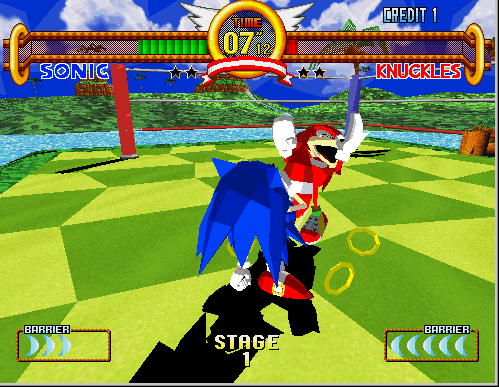
Sonic the Fighters
Console: Arcade Machine, Gamecube
Release Date: July 1996

Wow. Uhh... what to say about this one? Other than the fact that it's not that good.

Sonic's one of those versatile characters that you can use in a lot of genres, so it's not that he's in a fighting game. Brawl even made it work rather well. It just comes down to the fact that this game was pretty poorly made; it's only good point is the fact that we got to play as characters, mainly Amy and Nack the Weasel, that, at the time, we hadn't seen in years.

Seriously, the graphics blow, even for the era - it's sub-Virtua Fighters level graphics - the music isn't memorable, the arenas themselves are just there. Even the actual fighting is borked. It could have worked, but this was certainly not the era to have been trying it, judging by the results. They should have just put Sonic and Tails in Fighting Vipers as the original idea went instead of this.

But it's no big deal, because prior to Sonic Gems Collection almost no one had heard of - much less seen or played - it, given its very, very limited release. It probably should have stayed buried, though. How this made it on the Gems Collection but Knuckles Chaotix was left off, I haven't the foggiest.

The Score: 5 out of 10


So that's the Classic Era spinoffs done. The Main Game Gear titles will be next on the list. Don't miss it!

Wednesday, August 10, 2011

Superman: The Coming of Atlas (comics)

Writers: James Robinson, Jack Kirby
Artists: Renato Guedes, Jack Kirby
Collects: Superman #677-680, First Issue Special #1

I didn't really expect a lot from this story. James Robinson seems to be one of those polarizing names these days and you don't really hear anyone excited about his work anymore, at least you didn't prior to the announcement of the Shade miniseries. This story had some mixed reactions, probably with more negative than positive. I managed to get some enjoyment out of it, so in my personal opinion I'd say it's not terrible.

Make no mistake, this story has problems. Robinsons purple prose is in full effect here, completely outclassing Face the Face in that regard. I'm not exactly sure Robinson has a handle on Superman either. At times, he just doesn't sound like big blue; more than a few lines sound unnatural coming from him. The opening sequence in space with Hal - and the remarks about former Green Lantern Jade - make me wonder if Robinson forgot he was supposed to be writing Superman here. Actually, if we're being honest, almost everyones dialogue is clunky.

Then there are moments in the book where plot elements are brought in, amount to little and then peter out. The shadowy general? No clue who he is, who he's working for and how he really pertains to the plot. Supergirl shows up, is dropped in two pages, is asked to find the truth, then leaves? We don't see her again, so what does she do and what was the purpose of using her? Robinson was around on the Superman books for a while, so I assume some of it's set-up for the future - at the least, I know for a fact that the General will show up later - but the manner in which these seeds are sown is clunky at best.

One other thing worth noting, for good and ill, is that this ends up being a fight comic. It's four issues of action with Atlas portrayed as a real threat to the Man of Steel on a level he hasn't seen since Doomsday. Conceptually, that's pretty okay; it seems like we never really see Superman have a knock-down drag-out with someone, since few are on his power level. Still, it's four issues of action when it could have been less; hell, over a dozen pages are spent on the Metropolis Science Team fighting Atlas who, once they're dispatched, don't show up again or factor in to the plot*.

Now, looking at what I've said thus far, you may be thinking, "then how is it that the bad rap isn't entirely deserved?" To tell the truth... I kind of liked reading this. I cannot explain with a hundred percent certainty why - again, this book reads awkwardly and some choices are questionable - but I actually had a smile on my face a couple of times.

Could this be, in some respect, because of Krypto the Superdog? I cop to being a total Krypto mark**, in part because I've always been a big animal lover in reality. Robinson writes Kryptos thoughts in a way I can sort of see a dog thinking, if he thought in english. It doesn't bother me much, but when you think on it, it's almost amazing how often animals are written with thoughts in the fluent English you might expect from a human. It's nice to see the occasions a writer doesn't go that route.

On top of which, it's always awesome to see Krypto defend his master; anybody will tell you that screwing with the owner of any given dog is a terrible plan, so you can imagine what happens when the Man of Steels kryptonian dog decides he's going to tear out your neck muscle because you just knocked his owner through a building.

Hell, maybe it's the fact that Robinson decided he was going to use an old Jack Kirby concept. Why the hell not, right? Not sure kinda-sorta villain was what Kirby was going for back then, but it's a character that seems to suit Robinsons writing tendencies better.

So, in all, it's kind of a conflict. There are several problems - though admittedly, a few may just be plot threads being dropped for the future, time will tell on that - but I still enjoyed it. How the hell do you grade something like that? Does it mean Robinson's just rusty? I don't know.

Included as back matter if the First Issue Special where Jack Kirby created Atlas. It's... well, it's certainly a Jack Kirby comic. Can you really go wrong with that? Still, it's there for no other reason than to pad this volume out, since this was the only story Robinson got to do with Superman before New Krypton dropped.

There's another problem. The suggested price is twenty dollars for the hardcover. For four issues and a reprint. This is a THIN ASS VOLUME. The covers are thicker than the contents. Obviously, this isn't DC's fault; Marvel does crap like this on purpose, but DC didn't have a choice here, since Robinson barely got four issues out before New Krypton took over. Still, it must be noted.

The Score: 5.5 out of 10

In good conscience, I can't give this a good grade. It's not, however, trash. I'm having a hard time figuring out the circumstances that would determine whether a given person would find some enjoyment here. It's pretty much a crapshoot. May be worth a read, though I'd say you should see if your local library has it if you're interested. Hopefully Robinsons work gets better***.

* On the other hand, I'm grateful Robinson went this route rather than jobbing a couple other superheroes to make Atlas look like a threat. It still went on a bit too long - and we spent an odd amount of time in the heads of characters that don't amount to much - but credit where it's due.

** Shut up! Don't you judge me! Krypto's the best Superman support character no one uses.

*** Yeah, yeah. I know he wrote Cry for Justice. But he's got several things he did in the past that are regarded as classics. His track record evens out enough for me to give him the benefit of the doubt.

Friday, August 5, 2011

Siege: Dark Avengers (comics)

Writer: Brian Michael Bendis
Artist: Mike Deodato, Chris Bachalo
Collects: Dark Avengers #13-16, Dark Avengers Annual #1

I am not a fan of the Sentry. At all. Actually, it would be more accurate to say that I'm not a fan of Superman analogues in general, unless they're particularly well done. But the Sentry in general grates on my last nerve for multiple reasons.

Why is this relevant? Because this collection essentially focuses on The Sentry more than it does the titular team of "Dark Avengers".

Before the main Siege tie-in, we have the Bendis penned annual. In this, we catch up with Marvel Boy, whom Bendis sets up for the future, digging into his thoughts and his worries. It's illustrated by Chris Bachalo.

In general, I really enjoyed it. I'm not sure how accurate it is to whatever the character was like before Bendis used him, but he's likable here and to me that's what matters. Overall, aside from the tangential tie of what Marvel Boy was doing after he bolted from Osborns team, it doesn't have a lot to do with that book or the rest of the volumes contents. It doesn't matter, though, because it's a well written, enjoyable one-off, which is what more annuals should be.

Then there's the main arc, which focuses on the aforementioned Sentry. The character sucks, frankly. It's one thing when you look at his original purpose in his original miniseries. The problems started when he was brought into the regular Marvel Universe proper. There are a lot of reasons he sucks, but the big thing is that he's so powerful - the power of a million exploding suns or something - he not only doesn't really fit into Marvel all that well, but he presents a lot of problems for a narrative.

Some of Marvels biggest stories involved some big threats the heroes - essentially the underdogs - had to outwit and overcome. The Sentry presents a problem in that he's so friggin powerful a major event or the like either boils down to him swooping in to save the day or him having a really bad day and deciding to stay in his room. His insanity is typically used as a crutch to solve the dilemma of his power - oh my god I'm so powerful should I get involved in this fight oh no the Void waaaaah - which is a necessary measure to preserve some measure of suspense and in short, the character becomes very annoying very fast.

This tie-in and Siege in general end up being sort of a last hurrah for The Sentry, so Bendis takes the oppourtunity to dick around with some things and pull the trigger on Sentry losing his mind. The result is easily the most interesting story Sentry's been in for a while. Actually, barring the original miniseries and Age of the Sentry, it's probably the only interesting story he's ever been in.

Bendis sets up Sentry for his fall by essentially twisting what we know about him. Think "everything you know is wrong", only with a dude with the power of a god. Through his wife, we find that The Sentry was never really the paragon of virtue we thought he was. In fact, he started out nothing more than a thief and a junkie who got lucky when he was looking for a fix. Or was it really luck? The formula that made him the Sentry came with its downsides and lurking beneath the shiny surface lay a bunch of lies and deceit.

Is it the most interesting read this year? Not really. But it's more interesting than the typical Sentry centerpiece.

It's all essentially a lead-in to Siege, setting up the big moment near the end of that event. In that way, it adds a measure of depth to the event. Sure, it's not really required - given the characters history, it's no surprise when he loses his nut in Siege whether you've read this or not - but it gives you more of the hows and the whys of it all. So, in all, it stands as a pretty effective tie-in, enhancing the event without being necessary to understand it. Mark Millar - who penned Civil War - could take a few notes.

The last issue of Dark Avengers stands as an epilogue, not just for Dark Avengers and Siege, but for Dark Reign as a whole. Obviously, the heroes won the day - because geez, what else was going to happen? - so this wraps up Osborns reign and sets up the next step. Some expected things happen, a few aren't quite so obvious. Here we see Steve Rogers - who's to follow Osborn as the seemingly omnipresent man in charge as Osborn did to Stark before him - beginning his moves to bring things back.

Osborn, for his part, tries to justify everything to himself and tries to justify his vendetta against the heroes. We see the Green Goblin - or, to be literal, himself - to be his greatest enemy, fumbling everything he worked to achieve. Does he have a point or two buried in his madness? Maybe. But he's still the guy who dresses up in a goblin suit and throws pumpkin bombs at people. The fact that he was put in power to start with makes the people in charge look moronic.

The actual Dark Avengers issues are pencilled by Deadato. Do I need to tell you how good he is? His work is realistic, maybe even a bit darker and grimier. Look, I'm no art critic. But I know good work when I see it. Deadato's style definitely suits this story, one that wipes away the shiny finish and the pain on the Sentry to reveal the rust and rot below. All I can say is that when you go to read this book, you can rest assured it's going to look pretty. Just the names Chris Bachalo and Mike Deadato will tell you that much.

The Score: 7.5 out of 10

It's no slam dunk, must read comic book. It is what it is; a tie-in to a Marvel event. But it's still a pretty respectable one, especially considering the focus is the Sentry. I've read better tie-ins, but I've read worse ones as well. I'd say this is one of the few tie-ins worth your time if you decided you just got to have some supplemental material for Siege. It actually adds a thing or two to the proceedings.