Sunday, January 6, 2013

Wolverine and the X-Men Vol. 1 (comic)

Writer: Jason Aaron
Artists: Chris Bachalo, Nick Bradshaw
Collects: Wolverine and the X-Men #1-4

You'll recall in my review of Schism that I named this the book I was looking forward to the most out of anything. Funnily enough, I ended up reading the Uncanny X-Men relaunch first. I didn't review it - I've yet to decide if I want to - and in case I don't bother the short version is Cyclops and his not-so-merry band of X-Men continue to be stuck too far up their own asses. This comic is the exact opposite; it's funny, visually interesting, packed with great characters and never dull.

It's the X-Men book I've been waiting a long time for.

The setup will be familiar to almost anyone; we're back on the school grounds again, arguably where the X-Men belong. Schism surprisingly plays more of a role here than it did in Uncanny. The Kid Helfire Club - who you'll recall orchestrated everything that happened in Schism - decide it would be pretty funny if Logans new school blew up on the first day. So they blow it up on the day the board of education is visiting the school to evaluate. Hilarity ensues. Also Krakoa is involved. This all takes place in the first three issues, I remind you. The fourth issue is a standalone bridging our introductory arc and what comes next.

At first I felt Jason Aaron got the raw deal out of the split, with most of the power players sticking with boring Scott and his sinking island, but as it turns out he got the better end of the bargain. His eclectic group of mutants immediately proves themselves an engaging group, even as it becomes clear they're way out of their depth. The new kids are endearing and the old favorites are just as great. Everything simply works right from the first issue.

You can probably imagine my delight when I found out Chris Bachalo was on art duties. Turns out, he manages three issues before we need a fill in. But they are three stylish, visually striking issues. His exagerrated, animated style works perfect for a book like this; there are a couple of panels that aren't entirely clear in their storytelling, but they end up being minor issues in an otherwise beautiful book. Nick Bradshaw is also a strong artist in his own right and if he's the guy they have in mind for trading off art duties with Bachalo I'll have no complaints.

But there's just one other problem that has nothing to do with the contents themselves. The issue count. They want fifteen dollars SRP for four issues. This is quickly becoming standard at Marvel and it's starting to work on my last nerve. Once in a while is fine, but deliberately splitting stories or putting in a low issue count just to get more money out of the consumer is just low. I'm even more annoyed this time, because this is a series I'm buying rather than borrowing from the library.

The Score: 9 out of 10

If you are an X-Men fan and you don't like this book, I can only conclude that you either hate fun or are one of those odd souls that prefer King Cyclops and his team of villains.

Tuesday, December 11, 2012

Tales From Space: Mutant Blobs Attack (game)

Platform: PS Vita
Developer: Drinkbox Studios
Genre: 2D Platformer
Release Date: February 21st, 2012

For all the talk of the trouble the PS Vita is in - it does have a surprising lack of games for a system two months removed from a full year on the market - it does have several titles of a pretty high quality. Some are pretty faithful ports, which is astonishing in itself for a handheld, but of the native games it has thus far, Mutant Blobs Attack is probably one of the most fun.

You are a mutant blob who escapes from a science lab. Having been experimented on, you're understandably a little pissed. So it's time to absorb whatever junk you find lying around until you can get some revenge on those pesky humans.

Mutant Blobs Attack is a pretty standard platformer, but it's a well designed one. You're never at a loss for what to do or where to go, while traps and obstacles are quite clever. At times, the Vitas touch screen functionality comes into play, allowing you to magnetically move platforms and reverse the direction of certain traps. Even the collectibles - your other mutant blob buddies - are hidden in intelligent ways; some of the later ones take a bit of thinking to find while others require you to keep a sharp eye open.

Also included are a handful of levels taking advantage of the Vitas motion sensors, serving as bonus levels to add some variety. These are entertaining as well, allowing you to tilt the system to control your blob. A minor, unfortunate nitpick is the fact that this requires you to start with your Vita held flat, but it's hardly a major issue.

Style is the word with MBA. Everything is colorful and every level is packed with chuckle worthy jokes or homages to things long past. One of the "Tilt-a-Blob" levels was done in black and white with a pretty familiar border, paying simultaneous homage to black and white horror films and the original Game Boy. While the jokes aren't liable to make you laugh out loud, it's enough to make you smile and set a lighthearted tone that kind of obscures the fact that you're basically destroying the human race.

The game has about six chapters with three to six levels a piece, so it's a pretty respectable length for the money. Stages are long enough to keep your interest but short enough to get one in if you have five minutes to spare. In all, it's got quote a bit to offer for a downloadable title. It's well worth the price, especially if you're a PS+ subscriber where it has been offered for free.

The Score: 9 out of 10

If you love platformers, give this a download. It's a wonderful little 2D side scroller that deserves a spot on your Vitas memory card.

Wednesday, November 28, 2012

Spider-Man: Spider-Island (comic)

Writers: Dan Slott, Rick Remender
Artist: Humberto Ramos, Stefano Caselli and Tom Fowler
Collects: Amazing Spider-Man #666-673, Amazing Spider-Man: Infested, Spider Island: Deadly Foes, Venom #6-9

You may have guessed by the lack of reviews over the past couple years, but I fell off the Spidey bandwagon a while back. It's not for utterly boring reasons like "oh my god I'm so mad Peter and MJ aren't together anymore", as you may recall that I was pleased with that development. It's not really an issue of quality either, though I have some issues I'll get to in a minute. No, there are a few reasons, but the biggest one is a pretty simple one; I just plain could not keep up with the Spider-Man release schedule.

It started with Brand New Day, where Amazing went thrice-monthly. I loved the first few volumes, warts and all. But the trade release schedule was just as hectic; seemed like a volume was releasing every other month thanks to the accelerated schedule of the floppy and Spider-Man was about mid-way on my list of purchase priorities. It was sort of inevitable that I was going to fall behind. It got to a point where I was so far behind I just gave up and figured I'd get back to it later. I didn't.

Spider-Island seemed enough of a self contained thing that I could pick it up and go from there. The premise is just ridiculous enough to scream "fun" at me in big bold letters. Basically, everyone in Manhattan suddenly has all of Spidey's powers, with none of his morals or - cliche as it is to say it - responsibility. Clearly, this is not going to end well.

Oh, also, Jackal's involved, which nearly caused me to drop the book on page one - to paraphrase Mary Jane in this story, "If we're doing the clone thing again I'm leaving" - but thankfully there's only a bit of his usual shenanigans.

If you want to look at the big picture, it's easy to see the reason for this story. By giving everyone his powers and thus making him one in a crowd, Slott can highlight what it is that actually makes Peter Parker stick out. A good trick to be sure. DC had a similar idea not that long ago; the entire New Krypton saga existed for many of the same reasons, though how much success they had with that one depends on who you ask*.

Spider-Island is far from the most cerebral read going, but there's something to be said for some dumb superhero fun mixed with your typical Spider-Man soap operatics. It also has the good sense not to overstay its welcome; think about how many past big Spider-Man stories seemed to never end. Overall, we get a decent portrait of what makes Peter Spidey, along with some choice developments to the ongoing narrative.

But then there's the other half of the coin. I actually read the first volume of Big Time a while ago in an attempt to get back on the Spider-Man bandwagon. Apparently, I didn't review it - a quick check of the Spider-Man tag seems to indicate as much - but there was one impression that stuck with me. I just flat out hated the artwork.

To my disappointment, the artist Marvel chose to accompany Slott on the Big Time venture was Humberto Ramos. He's still around for the main storyline of Spider-Island. I am not a fan of his work for numerous reasons, many of which can be seen in this book. The anatomy is always off, limbs are bigger than they should be, judicious use of impossible poses abound (at least one panel has Carlie swinging while she's bent so far back I'd expect to see a "snap" SFX somewhere near her midsection) and everything looks vaguely ugly.

Being harsh is not my intent. His style does have its fans. I simply do not see it. I have a similar problem with Kelley Jones; at some point, I just can't chalk things that bug me up to "it's just his style" anymore. I don't begrudge the man work and have nothing against him. His art is just a major turnoff for me. I try, but I can't look past the Popeye proportions. It's part of why I didn't stick with the book after reading the first Big Time trade.

Also included here are four issues of the Venom ongoing. A while back I actually wondered where the hell #6-9 ended up and this seems to answer that question. The first couple can stand apart from the main story well enough, initially making me wonder why they didn't have their own volume, but by the end I understood; the events of #8 are very important and lead right into the next issue of Spider-Island, making them inseperable. Clearly Marvel hates me.

All four issues are very good - and frankly, I'd rather Tom Fowler or Stefano Caselli had handled art duties for Spider-Island proper - with numerous developments building off the first volume of Venom. This is a joy and a curse; these issues are important to the ongoing events of the Venom series, yet are tied so strongly to Spider-Island they can't really stand alone. As such, this is likely to be the only place you're going to find these issues in trade. Dammit.

The Score: 7.5 out of 10

I'd score this higher, but the art really hurts it for me. If you can deal with Humberto Ramos artwork - or are a fan of his - bump this up half a point higher. It's far from an instant classic, but it's fun and it's memorable.

* Some people think it was an interesting experiment, but most were sick of it and it seems largely forgotten now. It certainly didn't help that Geoff Johns run on Action Comics was cut short at the time for reasons I can't recall. He essentially set the whole thing up and had to bail, leaving New Krypton to others. The whole saga seems to be regarded as a failure and I'd say losing its architect before the plot gained momentum had a large part in that.

Monday, November 26, 2012

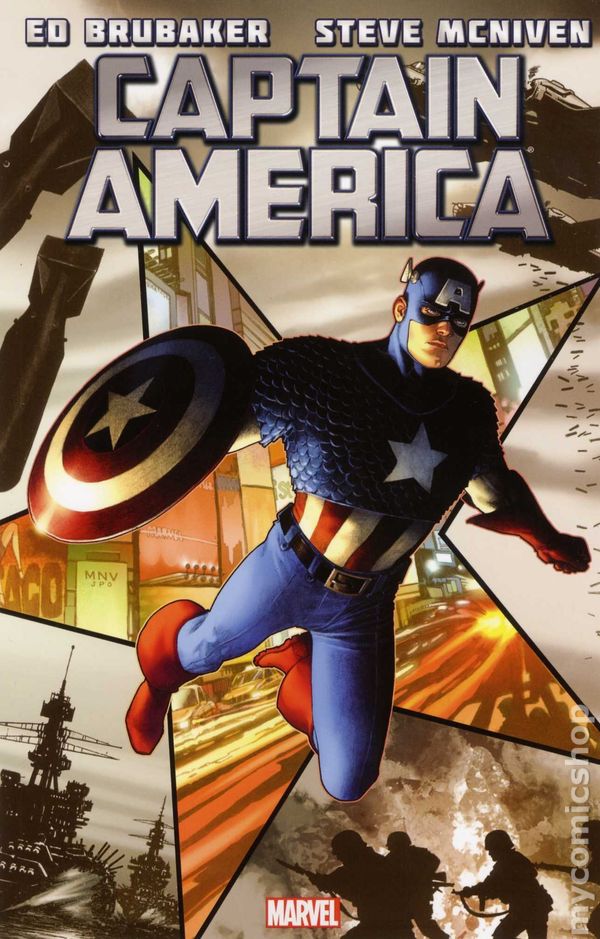
Captain America by Ed Brubaker Vol. 1 (comic)

Writer: Ed Brubaker
Artist: Steve Niven
Collects: Captain America (vol. 5) #1-5

The Marvel love affair with relaunching rolls on. The sad part being that it wasn't twenty issues before that they renumbered the last volume to legacy numbering. Then, this one lasts all of nineteen issues before they relaunch Cap again*! Unbelievable.

Steve Rogers has the mantle again and Ed Brubaker decides to lead off with an accessible story. You need no knowledge of prior volumes to read this one. Brubaker's been pretty generous in giving us an easy in between bigger storylines. "Two Americas" is similar in this regard.

This story leans on a few Captain America cliches to work. Someone from his past returns and is kind of cheesed at him. They fight. Steve then ends up wondering if he's a failure as Cap or if America has lost its way under his watch. On the plus side, Ameridroid shows up for a bit, even if we aren't likely to see him again. What we end up with is more of a straightforward action comic, which is not something Ed Brubaker has done a lot of in the past.

I mentioned Two Americas earlier; this volume has a few similarities to that book. The basic conflict is the same; someone shows up who is pretty unhappy with the way that America has gone, has a pretty concrete view on how it should be and will go to extreme methods to "fix it". The difference is in the message. The point of Two America's is that Crazy 50's Cap was essentially fighting to regain a vision of America that probably never existed. It was pretty clear that, however good the intent may have been, 50's Cap was off his rocker and definitely in the wrong. This time, it's left ambiguous; Rogers himself wonders if the jerkass had a point. Not exactly unfamiliar ground for a Captain America story**, but it's not something I recall Brubaker doing before, so I can cut him some slack here.

The ending points towards another multi-arc plot from Brubaker, but I have no idea if it's resolved. Brubaker's run finally ended - after a staggering eight years - about fourteen issues later. You'd think that would be plenty of time to wrap it up, but it depends on when exactly Bru knew he was leaving and if he got enough space.

Steve McNiven's art is nice, as expected. There's a gaffe or two in there, though. The two panels where Sharon tosses the shield from out a hole in a building immediately come to mind. I wish I could counterbalance with something other than "it was nice", but I'm far from a master art critic.

The Score: 7 out of 10

This arc doesn't hit the highs of the past, but it's solid entertainment. Not a bad place to jump on either; I wouldn't recommend it, but if you just wanted a recent Cap book without six years worth of ongoing plot driving it this is as good a choice as any.

* Because, you know, DC did it and it was pretty successful. They deny it, of course, but they're not fooling anyone. To their credit, though, they're doing a better job with the rollout; instead of the hardline "wrap your shit up before September" approach DC took, Marvel's spreading out the new number ones and allowing books time to finish. So I hesitate to give them too much of a hard time. Still, two Captain America and Uncanny X-Men relaunches within two years?

** We can thank Watergate for that.

Friday, November 2, 2012

Spider-Man: Death of the Stacy's (comic)

Writer: Stan Lee, Gerry Conway
Artists: John Romita Sr., Gil Kane
Collects: Amazing Spider-Man #88-92, #121-122

Time for a rough truth; a lot of old comics, especially from Marvels Silver Age, do not age well. As influential and groundbreaking as the work may have been at the time, the sad fact is that those comics were done in a style that is so far outdated that it's almost painful to read. Stan Lee, great as he was for the time, is probably one of the worst offenders; and while Gerry Conway isn't nearly as bad, he's still a writer of that time period and that particular style.

I've always had a problem reading old Stan Lee comics. Stan Lee wrote in the most verbose way possible, constantly having characters describe things clearly depicted in the artwork and narrating the hell out of the slightest action. It's not like he had incompetent artists, either; hell, here he has John Romita Sr., an all time great. Such was the strength of Romitas art that if you ignored the narration or speech and just followed the art you could get a clear picture of the fight anyways.

The problem, for me, is that I find myself struggling with all that redundant prose. I'm easily bored, especially with things I already know, which is why I've always had a rough time with old timey comics. On the other side of the coin, I don't want to just skip it because what if I miss something important or cool in the dialogue? That constant struggle always irritates me. A lot of people complain about how quickly you can read through a comic these days, but they forget that there are several very good reasons no one writes like this anymore.

So for all the strength of the stories - and the emotional beats contained within - their age shows, making them difficult reads today. Marvel is not like DC - they're fairly uninterested in retelling stories - meaning this will probably always be the official version of the Stacy family's death. That's probably a good thing for these comics, because - and your mileage may vary, since you may well have more tolerance for material this old - in this day and age the importance of the stories are about all they have going for them.

One last note about this whole thing and it pertains to Gerry Conways forward. He admits outright that he killed off Gwen Stacy because he wanted Mary Jane with Peter Parker and saw his shiny new job writing Spider-Man as his chance. Considering how iconic the story is now, one can always make the argument that he made the right choice, reasons for it aside. But does his reasoning reek of bad fanfiction or is it just me? Male writer kills off female character because he doesn't like her and she is in the way of his preferred pairing? That's about three quarters of internet fanfiction right there.

The Score: 6 out of 10

I can't say I had a good time reading this. I hesitate to give it lower, because it's an important story and, well, despite how much trouble I had enjoying them, these comics come from a different time. Don't let me scare you off if you want to read the Death of the Stacy's. Sixties comics simply don't agree with me.

Wednesday, October 31, 2012

X-Men: Schism (comic)

Writers: Jason Aaron, Kieron Gillen
Artists: Carlos Pacheco, Frank Cho, Daniel Acuna, Alan Davis, Adam Kubert, Billy Tan
Collects: X-Men: Schism #1-5, X-Men: Regenesis

I guess you could say this is a story that's been in the making since Wolverine first joined the X-Men. Perhaps what's important to you is the fact that the group is splitting up into two sides with two entirely different mission statements. For me, the most important part is the fact that I've finally got an X-Men comic I completely enjoyed with the promise of more in one of the series launched in Schisms wake.

I guess it had to happen at some point.

It starts out simple enough. Cyclops and Wolverine represent Utopia at an arms conference - because in the Marvel universe, all you have to do to become a country is herd two hundred people on a rock and call yourselves one - to ask nations of the world to disarm their Sentinels. Who knows if he would've managed to get anywhere, because Quentin Quire shows up and decides it would be a good time to make a complete mess of things by forcing the worlds leaders to embarrass themselves on live television. Guess how they react. Worse still, this is all part of the plan of the new Hellfire Club. On top of that, Wolverine is growing increasingly agitated over the use of kids in their little mutant wars. Cyclops doesn't help matters by insisting on it.

A lot of the book is a conflict of ideology, with the fisticuffs only coming into play in the last third. Cyclops sees himself as a General in a war, willing to use whatever is necessary to survive and win. On the flipside, Wolverine is a man who has found himself tired of seeing kids grow up without childhoods, knowing only how to fight. The tensions only increase over the five issues until Wolverine is ready to blow up Utopia to force everyone to evacuate - as opposed to Cyclops, who wants to risk the kids by leading them into battle with a huge Sentinel - and, out of options, Cyke goes for the verbal equivalent of a low blow. What Wolverine says next hits a little too close to home and the fight is on.

To a certain extent, you can look at Schism as a story of men who, over time, have changed. Cyclops barely even resembles the character he was before and I've detailed my disdain for that several times in the past. Wolverine, on the other hand, has become less a loner and more like a gruff parent who only wants what's best for the kids. It's a change that's happened over time and tracks well; he always took young wayward teens under his wing and tried to show them the way. The direction he's gone in only makes sense for his character and with the X-Men now resembling an army - one with child soldiers whose main education is in fighting - you get the feeling this is the only way it could have ended.

Ultimately, who is right is left up to your own individual opinion. As you can guess, I'm with Wolverine and think Cyclops is a complete ass, but Jason Aaron has gone out of his way to make it so that feeling the opposite is a legitimate view as well. This can be seen pretty clearly in the ending conflict of the book. Schism couldn't resist making Cyclops ultimately "right"* - he, Wolverine and the kids DO manage to push back the Sentinel, as he believed - but it doesn't forget to balance the scale; as Wolverine points out, it doesn't really matter that they COULD do it, the point being that the kids should not be forced into positions like the one Idie found herself in, as has been necessary in the Cyclops Army. You could take either side and Schism will not go out of its way to make you feel like you are wrong, unlike the inexplicably beloved "Civil War" event.

On the whole, Schism is a well written book that opens up different avenues for the franchise. If you actually like the way the X-Men books have been since House of M, well, I have no clue how to understand your point of view, but you could keep up with Uncanny X-Men and the other books following his side. If you're with Wolverine and want to read a book with a more traditional approach, you can follow him back to Westchester in Wolverine and the X-Men. Works for me. Guess which book I'll be reading.

The art situation is... complicated. There are five different pencillers, each assigned to an issue. Normally, this would be the sort of thing I would slam a book for. Trouble is, each and every one of the artists used is a great. They all do fine work, to boot. If I had to lodge a complaint, it would be that Acuna's art does not really fit with the other four, but that's about it.

The X-Men: Regenesis one-shot - scripted by the talented Kieron Gillen with art by Billy Tan - is also included here. It's not really necessary - the book is basically a "who will go with which side" deal juxtaposed against some weird tribal standoff representing the split of the "tribe" - but it's a nice inclusion that gives you an idea of which side you might find your favorite X-Men on. The art by Billy Tan is decent. I've never had a problem with his artwork, though I suppose he suffers a bit by comparison, given the number of great artists collected in the rest of the volume.

The Score: 8.5 out of 10

Against all odds, we get an X-Men event that manages to complete it's mission statement and be legitimately good. Who'd have guessed? X-Men: Schism is definitely worth a read, even if you just want to see the Wolverine/Cyclops brawl they finally decided to get around to years after the imitator**. Schism has me interested in Wolverine and the X-Men as well; we'll see if that's the X-Men book I've been waiting for.

Cyclops Douchebaggery Alert: The book takes great pains to keep Cyke from being too much of a dick and ruining his side of the argument, but he still has a few moments of his now patented brand of douchebaggery. Giving a troubled girl with questionable control over her powers the go ahead to "do what she has to" when the adults "won't make it in time"? Gee, I wonder how THAT plan will end? Also, see the complete dick move Cyke pulls when he brings up Jean Grey and tells Wolverine she not only never loved him, but was frightened of him. She had absolutely no bearing on anything; Cyclops was just pissed Wolverine left him with no options and decided to take the cheapest shot he could. He doesn't particularly care for the reply.

* Cyclops has been sort of a writers pet since as far back as Ed Brubakers run onwards. For some reason, writers have had a hard-on for the character, going out of their way to make him either right or "cool". They even gave him a jetpack. For me, it never worked. I just ended up hating Cyclops.

** I'm talking about the Teenage Mutant Ninja Turtles here. The relationship between Leonardo and Raphael has always been a carbon copy of the antagonism between Cyclops and Wolverine. They took almost as long as the X-Men to stop dancing around it and just have the two duke it out. That happened in the fourth TMNT film, which was done in CGI instead of live action. Decent film, if not particularly memorable. The Leo/Raph fight is worth watching online if you don't feel like seeing the whole thing.

Tuesday, October 2, 2012

Astonishing X-Men: Monstrous (comic)

Writer: Daniel Way
Artists: Jason Pearson, Nick Bradshaw
Collects: Astonishing X-Men #36-37, 39, 41

I've never been a believer in the notion that some titles should end when a story ends or a creative team leaves - serial superhero comics do not work that way for one and it just creates another damned "volume" to keep track of when it's inevitably relaunched for two - so I never had a problem with Astonishing X-Men continuing once Joss Whedon and John Cassaday finished their acclaimed run. It certainly helps that Warren Ellis put forth a pretty good effort, even if he didn't always hit the heights of the books past. With Ellis now gone, Astonishing marches on as the accessible, continuity light X book*; for this period Marvel figured the book should switch off creative teams telling their own story. This volume collects one of those stories.

I've always liked the idea of an island filled with monsters, so I'm always down with seeing Monster Island. Apparently, there's a bunch of oil under it too. Roxxon - whom you may know as Marvels version of a cartoonishly evil corporation - naturally wants it. So, of course, they go and hire an unstable supervillain to team with their employees tasked with blowing up Monster Island so they can get at it. They are then shocked when the villain turns on them, takes control of every monster there and then holds them for ransom. Meanwhile, some of Armors family has died, which is how the X-Men end up in Tokyo for the monster related shenanigans.

Daniel Way, the writer for the arc, is about as hit or miss as they come, in my estimation. I've liked some of his work - at one point I read a big hardcover of the first year of his Deadpool run, which was pretty good - and did NOT care for others. Monstrous sits somewhere in the middle. For every one thing I like, there's one negative to match it. I like that Way sticks with a theme of family, which is almost foreign these days. But then we have Armors dad, the stereotypical Japanese father**. Bunch of monster wrecking Tokyo? Tempered by the fact that things go laughably wrong when Way attempts to write an accent for Wolverine.

One problem that stands above the others is the fact that the book doesn't seem to give enough time to the things it probably should. Either things needed a bit more shuffling around or the book needed another issue. For instance, the story ends on Armors father finally accepting her life as a hero, but it doesn't feel earned; the last time we saw him prior, he was urging her to stand with her family and the moment where he realizes how important her other life is - when he watches her save others during the monster attack on television - happens off panel.

Then there's the fact that not nearly enough time is spent on Armor actually dealing with the loss of some of her family. We don't see much of the wake or her interactions with her father outside of it. Considering Armors powers draw from her deceased ancestors, it almost feels as though that half of the story only happened to give her a power boost.

Ah, and the villain. Some Z lister named Mentallo. I've never seen him before and had no idea what his deal was prior to this story. I can't say I would feel too bad if we never saw him again either. Aside from controlling some monsters to smack the X-Men around, he doesn't have a lot going for him.

I don't know; I didn't hate it, but the more I think about it the less Monstrous did for me.

Also problematic is the art situation. Mostly because we have four issues here and it switches artists after two. Why? It's not like this story is structured like a typical arc, with consecutive issues. Both #38 and #40 - not collected in this volume - belong to a different story, giving a month extra per issue to get the job done. What happened?

Regardless, Jason Pearson handles the first half; like the writing, there are things I like and things I don't. I'm fond, for example, of his Cyclops. The lines on Cykes suit are drawn much thicker here, which looks pretty great. Also a keeper is the fact that the colorist for his issues decided on black and gold for his costume as opposed to the typical blue and gold. They're small, simple alterations, but I thought they were improvements. On the downside, his Wolverine needs some work; the near constant bug eyed expression he's drawn with is downright odd. If he worked on his expressions somewhat, I wouldn't mind seeing Pearsons work again.

Nick Bradshaw handles the other half of the story. There's much less for me to talk about here. Whereas Pearsons work is stylized, Bradshaw gives us something a bit more standard. It's some rock solid art; nothing outstanding about it but nothing to dislike either.

Oh, on a final note, apparently Marvel threw in an old issue of Strange Tales to help justify the seventeen dollars they want for this four issue collection. I guess the official word would be that it's there because it has Fin Fang Foom. Like most old issues thrown in to pad a small volume, it's fine as a curiosity but you can never get past the knowledge that it's there for no other reason than to scam a few more dollars out of you.

The Score: 5.5 out of 10

It's alright. I wouldn't recommend a purchase, but if you see it at the library and need some X-Men it might be worth a read through. This volume is far from Astonishing X-Men's finest hour, but I must admit I'm glad to see Marvel is sticking with the idea of an X book that's light on continuity.

Cyclops Douchebaggery Alert: Immediately upon finding out the monster raging through Tokyo is under mind control, Cyclops figures they may as well just kill it anyways. Captain Kill'emall himself, Wolverine, is the one who steps up to say "hey, wait a minute, this is not his fault". Sure, it's a practical move - obviously they're out to save the lives of others as well as their own - but he doesn't even bother to consider another option before deciding. Not particularly heroic.

*This is a GOOD THING, mind you. I personally think it should be standard for every big franchise - Batman, Avengers, X-Men or so on - to have a book that strives to be accessible and keeps continuity wrangling to a minimum. They should also be books the companies put some of their best talent on, but I'm probably asking for too much with that one.

** I'm not sure if this is on Way or if her dad was always like that. I'm admittedly not as big a Marvel guy as I am DC, so my knowledge is a bit lacking in that area. For all I know Daniel Way is just following his established personality here.