Saturday, July 20, 2024

Batman - One Bad Day: Bane (comics)

Writer: Joshua Williamson

Artist: Howard Porter

Original Graphic Novel

Bane has had quite a journey over the last thirty years of comics and in the process become a rather complex character. There's obviously the work done by co-creator Chuck Dixon. There's everything Gail Simone did with him in Secret Six. It's far from the worst thing Tom King did during his Batman run, might even be low on the list, but his time using the character didn't really reflect any of that.

One Bad Day was an initiative I rolled my eyes at. DC can harp on the Killing Joke too much as it is, making an entire initiative around the line of someone being one bad day away from snapping seemed a little too cute. The first I read, the one dedicated to the Riddler, only reinforced that feeling. But whereas the Riddler book did some dogshit things with the character on top of leaning in too hard on the "One Bad Day" tagline, Banes graphic novel suggests it might play as more of a theme with others. A focus on the things that made the characters who they are and how they shaped them.

In wrestling parlance, Bane is what we'd call a tweener, a character who sits between a good guy or a bad guy and can lean a bit either way depending on circumstances. They can have a grudge against a hero, a case where they're firmly the villain, or a grudge against a villain, which obviously puts them in the opposite position. He has a complex relationship with Batman, both foe and begrudging ally when circumstances are right for it. Tom Kings run nearly ruined this dynamic by having Bane kill Alfred, which is probably why it should just be undone already, because it's a cloud that hangs over the character*. Especially when we get stories like this, where the complexity seeps back in.

Banes story revolves around the substance that empowered him to break the Bat, once upon a time. Venom is a cloud over his life, an addictive substance that can, over time, absolutely wreck your mind and body. On numerous occasions, when he's slipped from its grasp, Bane has dedicated his time and effort to eradicating it so no one can suffer the fate he had. It's his thematic "One Bad Day", the thing that changed his life forever.

When we start, it's seemingly some time in the future. Bane kicked the habit of Venom once and for all and, as far as he is aware, has managed to eradicate the substance from the face of the Earth. He spends his time in Mexico reveling in past glory; he's a participant in a regular wrestling event where he recreates the "breaking of the bat" with whatever local wrestler takes up the role that night. He has a mansion on the outskirts and his life is rather lonely. Over his fireplace, a framed newspaper of the day he broke Batmans back. Sometimes, he will see apparitions of his mother, long gone from his life. 

The obvious parallels Bruce Wayne are stark, only Banes life is far lonelier. He seemingly has no connections, just money, his matches and dark nights in front of his mantle. It changes when a small time drug dealer shows up at his door.

Banes reputation precedes him. You don't get a solid victory over Batman like Bane did and just end up forgotten. Hell, you can argue no one else ever did on the level Bane did. Batman was out for months and even required a temporary replacement. Everyone knows his story and of the drug that gave him great strength. The drug dealer has brought a vial of venom, something he thinks Bane would want. Only Bane is enraged. He thought he'd destroyed the substance entirely. Demanding to know where it was found, he and the drug pusher leave to finish the job.

The story paints a complex picture of the character, one that adds the depth that some writers forget. Breaking Batmans back is Banes greatest triumph in life, but much like some athletes, it's also a great success that he has never been able to replicate in his life. It hangs over his life like a cloud, his one moment of glory in a life ravaged by the drug that gave him the power to do it. He sees a parallel of himself in the drug pusher, a kid who got forced into the life when he was left with the debts of his dead father, a life situation the son of King Snake knows all too well. Bane struggles at moments with the temptation, obvious on his face, of reclaiming that glory while realizing it's a Faustian bargain. He has a subtextual need for Venom to die so he can be free of that temptation.

For a graphic novel clocking in at just under seventy pages, it does everything it needs to, tying back through the history of Bane himself and the very substance of Venom. There are callbacks that go as far as the Legends of the Dark Knight arc that introduced Venom a year before Bane made his first appearance. It looks to paint a full portrait of the man and I'm pleased to say it largely succeeds. It even ends up a positive note, with Bane reflecting on advice from Batman to make a change in his life. It's the closest to a "happy ending" you can picture for Bane at this point in his life, suggesting a change in life direction that could take him to a better place.

Howard Porter holds up his end artistically with some of his best work in years. His depiction of Bane is at times grotesque, always ugly, a man ravaged by time and the obvious effects using a drug that suddenly bloats your musculature might have on your skin and body. Moody colors darken the page during contemplative moments, contrasted with brighter colors in the ring, in action. The storytelling is clear, Porter will even get inventive with layout at times. He does that trick I love, where a ton of tiny panels can depict a long fight in the span of two pages without wasting page space.

The story and art synergize to make something that genuinely does Bane right. I'm unsure if it is in continuity. After all, the Riddler graphic novel was decidedly not. This one also seems to take place after much time has passed, perhaps up to a decade beyond the present day of the DCU. As such, I lean pretty heavily toward it being its own thing. But while I like continuity, it's far from the end all and be all. A good story justifies itself and hell, even if it isn't canon, this story uses past continuity incredibly well to tell its story. Continuity is a tool, it doesn't need to be a shackle.

Of the two One Bad Day graphic novels I've read so far, Bane is the first outright success. Sharply written, well drawn and respectful of its main character, it's the best Bane story I've read in a minute. I'd personally recommend tracking it down and reading it in whatever way strikes your fancy. It's worth the time.

* Speaking of this cloud, the one reference to Alfreds death, in flashback, aptly illustrated my meaning. It's took me out of the story for a brief moment, because if that event happened in this stories internal continuity it makes it harder to believe Batman will work together with the man who killed his surrogate father figure. But it's a rock and a hard place situation. The bedrock of this story is in Banes life story, so can you just conveniently leave it out to make things easier? I don't know the answer. It doesn't wreck the book, but it does remind me of what a mistake that moment was and that, whatever your thoughts on comic death or characters coming back to life, the character of Bane would be far better served if it were undone. It's a moment of cruelty that does nothing for the character.

Wednesday, July 17, 2024

The New 52 - Futures End Vol. 2 (comics)

Writers: Brian Azzarello, Jeff Lemire, Dan Jurgens, Keith Giffen

Artists: Patrick Zircher, Jesus Merino, Aaron Lopresti and many more

Collects: The New 52 - Futures End #18-30

 Volume one was a decent start but felt too slow at times, which became a bit of an issue by the end. The first volume contained eighteen issues worth of material including the FCBD special that kicked it all off, inching close to half the overall weekly in one tome, a lot of ground to cover without speeding up. Thankfully, that's less of an issue with volume two. Containing a lighter thirteen issues, it also shifts out of first gear and actually starts to get some momentum going.

We do start to get some answers as to what exactly is going on and some threads start to converge. The Firestorm arc starts to bleed into Tim Drakes plot, while Terry is also starting to think that he needs Tims help, thereby tying that in. It's made plain who attacked Stormwatch, though if you have a clue about what symbol said enemy uses you'll see it coming. Grifters plotline dips into Brother Eye shenanigans, so we're getting closer to whatever the hell let him take wider control, while also dealing with the mystery of the missing Earth 2 refugees. Most importantly, back in the future Terry escaped, Brother Eye realizes that Terry has traveled through time, which means he has to do his best Skynet impersonation and send someone back to deal with the threat.

By the volumes close, we've got all the pieces in play for the last volume. Brother Eye has escaped to the wider world, we have a new Firestorm, Brainiac is coming, Tim Drake is starting to realize he can't really leave this life behind and Mr. Terrific barrels onward with his tech ambitions, despite warnings from friends. Also, Frankenstein and his team manage to escape the danger they were in, warping away, but we don't actually see where they end up in this volume. For some reason, it happens in the middle of the volume and the remaining four or five issues are dealing with other things. A strange breakdown, but might simply be the nature of how the divisions for the collection broke down.

It's hard to say a lot about the writing that wasn't said last time, because I'm not at the end yet, but as mentioned before this volume moves faster and that does it a lot of good. Unfortunately, my nitpick about Terry needing more page time holds over from the prior volume, but it is what it is. They really are juggling a lot more ongoing plots than I expected and they all need page time. Thankfully we start to see him more as the volume wears on and with plotlines intersecting I expect it will be less of an issue in the final volume. 

As for the art, it's the same deal as last volume. Hard to critique. Competent work that blends together well enough. Never horrid nor spectacular.

Obviously I'm going to hold any opinions on if the weekly is good overall until I finish the final volume, but the second is a bit of an improvement over the first, which I already thought was a decent read. So far, as long as it doesn't completely shit the bed with the ending, it'll probably hit somewhere in the middle as far as ranking DC's weeklies.

Bit of a short review, I know, but there isn't a lot of bad that sticks out and any good I could emphasize depends on how the series closes out.

Tuesday, July 16, 2024

The New 52 - Futures End Vol. 1 (comics)

Writers: Brian Azzarello, Jeff Lemire, Dan Jurgens, Kieth Giffen

Artists: Patrick Zircher, Jesus Merino, Aaron Lopresti and many more

Collects: The New 52 - Futures End #0-17

I was pretty excited about this back in the day. It's a time travel, avoid the bad future story and I often dig those. It's a weekly with Batman Beyond, one of the best variants of Batman ever put to paper, front and center. It has a bunch of writers I generally like. But reviews of it week to week were mid and money issues put me off from getting the trades in a timely manner. It became one of those "I'll read it when I get to it" projects, only who the hell knew when I'd get to it.

Well, I finally did. It's pretty decent? I want to say good, but this is only a third of the overall weekly so I don't know how it will shake out. It's not quite the slam dunk I expected from the talent involved, but I'll get into that. Still, I enjoyed it.

The series starts out hot with its zero issue, which is entirely set in the devastated future of thirty five years out from the then DC Universes present day. And when I say devastated, I mean it. Brother Eye has taken over everything its eye can see, assimilating heroes in frankly horrifying ways, and the whole thing is essentially the last stand of the remaining heroes. Seriously, there's some body horror going on, as much as they can get away with for a general audience. Circumstances leave them unable to pull it off, leading to Batmans backup plan; he's going to go back to the past and destroy Brother Eye before he and Mr. Terrific even build it. Unfortunately, he's injured in a standoff, so he sends his protege Terry McGuinnis in his place.

From there, the series is structured similarly to past weekly projects. 52 comes to mind. There are multiple running stories throughout that dip in and out when necessary. The duo that make up Firestorm are on the outs and we see what leads to the two agreeing never to merge again. Grifter is caught by agents of Cadmus for shadowy business. Frankenstein is lured into rejoining S.H.A.D.E. to investigate a sudden attack on Stormwatch. Mr. Terrific is completely up his own ass and marching the world toward the dark future without realizing it. Lois Lane is investigating the Green Arrows death. Tim Drake is in hiding and it's unclear why. Then there's the most important plotline, Terry McGuinnis working to avert the future entirely.

Well, it's the most important in theory, but one of the things that keep it going from decent-to-good all the way to great is that it feels like, at times, that plotline is the one that has the least focus. After we're past the zero issue, Terrys story is around, but as you can tell from the preceding paragraph, it's one of like eight narrative strands the weekly chooses to service. I don't think any of the narratives lost me, but it's a lot to juggle and none of them have fully merged by the end of the volume.

Which leads to the other issue that keeps the first volume from being a bit higher up on the quality chain. With so much to juggle, the book often feels like it's moving very slowly. We're jumping between a bunch of narratives, for a good chunk of the volume all of them are in setup mode and you can go a couple issues before you see a plotline return again. I imagine this is a very large part of why the weekly issues god middling reviews. If the pace feels slow to me in a collected volume, it must have been absolutely maddening to follow week to week.

Having yet to finish the overall story, I'm not a hundred percent sure which you cut, but maybe Lois Lanes plotline could have been folded into one of the others at the least. I'd have said Tim Drake just going off this volume, but that's the one plotline I DO know the destination of and yeah, can't really be cut. Maybe some pages could have stood to be trimmed from Grifter on Cadmus island. But whatever could have been decided, Terry needed more pages. He was the big draw of this weekly and he could have stood to be front and center more.

The art is about what you would expect for a weekly. There's a rotating cast of artists, some regular and a few pinch hitters. They all generally hit a baseline of quality so it looks consistent enough to carry the day, you just can't expect any standout artwork because that's not really what you see on these sort of projects. I kind of wish there was more to talk about, but the demands of a weekly schedule mean consistency of the whole mean more than any individual part. No shade from me, it's about the only way to hit a weekly schedule for a year. Wildly different art across one project almost never works out anyway.

It's difficult for me to pass judgement on a single volume of such a large series. A good chunk of the plotlines only just kick into gear by the end of the volume. I'll have more formed opinions by the time I'm finished. But for one volume, it's a pretty decent read with the caveat that you understand that it's a slow burn and there are a lot of plotlines being juggled. If that's not a turnoff for you, feel free to give the first volume a go.

Monday, July 15, 2024

Strange Adventures (comics)

Writer: Tom King

Artist: Mitch Gerards, Evan "Doc" Shaner

Collects: Strange Adventures (Vol. 5) #1-12

I think one of the things I like least about Tom Kings work is that I always feel like shit after I read one.

His writing often has a theme he goes back to, trauma, and he's admittedly good at it. It likely stems from his past experience in the CIA. He knows how trauma can fuck you up and most of his stories are about how it can break you down, lead you to do things you might never have without it, from self destruction all the way to war crimes. It's a good theme, but I wonder if he ever feels the need to write beyond that. I also wonder if he realizes any time he takes a comic character his approach doesn't do a lot more than ugly them up pretty bad.

Adam Strange as a character is very much in the vein of classic space adventurer serials like Buck Rogers or John Carter of Mars. He's one day teleported to a far off planet, falls in love with it and uses its technology to fight against anything that might threaten it. A lot of adventure and sci-fi, pulpy stuff. There's the occasional war, but it's much in the way that sort of stuff is depicted in comic books, without dwelling much on the horrors of it. Pretty clean cut Silver Age fare.

Tom Kings "Strange Adventures"* asks what it looks like when we stuff all the horrible stuff in.

We start after the war on Rann, the planet of which Strange has become an adopted son of sorts, is over. Strange and the Rannians had pushed back the Pykkt and saved their planet. Now, in the wake of the war, a retired Adam has returned to Earth with his wife. What awaits him is adulation and medals. He wrote a memoir about the war, which carries the same title as this comic, and spends his days at book signings. Until one day, one of the people who showed up for the signing turns hostile. He screams about knowing what Strange did, about the things he'd done to the Pykkt, and causes a scene. 

Under intense scrutiny, Strange turns to Batman, asking him to dig into Stranges past and life to absolve him of wrongdoing. Batman rightly decides that he cannot do this for Strange, that given their long history of fighting together and friendship Batman could not possibly be objective, but he promises to turn the case over to someone who could. Michael Holt, Mr. Terrific. A man who lives up to his name. Suddenly, Adam Strange is wary of the investigation he called for. Turns out it's for good reason, as when Terrific starts digging deeper, some things stop adding up. By the end, a lot more will be revealed than Adam Strange bargained for.

As always with Tom King, it's impeccably written. Even when I don't much care for the work in question, I can never deny he's a skilled writer. And he synergizes well with Mitch Gerards and Evan Shaner. The story, as it unfolds, switches between the present day on Earth and snapshots of moments of the war on Rann in the past, both with a different style. On Earth, it's more detailed, almost grimier, reflecting the uglier side of things slowly coming to light. On Rann, it's brighter, cleaner, with simple lines and bold colors, as if to reflect the inspiring story he told of the war, of the biggest moments. It's a neat trick and the contrast can be a gut punch when things start breaking down in the present while we see moments in the past of triumph and love.

Tom King is spoiled for great artists to work with. He's like Mark Miller in that way. Only, you know, actually good at the whole writing thing. Or at least he's a hell of a lot more consistently good than Mark Miller's ever been.

I think I just don't like his approach or what he does to characters or settings. Most of the time it just makes me roll my eyes. I think back to Murderin' Riddler for one example but he does it to almost anything he touches. There's Batman, obviously, which he positioned as a form a slow burn suicide. But he also did it to Mr. Miracle, who may or may not be trapped in an eternal purgatory after a suicide attempt he may or may not have escaped from. He's done it to the JLI, where Guy Gardner is seemingly murdered quite brutally** and Ice ends up essentially fitting the femme fatale role that's never once been even remotely hinted for her as a character. He takes interesting characters, often with depth, and utterly breaks them in ways you can't walk back from.

I cringe when a new Tom King comic is announced with some DC property I like, because there will be some new way in which characters I like are twisted in ugly ways.

That said, I should say that it's fine and despite my probably harsh words I'm not mad about it or anything. His Batman run aside most of his work is self contained and designated outside main continuity. It harms no one allowing him to do his take on these things because he doesn't have to worry about whether he breaks the proverbial toy or not. Adam Strange is as he always has been in the DC Universe proper. For this reason it's not like I'm even saying "why do they keep giving this guy work". They're often Black Label. He can go nuts. I'll either like it or I won't, and that's okay.

I just think, after numerous work, I just don't like the way he takes these bright characters and utterly breaks them. Even when it's not in continuity, it's not fun to see Adam Strange as a war criminal who has done some terrible things beyond that I won't talk about because it would spoil the whole third act. Part of me thinks that taking these bright, colorful characters and doing such utterly nasty things to them is about as childish as you could ever view these fictional entities once written for kids.

That's probably why I've turned on a fair bit of 80's comics. You know the ones, where everything had to grim and gritty it up. Maybe it's because I'm getting older, but it starts to feel so very edgelord, to me, to take things that are meant to be a positive escape from a frankly terrifying real world and drag them through the mud. That's probably why I've turned on a lot of Alan Moores work, long held as classics, including Watchmen. Some like Swamp Thing fit, because that's horror, but everything else? Geez, dude.

But outside my personal feelings about approach? Or content? Strange Adventures is a very, very well written and drawn comic book. And it may well work incredibly well for you. Maybe this approach is what some people are looking for and it's good it's there for them. I don't even regret reading it despite disliking its tone and I would encourage anyone to try it for themselves. It might be their new favorite. It's well written, well drawn, I'd even say that overall it's a good story. I almost never regret reading a great comic, even if it makes me feel like shit.

I simply never need to read it again.

Sunday, March 10, 2024

It's Okay for Characters to Be Flawed

Keanu Reeves Takes The Stage as Johnny Silverhand in New 'Cyberpunk 2077'  Trailer - Bloody Disgusting 

I've been around fandom spaces and internet discourse for a long time, since I first hit my teenage years at the turn of the millennium. Most talk of anything is, well, frankly rather embarrassing. People making absolute asses out of themselves over shipping preferences, opinions on what games are the best in a series, film franchises, comics, you name it. People will absolutely gaslight themselves as to the meaning of something or other to fit the view they want to ascribe to the subject. Incredibly strange to watch in action. Few are stranger than one particular behavior I've observed over many years.

Some people absolutely refuse to let go of first impressions they'll have about a given character, good or ill. This can tie into the last thing I mentioned in the previous paragraph, where someone wants to brute force a certain take on a given narrative and will mischaracterize things to fit that. But others, I wonder if it's a case of people just not wanting to engage in a narrative or think about it too deeply beyond a surface level, causing them to miss what a work is saying.

This isn't really anything new. We do it in society and language as well. Calling someone a "Scrooge" has been a pejorative for as long as I've been alive, for example, because for whatever reason people latched on to how Scrooge started in A Christmas Carol as opposed to where he ended. In a way, it's a bit of a misnomer. The entire story of Scrooge is one of reckoning, of coming face to face with and accepting where the characters actions would lead him in the future and changing for the better. But pop cultures image of him remains the miserly, penny pincher he starts as. A Christmas Carol is a story of redemption, though many of us refuse to let go of who he was.

Sadly true of reality as well. It's easy to be skeptical of someone who presents as attempting to atone for their actions. Most refuse to buy it out of principle, some of them in turn incorrectly asserting that they do believe in redemption in other conversations. I've done it at times too. After all, there are plenty for whom it is incredibly obvious they're acting repentant simply to weasel out of whatever trouble they've landed in. You see it a lot with online content creators who get caught doing a slur or plagiarizing (the shit with James Somerton and his reaction to the subsequent fall from grace is ongoing as of the time of writing this). Some people really do want to pretend they understand they did wrong to dodge consequences.

Obviously, I get that, that's somewhat understandable. We can't read another persons thoughts or intentions. But in fiction, we have the answers spelled right out on the page or screen. Often, in prose especially, we're privy to their inner thoughts and private actions you would never see in real life unless you shadowed someone all day. Yet, strangely, we seem to ignore development or actions even in stories we make up.

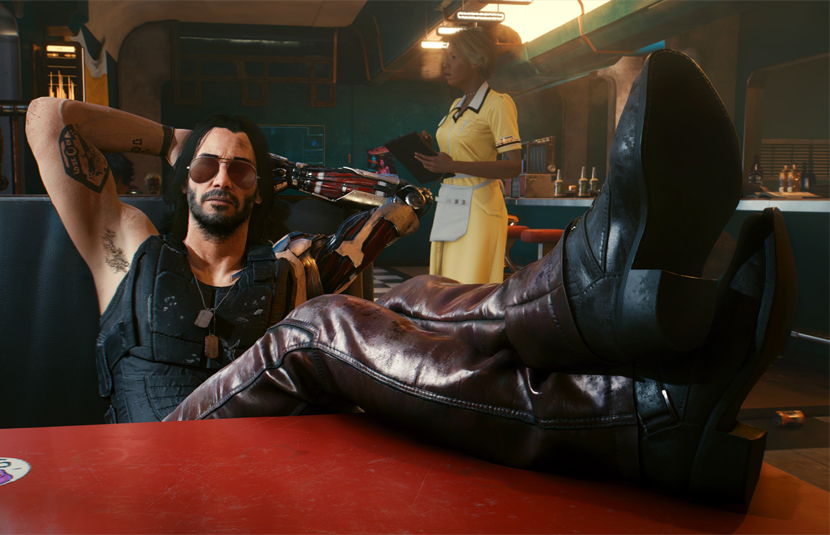
I'm sure you noticed that I've used an image of Johnny Silverhand, rockerboy and terrorist of Cyberpunk 2077 and its tabletop predecessors. It's because he's genuinely a good example of the phenomenon. This all comes with a caveat that Cyberpunk 2077 launched in an absolutely abysmal state that caused more than a few to give up on it at launch, so the first impression never advanced. It's gotten better since the game got fixed and had a superb expansion that brought a ton of people back to the game. But some people still don't allow that early taste to wash out of their mouth.

When you meet Johnny for the first time, it's at the player characters low point. You just got shot in the head, found out you're getting erased from your own body in favor of Silverhands personality construct and you're being framed for the death of the most important figure in the entire Cyberpunk lore. Johnny comes on strong, to put it mildly. Really, he's an outright prick, freaking out himself over the fact that he's suddenly "alive" and in someones head after getting fried by Soulkiller. He attempts to force you to kill yourself. These are usually the moments I notice people can't get past.

I suspect people ran out into the open world immediately and stuck with that impression until they gave up on the games horrifically buggy and broken launch state. I suspect that because the scene in question is discussed and moved beyond pretty quickly. In the very next main story mission in fact. He was, and is, an abrasive asshole, but he's had time to calm down and assess things. Came to the conclusion he and the player character, V, needed each other. He's got unfinished business dating back fifty years and you need to figure out how to stop your brain rot. The relationship resets a bit and moves on from there. None of this is to say that Johnny isn't an asshole. He absolutely is. But the more you play and the more you try to understand him in your dialogue choices, the more you realize that more than any other character, Johnny's the heart and soul of the game. 

There are plenty of standouts in the cast, but Johnny is in the role of a co-protagonist for a reason. V is a small time merc who dreamed of becoming a legend, now faced with their own mortality and forced to take stock of what they've done with their life and if any of it matters. Johnny's been there, nuked Arasaka and already died once because of it. He's a legend, memorialized by his own drink at the Afterlife. Now some semblance of him is back, fifty years later, and stuck in a body he can't control, forced to look upon what's happened to the world he left behind. When all the bluster and snide comments fall away, subtext becomes text.

Early on, there's a sidequest where you end up meeting a superfan of Samurai, Johnny's old band back in the day. Johnny is at times dismissive and mocking of someone holding onto a band that died fifty years ago, but eventually it becomes clear that at least some small part of that is self loathing. In an early moment of honesty, he lets slip that the thing that bothers him most is that after all this time, not a damn thing he ever did made a single difference. For all the defiance, for all he nuked Arasaka Tower, Arasaka just picked itself back up in his wake, corporations solidified their hold even further than they had in 2023 and both Johnny and Samurai became something of an underground legend of resistance, but ultimately a relic. Something peddled in a shitty street stall in the midst of a local market.

Whatever his various reasons, some more important to the why of his actions than just his ideals, in the end he gave his life fighting a malignant power and is forced to come back, long after it's over, and look at the aftermath. He doesn't like what he sees and as flippant as he tries to be, it's clear it bothers him.

He's forced to confront other things, too, like the broken relationships he'd left behind, broken by his own ego and narcissism. An ex lover who'd become colder in the time away. A fellow bandmate that still, fifty years later, hasn't squared away the sudden loss of Johnny or sorted out for himself what Johnny meant to him. You'll learn about his time in corporate military and the reasons he went AWOL, events that explain a fair bit of who he became. In a small patch of debris in an oil field out north, they search for where Johnny's body may have been dumped and find nothing. For everything he did, good or bad, there's nothing to mark his passing, not even a bit of graffiti. He's just gone, his worst nightmare come to life; his life and soul stolen by the corporation he hated more than anything and trapped in a prison of someone elses mind. An ironic fate given how irritable the flashbacks made him seem about the idea of a corporation coming for your very soul.

From there on, depending on your own choices, he decides to make a change. He'd already dedicated himself to helping save your life, so he knows that this is his last ride. If he and V have a good rapport, they try to make amends, to give a more positive goodbye, to the few people Johnny ever called friend. Johnny Silverhand is a bastard, but in life after death he somehow found some measure of peace and closure he never could find alive.

It's gripping and brings to life one of the most complex characters I've seen in a lot of video games. It's incredibly easy to sand off rough edges out of fear of alienating people from a character too much, but Johnnys attitude and flaws are a large part of what makes the game and the events therin work. How can you have a personal reckoning without a lot of personal failures to reckon with? Johnny is deeply off-putting at the start and the journey forward is long and hard. A lesser actor than Keanu Reeves might not have been able to pull off that mix of charismatic bastard that draws people to him despite all of his rotten actions. The journey to being a better person is improved by the fact that he's such a fucked up person. Maybe even the most self centered person can find some small measure of personal peace and improvement, if only at the end. Maybe it's not too late.

Would any of that growth have hit without the contrast of who he is where you start?

I'll tell you one thing that wouldn't have hit, and that's the Temperance ending. Most people prefer The Star, it being the most bittersweet ending for V themself, where they find freedom and maybe love to hold onto in the six months of life they have left, which they'll spend with the nomads outside Night City. It's my second favorite ending. I guess I'm just destined to gravitate to different things than others do, because Temperance is my favorite.

Temperance is the ending where, while stuck in Mikoshi, V discovers that no matter what they do, they'll only get six more months of life if they go back to their body. Only Johnny could stay in it and live a life of any normal length. The neurons are just too damaged, too warped in favor of Johnny. Rocked with grief, V makes peace with the coming end, which in itself is a bitter but fitting end for the character after wrestling with that end all game. Johnny, however, does not want to accept it and in a rare moment of honesty, even says outright that he's scared for V. If you press on, V goes with Alt into the net, itself a metaphorical afterlife in this game, and Johnny is left alone in V's body.

What follows is an epilogue where you realize pretty quickly that Johnny wasn't blowing smoke about wanting to change. Over the course of twenty minutes, it becomes clear that he understands the weight of the second chance he's been given. Sometimes talks to himself as if V were still with him. He's mellowed out, given up vices and distanced himself from the crusades he'd spent his first life on. He spends a little time with a young man for whom he acts as something of a mentor, buys a guitar and visits V's grave. In the end, he leaves the guitar with the young boy, boards a bus and leaves Night City behind. 

A constant metaphor in the game is that Night City drains you until there's nothing left. It's consistent across a good chunk of the games sidequests and side gigs, where you meet or deal with people who the city has sucked dry. That's why the only endings that are even remotely positive are the endings in which you leave it behind. It's the same for Johnny. Night City took everything from his first life. For his second, he's leaving on a bus to the unknown.

It's a cap to everything that happened with Johnny Silverhand, whether you believe the construct really is his soul or just data, and in many ways is something of the happiest ending if you believe at all in redemption. Even the nastiest rocker in the world found the will to become something different. Bittersweet, of course, with V still dead, but honestly V's a walking corpse no matter what ending you pick. Even The Star, with a small ray of hope, is at best a stay of execution. Temperence gives us a Johnny that has another shot at life, to do something. So he leaves. Much like The Star, the where and the what don't matter as much, it's all possibility beyond the city limits.

The further Johnny starts from where he ends, the more the transformation means. We're with him the entire game. For all his faults, by the end he's V's ride or die. The rough edges were needed.

At the time of this writing, there have been some other controversies over similar topics. Netflix just dropped a live action adaptation of Avatar: The Last Airbender. As tends to happen with Netflix adaptations, the story got cut to the bone to fit into the eye rolling streaming standard of eight episode seasons. One thing that got changed caused a bit of an uproar, and it was the sexism Sokka had ingrained in him from the Water Tribes culture. In the original show, he's forced to grapple with this when a group of warrior women hand his ass to him, training and learning alongside them and casting aside hid old prejudices. It's a character flaw, one the show makes a point to show him grow from as a part of his journey. The live action changes it entirely, removing the sexism, sanding the rough edges away. That trait that Sokka has to grow from? Gone. He's shallower because of it.

Another character I'd get no end of shit about is Tifa Lockheart of Final Fantasy VII, appropriate because the second game in the remake/sequel trilogy, Rebirth, just came out. At times I feel like I've watched through actual decades as fandom seemed to almost warp her character, to not understand it. Or maybe it's more accurate to say that they seem almost unwilling to engage with her flaws or even be honest about them. 

There's a tweet I saw the other day where a games journalist mused on Tifa being emotionally intelligent, among other platitudes. When I saw that, I thought about the scene from Remake where, next to a man who had just lost his friends and was actively grieving after the drop of the Sector 7 plate, she remarks that maybe they deserved this. In the most recent game, she repeats some of the actions she'd done from the original, keeping secrets and generally keeping distance from truths she doesn't want to deal with. Emotionally intelligent is not the phrase I'd use. Seriously, I've felt like I've been gaslit by other people for twenty seven years in regards to this character. I don't see the path where the Tifa presented in any of the games reaches the Tifa that exists in peoples heads.

This is somehow a controversial take, but Tifa is a deeply flawed person. She's got an absolute inability to confront things she's uncomfortable with to the point of avoidance, prone to keeping secrets no one asked her to and honestly rather selfish. That last one usually raises an eyebrow or two, but I genuinely wonder if anyone confused by that take paid attention to the lifestream event near the end of the original game at all. It's entirely about her confronting her actions up to that point, outright admitting that she kept from addressing that Clouds memories were not lining up with reality. She doesn't even address it when a friend dies. She only admits to it when Sephiroth forced her to while Cloud was in the midst of a mental breakdown. The reason? She was afraid the truth would take Cloud away from her

It also forces her to come to terms with the lies she's been telling herself the whole game, specifically about how close she and Cloud were as kids. When you actually look at it, Tifa is a deconstruction of the childhood friend trope so popular in Japan. It was lost on a lot of us back in the day, given Final Fantasy VII came out around when anime was really just taking root here in America. We hadn't been exposed enough to be overly familiar with Japanese tropes. But these days it feels almost painfully obvious. 

They lived in the same town, sure, and a teenage Cloud had a crush on her, but that was as deep as it went. Cloud was ostracized in their hometown in large part because the townspeople blamed him for Tifa getting herself hurt by her own grief fueled actions. The water tower, the basis for Tifas fantasies of the two being childhood friends, is the first time they had any real connection at all and that scene itself has both of them on different wavelengths. He's trying to impress her by leaving to become a SOLDIER, while in response she wishes him to become a hero who could rescue her, an image he twists in knots to try to live up to even when teenage infatuation fades.

In the lifestream, Tifa comes to terms with different parts of herself and wants to be better, but if you go by the way fandom talks about it and numerous other scenes you sure as shit wouldn't know it. I'm not fond of Tifa. She has elements of characters I love, one of which is the fact that she's a strong punch lady representing the usual monk class of the series job system. Obviously she's hot. But that I don't like her personality doesn't necessarily mean I think she's a terrible character. Most of her actual depth comes from those numerous flaws. It's quite literally her entire character arc in the original game. If you take all that away she's just kind of there, pining over Cloud despite not really understanding him and eventually slap fighting Scarlett on top of the Junon canon.

By the way, I know this is a digression just for me to bitch, but can I take a minute to talk about that? About how Tifa, a martial artist, gets into a slap fight with an executive on top of a canon above a large ass drop to oblivion? Said executive having no real reason to go out there or think she'd win in a hand to hand fight with a punch chick? She'd more likely take pot shots with a gun for safety. Why would Tifa get into a slap fight? One right hook to the head and Scarlett's plummeting to her death without much fuss. Was someone on the dev team horny when they came up with that catfight and no one said no? Always been the stupidest moment of the original game and one I sincerely hope does not make it into whatever is done with the third of the new trilogy. It never made either of them look good.

Sorry, I know, this is overlong as it is, that whole scene always annoyed me. Even as a teenager going through puberty I wondered why the hell Tifa didn't roundhouse Scarlett into the abyss. If she'd done that I'd probably be one of her millions of stans.

Anyway, yeah, fanfiction is where I saw a lot of the off interpretations take hold back when I read a ton of FFVII fanfic back in the aughts. Hell, that's it's own conversation. The way that a lot of fanfiction writers will often absorb ideas from other fanfiction which eventually evolves into a kind of shared headcanon. Sometimes if you read enough you can forget what was actually in the source material and what was fanon. I saw this happen a fair bit with Dragonball Z and Teen Titans fanfiction in the aughts. It's an interesting phenomenon to think about, but I've digressed too much already.

So yeah, over the years I've seen a lot of people in fandom circles say all the time that they want more complex characters, for negative traits to grow from. But it always feels like the second you give them, people start trying to find ways around them. Why? It's harder to love a character, I guess, if they think or do gross shit, even if they grow out of it. Easier to explain it away or just not deal with it. It's strange behavior, really. When you think about it, overcoming those flaws is a part of what made them into the characters people love in the first place.

People really need to get it in their head that no character is, or should be, perfect. I see a lot of nonsense opinions about Superman all the time, he's too perfect, you can't relate to him. Never mind that Superman has flaws as well and I'd argue a vast majority of stories with him, especially the best ones, test his morals and ideals, not his powers. Even Superman has flaws.

Maybe everyone just wants some trash main characters who are never wrong about something. You see it a lot in a bunch of semi-popular manga. I kind of get it. I enjoy trash sometimes. Sometimes you're just in the mood for trash, shit that you know isn't good but dammit, it hits some kind of sweet spot. Om nom, delicious trash.

But for fucks sake, I wish people would stop trying to make every character that, whether it be through gaslighting in discussions, arguments or through fanfiction. Conflict and the growth that comes from it is what makes most stories interesting. I need a lot of the good shit in addition to the trash, I need a well balanced quality diet, stop trying to make everything trash!

Friday, February 9, 2024

Does The Rock Still Remember How To Act Human?

So we're a couple months out from WrestleMania and The Rock is somehow in the mix of it all. That's been quite the surprise, largely because Dwayne Johnson's never had much time for wrestling or its fans these last twenty years. After his last brief full time stint back in 2003, he popped up for one match at WrestleMania the next year and then spent the next seven years distancing himself from the industry as he threw himself full time into Hollywood. He came back in 2011, basically walking in and taking some main event spots, which should sound familiar if you're paying attention to current angles, then after a total of five matches and maybe a dozen TV appearances fucked back off, going years at a time between appearances.

At the time of writing we're about a week removed from his insertion into the road to WrestleMania. Last Friday, he'd seemed to just walk in and take a main event spot from a regular worker, which CM Punk was sure to note looked a lot like what happened a decade ago. Last night saw a swerve, with Cody demanding his rightful title match as the winner of the Royal Rumble, while Rock seemed to lean heel for the first time in twenty years, since as far back as the Hollywood Rock character that closed his full time association with the ring.

Some friends in a wrestling discord I'm in disagreed with me, but overall I wasn't impressed. I'm not all that sure Rock still knows how to be the kind of heel he used to be. As I said to others, okay just doesn't cut it when you're discussing someone frequently described as one of the best talkers the business has ever seen.

Maybe I'm poisoned. The nostalgia for the Rock had worn off me a while ago and I finally got sick of him last Friday. But while the nostalgia doesn't have the hold it did on me anymore, I remember how he used to be. It's not a flattering comparison.

Rock was an important part of my formative years as a wrestling fan, debuting the very same year I first got into the hobby as a nine year old. To tell the truth, by the year 2000 he'd even eclipsed Stone Cold Steve Austin as my favorite wrestler. Back then, he was cool personified. Unflappable, endlessly confident and with perhaps the quickest wit in the game, he'd give promos so engaging and filled with energy it was worth it to tune in just for the talking. Expensive shirts, sunglasses and boundless drive. He could, and did, cut momentum out from under more than one superstar with a single promo.

Then he left and at some point seemed to forget what wit looked like.

We can go on all day about Rocks time in Hollywood and it would not be a conversation that was overly kind to him. Bluntly stated, his filmography is a dogs ass, the few worthwhile portions being as part of a franchise he isn't the star of and ten minutes at the start of a Will Ferrel movie satirizing the only sort of character he plays these days, the cool tough guy. Somehow John Cena, The Enemy of smart wrestling fans a decade ago, and Dave Batista racked up better filmographies than Dwayne ever had in a fraction of the time. No amount of box office receipts can change that. But worse still, looking at those films, you realize something that carries over to any return he's made to wrestling.

He's over-relied on his natural charisma and connection to fans. In some ways, abused it even.

When Rock first came back in 2011, it seemed fresh and exciting. He'd been away a long time and his first promo back had seemed electric. The prodigal son coming home. But much like a bad sequel can sometimes color the prior films, everything that came after wasn't kind to that promo. If you were paying attention, it was like Rock was reading from a template, a script. Fitting, I guess. It started with Kung Pao Bitch and sort of became a trend with him, every promo needed some kind of new catchphrase, usually one or two adjectives or noun followed by the word bitch. Some dumb new call and response with the crowd. Pointing at his arm to show goosebumps, which he did so often it feels like his version of John Cena talking to the cameraman on his way to the ring.

Then it became obvious when the dueling promos happened. Something was wrong. In the old days, The Rock never lost on the mic. But boy oh boy, was it clear it wasn't the old days anymore and his new schtick wasn't cutting it. The man was getting smoked out there. Miz got more than a few good digs in, which Rock made easy for him by phoning in half his "appearances" by satellite. Then the feud with Cena started in earnest.

One night, face to face on the road to WrestleMania, they had a war of words. The Rock lost, pretty badly. Near the end of the faceoff, John pointed out that Rock had written notes on his forearm for his promo. He might as well have won the feud right there. Rock never used to use promo notes like that, relying on his quick wit and ad libbing. Now he needed the equivalent of a teleprompter. Who's the last guy reading off a teleprompter you thought was cool? It shot some of the credibility he held as a talker and you could see the result right in front of you. Rock was shook. Scripted? Ad libbed? No one can say for sure, but the man looked genuinely annoyed, rattled, and his subsequent lost rhythm suggests it wasn't entirely planned. He stuttered briefly on the mic, trying to get some momentum back, and hit his "if you smell what the Rock is cooking" to try and bring it home. 

I hadn't seen it happen before or since. I've seen a ton of Rocks movies. He's not that great an actor. The Rock has been leaking cool ever since that night.

Then he stuck around a little longer and had a feud with CM Punk on the way to a rematch with Cena. If the stuff with Cena was bad, the Punk promo battles didn't go much better. Rock couldn't hang with Philly Phil at all really. It was kind of sad to watch. One night, Punk hit Rock with "your arms are just too short to box with god". Rocks response? Some witty riposte? Observation? Turning the line back on him? Nah. "Let me tell you something, you're not god."

Thanks for coming, Dwayne, good talk. The man we once thought was the coolest guy in the world, ladies and gentlemen.

I'm not sure when it happened, but Dwayne Johnson got complacent with regards to his skill at talking and never really tried again. It was a lot of the same sort of trite pablum whether on screen or on his instagram or wherever else he could drop a video. And he was always shilling something. If it wasn't a movie it's some new venture of his, like his latest, a line of whiskey. Thanks Dwayne, you want to sell me gold, next? Jeff Jarrett's already tried that one but maybe you'll have better luck. If he wasn't shilling, he was pandering.

Even last night, I didn't feel any of the old magic despite Rock leaning heel for the first time in twenty years. His big catchphrase or insult of the night was "Cody Crybabies" for the fans who were incredibly upset he'd walked in and seemingly took another mans main event spot. I guess the Rock is five now. Or maybe he always was. He hit the "it doesn't matter if you like it or not". Pretty rote stuff.

The big moment where he finally leaned into it a bit came much later. Cody came out and asserted his right to the title match. Rocks cousin, Roman Reigns, brought up Cody's father Dusty Rhodes, because it seems like everyone's got Dustys name in their mouth, and Cody fired back with a comment about their family. So Dwayne puffed up and did some "you don't talk about my family" shit, then slapped Cody. It was the most intimidating he'd looked in a long time.

It was also just him playing Luke Hobbs again, a character that's the most Rock that ever Rocked. The facial expression, the quiet glower and puff up. I recognized it immediately. All that he missed was to flex out of a cast. He just slipped into tough guy mode, because that's the only place he can go now. It used to be he would have just ethered the other guy with words, but that Rock was eroded over twenty years and this is just what we're left with. A big, sweaty wall of meat surrounding a Terminator endoskeleton, programmed to pander and shill and sometimes puff up and act like a big tough strong man. The sort you see blabber on in the UFC. You know, utterly unimaginative, lame individuals who can't dream up a semi-intelligent way to insult someone. If Rock started calling people betas he'd complete the transformation.

I won't get into his ego plays or any of the other stuff that soured me on him. I don't think it matters. But maybe it's time for us all to admit the Rock isn't cool anymore. He hasn't been in twenty years. After last night, I'm not sure there's much of the old Rock left in him. There's something sad about that, about him becoming a Machine Organism Designed Only for Shilling.

But maybe that makes for a good chance to be done with Dwayne Johnson, as a wrestler or otherwise. What's even left to hold on to? It's not like we'll miss out on any great films, that's for damn sure.


Thursday, August 17, 2023

Batman - One Bad Day: Riddler (comics)


Writer: Tom King

Artist: Mitch Gerards

Original Graphic Novel

To my surprise, this is the first time I've reviewed a comic or graphic novel written by Tom King. A strange omission, really, given I've read several of his comics. So I might as well get this out of the way first.

I've liked some of Tom Kings work but whenever the man is on something related to Batman he just absolutely loses me.

I didn't review it, partly because it slipped my mind during the years long span I'd been away from this blog, but I had read roughly half of his time on the mainline Batman book during the Rebirth relaunch/rebrand. First arc was shaky but not bad, but he lost me with the second, I Am Suicide. His thesis statement for Batman, at least that early in the run, seemed to be that the very identity of Batman was meant as a form of slow burn suicide in the wake of his parents death. 

I'm not going to go into all the problems I have with that because this review is not about that run, but at least a part of my problem with it lies in what an utterly dour, cynical, selfish slant this places on the entire being of Bruce Wayne and Batman. It removes anything heroic about the crusade and, in some ways, makes him a monster. It colors everything differently. Robin and the Bat family suddenly become less about found family and trauma bonding, instead becoming about a psychotic broken manchild dragging a bunch of kids into something that he intends to kill him someday. It's less about justice and more like a slow form of slitting his wrists.

Suffice to say, I didn't finish the run. I made it farther than you might think, all the way to the wedding-that-wasn't, before I called it. It was around when Catwoman decided Batman couldn't be effective if he was happy. Maybe that was editorial, who knows, but it fit too well with what King was doing even if he didn't originally intend it. I was looking for some kind of refutation of this thesis, but somewhere around fifty issues in it didn't seem to be coming and it was, frankly, a little too late even if that actually was the endgame. The run kind of ruined Batman and Catwoman together for me, to the point I don't really want to read it anymore, and when I saw the next arc was going to be super dark Batdickery like we were still in the 90's, I dipped. Out of like fifty issues I enjoyed the double date two parter and that was pretty much it. Kite-Mans reinvention was great, but it happened amidst an overlong and weirdly bad take on a war between two rogues.

This graphic novel has the benefit of being out of continuity, I assume, and boy is that ever a good thing.

Most of this overlong preamble has been spent complaining about Kings take on Batman, so this is a good enough spot to break that a bit and talk about what works. Tom King is a talented writer. That's obvious even in the things I don't like. He has a nice rhythm and storytelling sensibility that combines to feel very him, if that makes any sense at all. I can dislike a story he writes, but it's less an issue with the mechanics or flow than it is with what the story is about, themes and the like. The mechanics are the aspects of the bookending sequences that I like, even as I don't much care for the ending itself. We'll point of view through a bystander as they set off home from work, texting his wife, then bam, cut to black. We get several black panels for the rest of the page, signifying death, before flipping to the next where confirmation comes with CCT footage of the mans last moments.

It's the trick The Sopranos famously pulled in the very last scene of the show, only this graphic novel knew to set up and explain it beforehand so no one is confused at the final reprise.

Mitch Gerards is one of Kings better collaborators. Which is not a diss on the others, Tom King seems to attract good artists, Mitch is just that good. There's a moodiness to everything, a dreariness, that colors every scene without being dark or grimy. Shadows are heavy, but the other colors contrast through brightness. Slim shafts of white for rain, a near constant in any outdoor scene. Deep in the book, Gerards hands us one of the loveliest scene transitions in comics through use of a basketball court. The change in time period signified by color, the past using the haze of orange that's been part of every flashback breaking into the thick shadows and dark greens hanging over the present day sequences. Top shelf work.

Too bad about the actual story.

I'll preface here by giving a big old SPOILER WARNING. I'm going to talk about the entire plot. Blogger doesn't exactly have spoiler tags, so this is the best I can do. If you somehow made it to my site, I assume you want my opinion and to give that, well, I gotta talk about the story. Otherwise, you might as well cut here and rest assured I didn't like it. I think I'm done with giving arbitrary grades, so there's nothing like that to look for. I'll also note these are all my opinions, so you may feel differently, and also that this is not intended for continuity so it's more or less harmless.

All that now out of the way, One Bad Day: Riddler as a story is essentially bad fanfiction.

Strong statement? Depends on how you mean it. I have a fairly positive view of fanfiction. It's essentially free, democratized writing. Anyone can write whatever they want and put it out for their peers to read. It isn't making any money, so burgeoning writers can play with characters and settings they would otherwise never be allowed to. You know, since capitalism and our copyright laws are an utter joke. 

Most people like to say that "most fanfiction is bad". So? Have you taken a look at a lot of things that have actually been published? Eragon and Harry Potter were once wildly popular despite the actual writing being somewhat pedestrian, at times bad. 50 Shades of Grey made a load of money and that started out as actual fanfiction. You can get enjoyment or like characters even in bad work. That's the entire concept of "good bad" media.

Also, to be blunt, most of todays most popular media are basically corporate approved fanfiction. Stan Lee hasn't exactly written Spider-Man or Iron Man since the 60's. Bill Finger and Bob Kane have been dead a long time, but Batman lives on. We place too much stress and negative feeling on the word simply because it's unofficial or because random people are allowed to put whatever they want out.

When I think of bad fanfiction, I think less in writing quality and more of a bunch of tired tropes or lazy ideas. Things that have been overdone. Possibly pretentious. Often rooted in a misunderstanding of characters and theme. Or maybe they just make everything really gritty and dark and depressing because that's real, man.

Unrelated to the previous sentence, I joke, the Riddler is a murderer in this comic and the smartest bestest man in the world.

Murderin' Riddler is not a take I like, but whatever, I can deal with it. The Batman had him as a killer and that worked. But that film was also trying to tell a story about class inequality that tied into what Riddler was doing. He, along with Catwoman and Batman himself, was a third of a trio that spoke to three different walks of life, status and privilege. It played to the theme of the film and that's why I accepted it.

In One Bad Day: Riddler, the Riddler decides to just start offing civilians because all the riddles prior to this were just one big game to him. Now he's tired of the game and wants to send a message to Batman that old Eddie is his better. Interspersed with all this are flashbacks to Edwards childhood as the son to the dean of a prestigious school. Said father demands perfection or he breaks out the corporal punishment. One of Edwards teachers likes to encourage outside the box thinking so he puts one riddle at the end of tests. Edward cannot think outside the box and gets frustrated so he cheats. He's caught, but the teacher gently chastises Edward. However, when the teacher mentions he'll have to tell Edwards father and hopes at least it'll be a learning experience, Edward coldly murders him on the basketball court, slamming the teachers face into the pavement until it's crushed. 

That is his "One Bad Day".

It's rather groan inducing, really, when you get to the end of the comic and realize everything has just been a pretentious "the gloves are off, the silly villain everyone laughed at is a grim, dark, gritty killer" story. Hell, it's groan inducing even before you get to that point. In order to make this all work, Edward Nygma is given a competency and cognitive ability that borders on superhuman. But really, it's just kind of stupid.

Eddie always knew who Batman was, you see, along with all of Bruces kids. He's been able to sneak in and out of the Manor a lot over the years, get into safes, even found The Pearls. Seen everyone sleeping. He knows who every cop and guard is, who their family is. There's a confusing sequence late in the book where he seems to be able to lay down on the ground, his words causing the guards to shoot and kill each other. He convinces Film Freak to slit his throat after Nygma bests Film Freak in a film trivia game. He knows about Jim Gordons marriage failing, what happened to Sarah Essen, a bunch of personal events he should never be able to find out because how would he have been there. He was apparently the one who gave Joker the plans that led to the famous apartment shooting in Killing Joke.

You see what I'm getting at here? I didn't even get everything. Written out plain, it's absolutely ludicrous. How hard is it to hit that point in a DC Universe story? Where I accept a man who can fly and shoot heat beams. Where a guy dresses like a Bat to fight crime without being crippled by year three. Where a ring powers up and creates things out of green light. It's sudden over competence, reminding me of some fanfiction I've read in the past where a fan of a minor character is upset at how said character is treated in universe so they're going to make them a real threat.

All in service of an ending you know is coming. I sighed halfway through. The threat in the last confrontation is that Riddler knows everything, he's changed and if Batman ever hits him again he'll kill someone, so Batman has to leave him alone. Then a couple page sequence of everyone being scared stupid by him, where mob bosses and bank heads all decide if the Riddler shows up you give him whatever he wants. Everyone laughed at him but now he's scary. No one can stop him, everyone is too afraid.

Did you guess how it ends?

Batman tells the Riddler that he can change too. That Riddler has been abusing his weakness for mercy. We point of view with Riddler. In the mirror he finally notices Batman behind him. Cut to black. Four whole panels of it.

What can I say but "fuck off".

It's definitely non continuity. I don't think I have to explain why at this point. So you can take it or leave it as a what if. But for my money, it's a comic that is unintentionally sillier than any gimmick scheme Riddler's ever done. The book never tells us that Batman killing the Riddler is the only way, only implying it through a seemingly extreme no win scenario. You'll often see some people excuse storytelling beats like this, where a character who kills is suddenly forced to cross that line because they were "left with no choice". The film Man of Steel is a good example with its climax of Superman being forced to execute Zod to save a family, a hollow sequence that occurs after the two practically level Metropolis amidst their fight and likely kill tens of thousands. But there's always a choice.

After all, everything is as it was written to be.