Saturday, November 14, 2009

Spider-Man: Web of Shadows (video game)

Platform: X-Box 360
Also On: PS3, Wii, PS2, Nintendo DS
Developers: Treyarch
Genre: Action, Adventure
ESRB Rating: T
Release Date: October 21, 2008

"This game needed more time in the oven."

That's what runs through your mind less than thirty minutes into playing this game. The ingredients for success are there. The good parts may outweigh the bad. But the details drag what could have been a great experience into mediocrity. It just doesn't feel done.

This isn't to say the game is a total wash.

The story is one of the positive elements. During a fight with Venom, a piece of the symbiote breaks off and bonds with Spider-Man, giving him back the symbiote suit he wore a long time ago. From there, things go to hell pretty quick, with symbiotes taking over the city one citizen at a time. Before the end, Spider-Man will do battle high above the broken metropolis aboard the S.H.I.E.L.D. Helicarrier make a choice; save the city from the symbiotes or embrace them and take over.

While this game embraces the symbiote tropes of Spider-Mans past, it doesn't mean that's is all you're going to deal with. Through the course of the game, you'll meet - and fight - stalwart Spidey characters such as Black Cat, Vulture, Electro and of course Venom. Also on tap are some heroes such as fellow New Avengers Luke Cage and Wolverine, whom add some legitimacy to the games setting. Even Mary Jane plays a role in the game; to my dismay, as she's as annoying as ever.

This game plays rather fast and loose with actual comic continuity; it doesn't take place in any specific part, but references things such as Daredevil declining membership into the New Avengers and Spidey's team up with Wolverine to track Ned Leeds killer with seeming glee. It helps the game feel tied in some ways to Spidey's comic roots without ever confining the game within it.

The sound suffers. The script is perfectly fine - Spider-Man has his usual amusing remarks, banter is plentiful and no one feels out of character - but the voice acting absolutely ruins it. The side characters are fine in this regard - and more Steve Blum as Wolverine is always a good thing - but Mary Jane and Spider-Man are so annoyingly miscast that it all but slaps you in the face every time either speak. Mary Janes dialogue is made even worse by the way some lines are delivered. Then there's Spider-Man, who sounds like a pre-pubescent teen who hasn't even made it into high school yet, much less a grown man. When even the wittiest lines make you cringe because of the awful voice casting, you know there's a problem. The music is alright, though, if unremarkable.

Control is arguably the most improved. Spider-Man 2 pretty much invented the control style that the subsequent games have used. This game takes it further. You can now fight in three different ways; in the air, on the walls and on the ground, each with their own combo's. On top of that, the suit switching mechanic - used by pressing in an analog stick - changes the fighting styles of all three entirely. Swinging is also much simpler than it was in Spider-Man 2; a welcome addition.

But for all the game manages to get right, there are several problems that stick out. This is one of the glitchiest games that I've seen in recent years. Late in the game, enemies and optional mission objectives will outright disappear from the game and your minimap without warning, even if you're right in the middle of a fight with said enemies. By the time the Vulturelings show up, the game is prone to crashing outright. It's absolutely ridiculous to the point where you wonder if the game was ever even beta-tested, as these issues are right in plain sight.

On top of that, the graphical glitches are just sad. If you pan the camera up while swinging, you'll notice that a lot of the time the webs aren't even attached to the buildings; also returning is the lovely Pre-Spidey 2 "webs seem to connect with the clouds" annoyance, which I thought we were done with. Clipping can run rampant and you might even be hit by some slowdown. On top of that, the awful draw distance is inexcusable in this day and age; things will pop out of absolutely nowhere from a few hundred feet out and the textures will drop out if you go too fast, leaving the game to draw it in after a few seconds. If you're going too fast while swinging through the city? The game will hang - everything literally just stops in midair - while while it desperately attempts to catch up.

To add insult to injury, the camera is a mess. Trying to wrangle it once you start running up walls is an exercise in frustration. Sometimes it will even lock during or after you finish running on a wall, with the slightest twitch sending the camera flying to the extreme up or down. This can be remedied by pressing in the right stick to center the camera, but it's still an annoyance that can will get you killed at least once.

Even worse, one of the games key features - the "choose your path" feature allowing you to make good or bad choices - is rather limited. The story is short to the point where there are only around eight or nine times in the game where you can make a choice, with one of them being made for you depending on the ratio of good-to-bad choices made. On top of that, it's painfully obvious the developers meant for you to play as a good guy regardless of the illusion of choice; they didn't even bother to change all of the dialogue for the black suit path, leaving Spider-Mans voice constantly switching between the high "good guy" and low "bad guy" pitch. Then there's the endings. There are four of them - and you're technically supposed to be able to choose the love interest you want - but only one of them will see you with Black Cat. That's the evil one, by the way. The hero ending where you choose Cat has Spider-Man by himself with Cat nowhere in sight, much less even mentioned. Thanks Treyarch; if you're not truly devoted to allowing the player choices then why even bother?

I wanted to like this game a lot. Really, I did. There's plenty to like about the game. But the glitches and issues it has take a crap all over the parts of the game that make it worth it. It's still worth playing, but unless you get it at a discount or used it's probably not worth owning. This one's definitely rental territory.

My Opinion: Try It

Tuesday, October 13, 2009

Batman & Son (comics)

Writer: Grant Morrison
Artist: Andy Kubert
Collects: Batman #655-658 and 663-666

My god, I love Grant Morrison comics. I love the imagination, the complete insanity and the layers of themes to his work. You can easily call me an International Smug Elitist and I'd agree with you a hundred percent. But as a reviewer, I have to be fair.

Thankfully, Grant makes it easy; Batman & Son quickly wormed it's way into my heart as a Batman volume.

The title story - Batman & Son - isn't so much an outlandish idea as it is an update on a classic one. An old story from the 80's called Son of the Demon first introduced Batman and Talia son. It's wavered in and out of continuity since that time, however; aside from the Elseworld Kingdom Come, few stories really even reference that particular story. But now, Batman's son - an insufferable little prick named Damian - has reemerged in continuity.

To my surprise, I love the little bastard.

Batman & Son feels like a mainstream Batman story in that it feels more like something you might expect out of mainstream Batman work than something from Grant Morrison. This isn't the first time the man has worked with the character, as you may know, and those earlier stories felt more like a Morrison story than this did. Arkham Asylum - very loosely adapted in a hit video game you might have heard of bearing the same name - was a trippy journey into the psyche of both Batman and his rogues gallery; an almost nightmarish story. Gothic dealt with supernatural elements as well. In contrast, Batman & Son feels a bit more straightforward.

But what I found the title arc to be is fun; and despite the lessening of Morrisons trademark craziness, there are elements that just smack of his influence. Ninja Man-bats, the Bat rocket, the battle between Batman and said man-bats in a pop art museum. In what I suspect is going to be a theme throughout his run, Morrison blends some of the old fashioned Silver Age zaniness in small doses to modern Batman. The remarkable thing is that it works.

The story is basically Batman finding out he has a son, whom is dropped on him by his one time fiance Talia Al Ghul. The boy was trained by the League of Assassins and has a serious sense of entitlement, not to mention a temper. He is also a spoiled little kid. But he's not completely insufferable. At certain points within the story you could see parts of this kid that are truly good. In many ways he's not so unlike a miniature version of Bruce Wayne. The brooding, the temper and darkness he exhibits isn't all that removed from his old man. He really is his fathers son in more ways than one; he carries a deep respect for the father he never knew and points in the story show that this little boy may also carry his fathers innate purity. It's going to be fun to see where he goes from here and I hope Damian sticks around.

Batman #663 - dubber here as an interlude - is a strange beast. This story, titled The Clown at Midnight, is not a typical comic. It's more of a prose story, with overwrought descriptions and metaphors piling on gobs of atmosphere. It's also so much more of a Joker story than one of Batman. Picking up on an element from the first moments of Grants first issue - where Joker was shot in the face by an imposter Batman - we watch as the Joker changes. Changes in a fascinating new element to the character that I hope stays forever more.

The gist is that every so often Joker reinvents himself completely, in something not all that dissimilar from the idea from Arkham Asylum that states Joker reinvents himself each day to cope with modern life. This singlehandedly explains not only the different versions of the Joker that have come and gone, but the different Jokers of different writers; this makes every interpretation valid, because The Joker changes rapidly, shedding his skin for a new one, as it were. It's a brilliant concept that also adds to Jokers insanity in a frightening way.

The story also gives us a new version of Joker unlike any one before. The Harlequin of Hell is a straight up, bust your skull in, freaky, insane Joker unlike anything we've ever seen. This Joker truly is chaos; in some ways, this is the sort of Joker "The Dark Knight" gave us, only far deadlier and before that film had even shown it's first still.

This story is more a product of writing than anything else. It's very overwrought, but I felt that really helped it. In an age where storylines are drug out across four to six issues of a comic, this bucks the trend. This issue is a compression of a story instead of a decompression. What would have taken around three or four issues if done in a standard comic style is done in one. It's not for everyone - I suspect as many love this daring mood as there are who hate it - but I thought it was a genius way to do this and it offered up a nice change of pace from the more typical comics.

The next two parter feels like something closer to what may have been expected of Morrison when he came on. Dubbed "The Three Ghosts of Batman", the two parter deals with the thread of imposter Batmen introduced in the opening moments of Batman & Son. The second is almost a reflection of Bane, which interestingly brings fear out of the stoic Dark Knight. If anything, it shows that even to this day, Knightfall left scars on The Dark Knight. You get the sense as this short story ends that it's only the beginning of the story; there's one more "Ghost" we've yet to meet when it closes and it's here that the sense that bigger things are on the way first comes to the forefront.

This arc adds another element I'm very fond of in introducing to us the concept of "The Black Casebook". Basically, anything Batman and Dick encountered in their early years that the rational, scientific mind of Batman could not explain, he wrote down in detail. In effect, this brings old stories from the fifties back in continuity; cases that effect the Dark Knight with their outlandishness. This is a fantastic way to bring elements of the old days back in continuity at will and it really feels like a Morrison idea. It also feels like one that needs to stay; like Damian, The Black Casebook just feels like something that has the potential to be truly special and potent.

The final story - Batman #666 - is easily my favorite of the bunch. We get a one issue glimpse at the future - one possible future - where Bruce Wayne is gone and Damian has long since assumed his fathers role as Batman. This issue takes it's issue number very, very seriously; the anti-christ allusions are thick all throughout the story as Damian actively works against the apocalypse. In one issue, we get a feel for this futures Damian as Batman; and he's definitely of a different variety. It's a dark future that can possibly come to pass; a glimpse into a future that must be avoided. But it's one where, no matter what, Batman lives on in some way to fight evil.

The art of everything in this volume save The Clown at Midnight - which was a prose story with only a few CGish illustrations by John Van Fleet - is done by Andy Kubert. While I absolutely adore the stories Grant Morrison is putting forward here, the art is something I'm a bit iffier on. Most of the time, it absolutely pops, with fantastic linework and great flow. But sometimes, we come across panels that feel rushed. With the detail that Andy puts into his work in this volume, one panel with less detail comes off as a striking contrast and is a real detachment from the story. The slow work of the Kubert brothers is particularly well known by now, but it's these panels that it really shows; one gets the sense that Andy may have been pressed for time and figured it was alright to spend less time on a panel where the characters are further in the background and such.

Still, I'm not sure I would trade Andy for anyone else in this volume. He really runs with some scenes; the fight in the pop art museum in particular is something he truly shines with. Despite having a few of the aforementioned panels in it, I wouldn't have traded Andy for #666 either. He really drives home the feeling of the apocalypse nigh on this future Gotham.

This is all to say nothing of the coloring. Something like that isn't normally what you'd see time devoted to, but I have to mention it. The coloring was fantastic. Batman has been awash in dark colors for far too long. While it suits him, it feels so grim sometimes. But the coloring throughout this volume washes this story in bright colors, neons and glows that simply pop off the goddamn page. It's gorgeous. This colorist needs to stay with the title forever. Seriously.

The Score: 8 out of 10

I truly get the feeling that this is the start of something special. It's probably not going to shatter internets or the Earths crust, but it's a lot more fun than most modern Batman stories. It feels like it's really going somewhere as well, even if you already know the path things take in future work. It comes with my recommendation; I personally loved this volume and it sticks on my bookshelf proudly alongside the classics of Batmans long history.

Friday, September 18, 2009

Op/Ed: Titans in the Justice League


In case you haven't heard, the League is undergoing a shift into a new era and a new roster.

This time, it's some of the next generation stepping up to the premier team in the DCU in the absence of the Trinity. In particular, several former Titans have joined the roster for this new era. Now, I'm an easy mark for the Titans - yeah, yeah, I know the franchise has hit hard times in recent years and I agree; I still like the team and several of the characters - so I'll admit right up that my interest in the League book has shot up.

It seems everyone has an opinion on this roster. Many seem to be positive about it, but there are some detractors; most of the latter take issue with some of the characters on the roster they deem "unsuitable" for the team. The former Titans in particular seem to be a focus of this type of discussion; most seem to be in complete agreement that Dick Grayson (currently Batman) and Cyborg should have been on the League a long time ago, but Starfire and especially Donna Troy seem to be targets. I think those folks are missing the point.

It was time; this sort of roster was truly a long time coming.

I'll run down the roster in particular and give my general thoughts on it. Before I do that, however, I'd just like to mention that I like the general conceit of the key three members here. The Trinity are off the board, so it seems like the center of this roster is a new "Trinity" comprised of characters heavily tied to the original Trinity; Mon-El for Superman, Dick Grayson for Batman and Donna Troy for Wonder Woman. It's an interesting twist on that League dynamic and helps keep the marketable star power of DC's three most recognizable characters suitably visible.

Anyways, my thoughts on the roster are as follows.

*****

Congorilla: I have to admit right up that if there's a choice on this roster that baffles me, it's Congorilla. Aside from the admitted awesome of gorillas, what purpose does he serve? I didn't even know who the character was before James Robinson dredged him up. I'm willing to give James Robinson the benefit of the doubt here - he did wonders with Starman, so he certainly deserves it - but of all his choices this is the one I'm least certain about.

Mon-El: Some of my friends were wondering just who the hell this guy was. It's not an unfair question; unless you're familiar with the Legion of Superheroes or have been reading Superman recently this guy is going to baffle you. The long and short of it is that Daxamites are very similar to Kryptonians, only lead is lethal to them. As you probably guessed, Mon-El is a Daxamite. He's also currently associated rather heavily with Superman. Add on to this the fact that James Robinson has been writing him a while now and seems comfortable with the character, and you can see why he might end up being a perfect addition to this new League.

Donna Troy: Obviously the representative for Wonder Woman. She's the only one of the Titan additions I'm not sure about; in the past she's been one of those characters who was just there. I understand why she's on the roster, but I hope James Robinson knows what to do with her. I also hope he does not even remotely bother with the mess that is her origins. She needs a new direction and story not tied to that ungodly mess. The character has been so tied to the story of clearing up her origins that she has never gone anywhere else as a character.

Dick Grayson (Batman): This one probably should have happened a long time ago. Sure, Dick has been a Justice League reservist for a long time and he served in the replacement Justice League while the real deal was in the past once, but he hasn't ever been an official, active member. Many say that he should have been the first to move up; while I'm not quite so sure about that, he definitely should have before now. He belongs on the League and I hope Robinson has a good idea of what to do with him. There's no way he's going to be Batman forever - or even that long, arguably - but hopefully when Bruce Wayne returns he decides to focus on Gotham and leaves the Bat position on the League to Dick. Actually, the same goes for all the replacement Trinity; it would make appearances by the real Trinity special by reserving them for only the biggest threats.

Green Arrow: I've got to be honest here. Ollie's not a bad character. I have no problem with him. But I've very disappointed that he's basically replacing Roy Harper as the teams archer. Ollie is always going to have his own title. DC is always going to try with him. Roy, on the other hand, really needed the exposure and time in the limelight. Of course, who knows how Blackest Night may shake out if Roy is actually involved; my complaint may end up being entirely moot depending on how things shake out there and depending on his own role in things. But still, I'm not fond of this change, at all. Especially with much of this team lineup being a "next generation takes the reins" sort of thing, replacing Roy with Ollie just seems odd and kind of dumb.

Doctor Light: I'm not entirely familiar with the Japanese, heroic female Doctor Light. What I've seen hasn't exactly endeared me to her either; she comes off so hopelessly arrogant and grating that you just want somebody to backhand her. I'm willing to give the character the benefit of the doubt and give James Robinson the opportunity to sell me on the character. I'm not going to dismiss the character outright just because she seems to be a total douche in what little I've seen.

Starfire: Of the "New Teen Titans", she's certainly among the best picks to move on up. Over time, she's grown out of her role as a Titan. Slowly but surely, she became a central part of the Space Team and had adventures outside of the Titans. This is the next step away from perpetuity as a Titan. Dick is already there, which allows them to finally use the two together in a meaningful way again. She's een set up with issues stemming from Final Crisis. She's a great character in general. I'm glad she's there; this is a natural step in her progression away from the Titans.

The Atom (Ray Palmer): You know, I've never really paid much attention to the Atom. The most I've really connected with the character has been in Identity Crisis, where he's a part of the climax of the story and is forced to make what must have been a horribly difficult decision. Maybe I'll see what others do in him. As of right now though, I don't have much of an opinion on him as a Leaguer; I've read some of the old JLA where he was more or less just a reservist and he seemed good in that role. We'll see.

Cyborg: What the hell took so long? Seriously, Cyborg has deserved to be in the Justice League for years now. No, I don't mean just because he has an association that stems from the final seasons of Superfriends; though let's face it, that certainly does help. I mean the fact that he's always been the most grown up and mature of all the Titans and he has the capability to be a major player in things. He's deserved the honor of becoming a Justice Leaguer for a long time now. Of any of the characters on the League, I think he's definitely one of the most deserving of any of them. It's time; it was time for him to step up years ago.

The Guardian: Yeah, this one definitely seems to be a pick more because James Robinson is comfortable writing the character. I mean, he's been handling him along with Mon-El in Superman. For that reason, I suppose he's a good choice; I'm certainly not against Robinson using characters he's grown comfortable in the voices of. Not sure he's League material, but I'm willing to keep an open mind.

Hal Jordan: To be honest, it would be strange to have a Justice League without a Green Lantern. I've never been entirely sure which I'd rather have. I've got a fondness for Kyle Rayner, to be certain, but John Stewart doesn't exactly get the time to shine he deserves half the time so his status as the Leagues Green Lantern was always a good use of the role. Still, Hal has an association with the League that goes straight back to it's inception. It's kind of like coming home in regards to the characters association with the team. While I'd prefer Kyle Rayner, I like Hal Jordan as a character too; all in all, I can live with this as long as Robinson writes him better in the actual League title than he has in Cry for Justice.

*****

The only true oddity of this roster is the lack of a speedster. It's honestly weird to have a League without one. James Robinson says that one is coming, though, so I guess the complaint is moot. I wonder which it might be though. It could honestly go either way; this team is kind of a mix of the old and the new, so Barry Allen would fit in some ways, but Wally West has been the speedster of the League for what seems like forever. Personally, I'm pulling for Wally; Barry looks like he'll be the key speedster under the Flash mantle in the future, so it'd be nice to not completely marginalize Wally by taking his place on the League.

Robinson has also said that this League is going to be a large one, like the old days with Len Wein. Characters will come and go, the focus might shift from time to time. I'm cool with that, honestly. As long as James Robinson stays on for a good long time and has a long run, this has great potential. It would suck royally if he didn't stay long enough to do loads of stories with these new Leaguers.

The start of the new lineup isn't going to crop up until #41 though, so there's still a bit of a gap until the new era truly kicks off. James Robinson starts with #38, but for that and the two succeeding issues he's working with the remnants of the League as it stands. All four of them. I'm not against that. It seems best to springboard the new era proper after the Blackest Night tie-in. Plus January is the first month of a new year, so a new start for the team seems appropriate. Still, it means a bit more waiting for this new era.

But thankfully, while excited, I'm also patient. This new era has a lot of potential. Hopefully James Robinson won't disappoint.

Sunday, September 13, 2009

Hitman: A Rage in Arkham (comics)

Writer: Garth Ennis
Artist: John McCrea
Collects: The Demon Annual #2, Batman Chronicles #4 and Hitman 1-3

His name is Tommy Monaghan; and he kills super people. For money.

This series had the unfortunate luck to pin out of a godawful crossover named Bloodlines, but what's remarkable is that Hitman was the one concept that actually survived it. Bloodlines had been conceived largely to create an abundance of new superheroes; in a lot of ways, it failed miserably, as almost all of the heroes that came from it were so lame that they were either promptly forgotten or killed off with little fanfare. But Hitman survived and spun from it; and what a series it was.

This book is easily one of the highlights of the 90's, typically known as the dark ages of comics.

The books premise is simple; an irish hitman named Tommy Monaghan gains superpowers - telepathy and X-ray vision, in particular - and instead of throwing on spandex he uses them in his job. But instead of taking on the regular hits, he decides to change tactics and focus his powers on taking down the supervillain set. Tommy has a strict code of honor; he will not kill anyone he deems to be a "good guy", but he has no problems killing those of ill morals. In fact, he finds the cape and cowl set to be idiots for not killing their villains.

This trade collects the earliest stories that introduced the characters and while some may be a bit rough, things begin to click by the time you get to the first issues of the actual Hitman series. The Demon Annual has Tommy's first appearance and the sequence where he receives his power. The annual is a tie-in to Bloodlines, but thankfully Etrigan and Tommy end up saving it from suckitude. The Batman Chronicles issue is where things start to get into gear; taking place during the events of Contagion, a walking disease bomb wanders into Gotham and Tommy is hired to take him out, which of course leads into conflict with Batman. Then there are the Hitman issues, which comprise the first story of the ongoing series. Tommy Monaghan is hired - unknowingly by demons from hell - to break into Arkham and kill The Joker. The hit turns out to be a ruse - the demons want Tommy as their personal hitman - and things get crazy. Batman is involved, of course, and his appearance leads to one of the funniest moments I've seen in a while; Batman nails Tommy right in the gut and Tommy promptly vomits on Batman.

It's kind of funny to think that Garth Ennis once wrote a series like this, which is firmly set in the DC Universe. He's one of those bitter guys who doesn't like superheroes unless he can make a complete mockery of them in his books; the only characters he seems to have any respect for are Batman and Superman. He's not at Warren Ellis levels - you know, the guy who considers his superhero work to be working bottom of the barrel - but still; the concept of him doing a book set in a superhero universe is so freaking odd. The great part is that he manages to use it to his advantage; Tommy works in a distinctly recognizable Gotham City, complete with the sorts of whacked out occurances that happen almost daily in the DC Universe. Whether he's taking the piss out of event storylines or concocting weird ass storylines, it feels like it's a DC book.

This books strength is easily it's lead character and his supporting cast that is introduced in the Hitman issues. The thing about this book is that simply scenes like Tommy and the boys playing poker at Noonans bar are often as memorable as the scenes when Tommy is out on the job doing what he does best. There's a real sense of comraderie and male bravado here that is simply enticing; many of the people Tommy associates with are either past or present hitmen and each has their own views on things. These men kill for money, but they're not bad people; if anything, they're the sort of men you could imagine having a friendly drink with. Tommy's world is different from the views of the heroes of DC; they see things in black and white, but Tommy's life is colored in many shades of gray. It made this corner of the DC Universe easily among the most compelling.

It's hard not to crack a smile during the scene in Arkham and his reaction upon stumbling upon the real Joker in the midst of his escape; one gets the feeling that if more people were like Tommy in the DC Universe, it would be a safer place to be.

The art is pretty good, but it's not the best you'll see around. John McCrea is rather solid, but one could argue that his storytelling through his art could be better. Also, sometimes the DC heroes will look downright odd; Etrigan, for instance, will shift sometimes from lean-but-solid looking to damn near anorexic. Batman sometimes suffers from this problem as well; some scenes with him seem stiff and Batman comes off too bulky at times. Still, the art works well; if anything, it works the best when the recognizable heroes and villains aren't present.

The Score: Dramatic Thumbs Up

Top to bottom, this trade is solid work that sets up the things to come. The Hitman issues are where things really begin to come together, but that's not to discount the Demon Annual and the Batman Chronicles issues where the character is set up; it may be his debut, but he's still debuting in someone elses show, so there are different subject matter in those to the Hitman issues. Irregardless, the character is set for the future, where things only get better. It's not as good as the things to come, but the first volume is still good stuff. I recommend it wholeheartedly; too few people read this book when it was releasing monthly and you have only yourself to blame if you do not check out the DCU's most underrated series of the 90's this time around in trade.

Tuesday, September 8, 2009

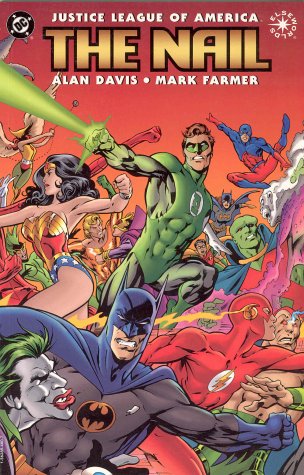
Justice League of America: The Nail (comics)

Writer/Artist: Alan Davis
Collects: JLA: The Nail 1-3

Elseworlds seem to divide people, I've noticed. Some like them, just as many don't. Why is something of a mystery; it's interesting to see alterations on a familiar universe. Sure, not all of them are winners, but that excuse has never washed for me; no form of entertainment is filled with nothing but perfection.

So, here we are with an Elseworld. The concept behind the story? The Kents truck recieved a flat tire and were kept from finding the Kryptonian shuttle that contained the child who would become Superman. Such a simple change, but Alan Davis makes a world without Superman feel suitably different; without such an icon or a shining example of the metahuman community, humans grow to distrust the heroes, or so it seems. All signs point to an alien conspiracy as the heroes fall one by one.

I thought the writing was quite decent, if a little overwrought. Once you start reading, it isn't long before the style smacks of the Silver Age writing conventions; characters more or less narrate their actions, exposition at times reigns supreme and some conversations are overly wordy. But when you can simply accept those quirks, it works. The story also works nicely with a few red herrings and surprises in store; I spent two third of the story convinced Starro the Conqueror was behind everything. In some ways, the story ends as you might expect, but it's still an interesting ride along the way. In a nice twist, it's a story that focuses on all members of the league rather equally as well; no character will steal the show here, which I liked.

The art also feels like a bit of a throwback. Alan does a hell of a job with the artwork, giving us visuals that feel like the solid, colorful work of the seventies. It's great stuff, to be certain, proving that Alan is the rarest kind of comic creator; someone who can competently write and illustrate a story. It's hard to find much fault with work this solid.

As an Elseworlds, I suppose I can say that it does it's job rather effectively. It's not as much of a radical departure as some others; take the story where Batman became a Green Lantern instead of a dark avenger of the night, for instance. Still, it does show that things would be different without Superman. Lex Luthor becomes the mayor of Metropolis without the hindrence of his narrow obsession with the Man of Steel, for example. Without the shining beacon of Superman, the superhero community is feared almost irrationally. The world without Superman is a convincingly different place; so mission accomplished, even if a bit more subtly than other Elseworlds.

The Score: Dramatic Thumbs Up

I quite enjoyed this story. It's quite a solid Elseworlds tale and I'm not sorry I made the purchase. I'm interested enough in where the story could go from the end to pick up this Elseworlds direct sequel, Another Nail. I only hope it's as solid as this one. Recommended.

Sunday, September 6, 2009

Batman: The Man Who Laughs (comics)

Writer: Ed Brubaker
Artists: Doug Mahnke, Patrick Zircher
Collects: The Man Who Laughs one shot, Detective Comics #784-786

If there's one thing fans aren't lacking, it's Joker stories. The character is nigh omnipresent at times and never too far from any writers mind when they get their hands on one of the books. If there's a story they don't go back to much, though, it's the first encounter. Sure, there's the original issue - Batman #1 - that introduced Batman's enduring arch-enemy, but that's also, like, seventy years old now.

Enter Ed Brubaker and Doug Mahnke with the "Man Who Laughs" one shot. Structured like a sequel to Batman Year One, it fits right in, taking place before and after those last few panels of the aforementioned story, where Jim Gordon mentioned the villain by name and his plot to poison the Gotham Reservoir. We don't exactly waste time with any origins, either; much like The Killing Joke, it's kept vague, focusing instead on the terrorist nature of Joker and the chaos he delivers. Why he's there doesn't matter as much as what he does now that he's there. Batman muses that he'd prepared for murderers, rapists and petty thieves, but not the mentally unstable. Nothing will ever be the same again, something Gordon and Batman are keenly aware of.

If you're familiar with the name Doug Mahnke, you will probably expect some very good art. You won't be disappointed. As you might expect, Mahnke draws the hell out of the story, making the story as solid visually as any other aspect. The linework is a bit sketchier here, but it's a style that works. Unlike other attempts by other artists, Doug Mahnke manages to keep the style from becoming an eyesore.

Also included in the trade is a three issue story from far further into Batman's career. Near as I can tell, it takes place a while after No Mans Land has come and gone; Jim Gordon has since (temporarily) retired as a cop and assists the Dark Knight in an unofficial capacity. The story itself is a team-up between the current hero of Gotham - the Batman - with the original hero of Gotham - Alan Scott, the original Green Lantern - to solve a case that went cold during Alan's original time in Gotham in the 1940's. It is a copycat? Or the original returned?

It's fine, even if it's not going to have a large impact on the Batman mythos or anything. But really, it's impact doesn't matter; it's a nice extra, included to give you another Brubaker penned Batman tale and pad the length a bit. It reminded of what you might get if you took an issue from "The Brave and the Bold" comic and gave the team-up three issues to play out. It's fun, which is all that really matters. Also, if the last couple pages don't make you smile, I'm not sure what will.

The art is fantastic. Patrick Zircher's style there is a bit more solid than Doug Mahnke's approach in the title story and it looks very modern. It's some slick work and makes the team-up as good looking as it is fun. So the entire book looks good from cover to cover. You can't ask for much more.

My Opinion: Buy It

Saturday, August 22, 2009

Amazing Spider-Man: Brand New Day vol. 2 (comics)

Writers: Bob Gale, Zeb Wells
Artists: Phil Jimenez, Chris Bachalo, Barry Kitson
Trade Collects: Amazing Spider-Man #552-558

With the first volume of the opening of Spider-Man's new era, Brand New Day, behind us it's time to move on to volume two. After a very solid first volume - which collected the opening arcs of Dan Slott and Marc Guggenhiem - the final two writers of the initial Spider-Man "Brain Trust" step up to deliver their opening stories. Is this volume as solid as the first?

No, not really; in truth it feels a bit uneven. After reading this volume, I found it really brought attention to the rotating writers we have in the current era of Spider-Man in ways both good and bad. But we'll get into that soon enough.

The first arc collected this volume is the first of Bob Gale, whom was one of the original members of the Spider-Man "Brain Trust". It details Spider-Man through his troubles with the DB, now owned and operated by the sleazy Daxter Bennet, and the appearance of a new enemy named Freak, whom we met in the short backup centered around Aunt May last volume. The second arc is the first of Zeb Wells; a blizzard has hit New York City in the middle of April, caused by means we come to find out are quite unnatural. Spider-Man must weather the storm and try to figure out what is causing it. The last issue collected is written by Bob Gale and ties up the Freak storyline for the most part, as Gales arc left it open somewhat. Also returning in the issue is new villain Menace whom was introduced last volume.

Bob Gales arc centered around new villain "Freak" is something of a mixed bag. Unlike the first storylines of Brand New Day - which set Peter back to basics in a way that felt modern without being derivative - Bob Gale's style of writing feels way too old fashioned. Thought balloons are over abundant here, we have Peter over-talking or over-thinking what was happening all and then we have an over-reliance on old fashioned page transitions. Even the dialogue feels too old fashioned to be taken seriously in this day and age. One of the things people whined about in regards to the change of status quo was that Spider-Man was going back to the seventies and eighties; here comes an arc that feels like something right from that era and it's really the last thing the fledgling direction needed at this point.

On top of that, out of the three new villains introduced thus far Freak is by far the least interesting. Mister Negative worked well and Menace is alright for a character that looks far too gobliny for my taste. Freak, on the other hand, is the loser out of the crop so far. For the most part, he boils down to a drug addict who stabs himself with stem cells when he mistakes them for drugs; the end result is that he turns into a monster that, whenever killed in some fashion, cocoons itself and mutates into a form even stronger than before that is also resistant to the previous method of death. The concept is solid enough, but Gale never manages to sell it; Freak's dialogue is almost laughably bad sometimes and you find yourself unable to care about this new rogue.

The artist for this arc is Phil Jimenez. I have to say I don't think his work was quite as strong here as in the past. Sometimes the faces look a little off and the art feels a bit more rushed than what we normally get from him. Considering the weekly format and the grind it must put on the artists, it's not terribly surprising, but it is disappointing.

Zeb Wells arc is much, much better. We're thrust back into more modern storytelling. No more over-exposition; Wells seems to know when to let the artist carry the story. The arc starts out with a guest star appearance by Wolverine and Doctor Strange before Logan departs and Spidey is left to figure out the cause of the blizzard. The story feels a bit more claustrophobic than previous arcs, which works to it's advantage; with the story feeling more closed in, the blizzard really creates a feeling of isolation in the Big Apple and helps with the sense of urgency the overall threat later places on things.

The artist for this one is Chris Bachalo, whom is imminently capable in his own right. The artwork for this arc is simpler, with less lines and a bit less detail, but it really gels with the overall story. Aside from the heroes, the colors are less pronounced in this tale, with their backdrop being scads of white and some snowflakes in the foreground. It's beautiful in it's own way. The only nitpick I had with the art is that I though Bachalo drew Wolverine overly beefy; Wolverine's a muscular guy, for sure, but he was a bit too hulking in this one.

The last collected issue is again written by Gale, but thankfully the writing felt a bit more restrained in this one and less like a lost 1970's Spider-Man arc, though it still suffered from some of the same writing pitfalls of the earlier arc. For the most part, the Freak storyline is more or less wrapped up for the time being in a semi-conclusive way; in other words if no one wants to use him again it's really not necessary by the end. Menace also makes an appearance as the Mayoral election plot moves forward a little bit. All in all it's not a terrible issue and it feels like a better installment than the arc it wraps up.

Barry Kitson pulls art duties on said last issue. His work is much cleaner and feels more modern to me in this issue and I thought it was pretty good. It doesn't stand out much either way though; it feels like some dependably solid Spider-Man art that I don't have much in the way of complaints about.

As I mentioned earlier, these arcs really brought about the good and the bad in regards to the rotating creative teams. Thankfully, there's more good than bad; one bit that's much appreciated are the different artists, which gives each arc it's own look and helps each volume feel a bit like a showcase in different arts, even if the effect is unintended. The other good part is that when they remain relatively consistent, each arc will flow together well and still feel like the same Spider-Man. On top of that, we get a unique voice and addition with each arc that comes down the pipeline.

The bad, however, lurks right around the corner. All it takes is one writer to muck up the consistency and sadly that writer is Bob Gale. His wildly different style of writing things feels so overly retro that it becomes something of a stark contrast to the relatively consistent feel the other writers bring. In regards to the other writers, while each arc feels different, they still flow together and feel consistent. Gale doesn't write like that here and it really is to the detriment of the team.

Back to some positive. MJ is not missed, even in the lesser arc. Without the writers having to worry about forcing her in, we get scenes with the supporting cast. Really, the supporting cast helps make things so much better; losing it was really the stupidest mistake ever made in the history of the franchise. I'm glad this aspect of Spidey has returned; even in Gales opening arc they help quite a bit.

Also, I can't stress enough how great it is to have running subplots back. That's another thing that helps out even the lesser work in this new era. Things like checking up on Jonah Jameson, whom had a heart attack in the last volume and lost the Daily Bugle without his knowledge, or the slow burn of the mayoral election subplot are welcome insertions and help mix things up. They also help things feel consistent from arc to arc; the writers may change, but the suplots and issues carry over. The little touches that tease upcoming events or refer to past events in the book are great details as well; an odd, upcoming blizzard is telegraphed in the background of Gales arc almost throughout, which really helps lead into the aforementioned arc.

Things are still fun as well, even if this volume isn't quite as much so as the last. Despite the issues with Gale's writing, even his work feels a bit more "free" and loose. It's this feeling that really makes Spidey worth following again.

My Opinion: Try It