Writer: Geoff Johns
Artist: Gary Frank
Original Graphic Novel
Volume One was a pretty decent start, but suffered from a weak antagonist that detracted from an otherwise compelling portrayal of Bruce Waynes extremely rocky road to basic competency as a vigilante. Volume Two builds off what the first started, but it's an upgrade in a lot of ways without sacrificing what worked the first time around.
Much like Supermans second Earth One outing, we're veering into this continuities version of classic rogues. This time, it's the Riddler taking center stage, with a subplot involving Killer Croc. Riddler basically starts giving riddles to groups of Gotham citizens. If they answer it correctly, they live. If they fail, they're dead.
On its surface, the idea of murderin' Riddler is a bit off-putting, as it seems pretty grim-dark at first glance. I've always felt his stint as a private detective, competing against Batman for fame and glory, was as good as the character has ever been. But in the context of a new continuity divorced from the main line, it works. He's tied to events in the first volume and ends up with a fairly clear motive that works for the world that has been set up so far.
Of the two, I like what they've done with Croc more. Croc is a character that, if you think about it, is easy to give a sympathetic angle given some of his varying origins, but I can't think of too many times they've gone with something other than a thug or monster. Here, Johns and Frank decide to buck trend a bit, giving us a Croc who's just the victim of a skin condition and, frankly, might not even be all that bad a guy. His role in the story is brief, but by the end he seems set to become a recurring character, which I'm actually all for.
If there's a reinvention of a rogue that poses a problem, it's the one for Two-Face. Without giving too much away, it seems JMS and Geoff Johns both had the same idea. The situation in this volume echoes what was done with a classic Superman rogue in volume three of that Earth One series pretty heavily. The two were even released but a scant three months apart. It's not a huge deal, but if you've read both series you're going to notice it.
Before moving on, I should say that I appreciate that Earth One has completely eschewed use of the Joker thus far. He is a classic villain by all counts, but it's nice to have a build-up for once and use different people. Joker's going to show up at some point, let's not even kid ourselves, but I'm hoping we make it through another volume or two before we get there. Superman only made it to the third volume before it went to the Luthor well.
A lot of the aspects I enjoyed from the first volume are back, including the new version of Alfred. As I suspected, he hasn't given up on his mindset, though we've yet to see any major fight over it quite yet. It seems inevitable, though. I enjoy the differences from classic Alfred, especially the fact that Bruce Wayne now has a test of his resolve not to use guns and not to kill coming from within his inner circle. Our Earth One version of Harvey Bullock takes a back seat this volume - a shame, as I do enjoy this iteration - but he has enough page time to advance his character arc from where we left him at the end of volume one, despite so much else going on in this volume.
As for the Geoff Johns version of Batman, I like how this version of the character seems like he has to build himself from the ground up through literal on-the-job training. It's different from the norm, where Bruce Wayne takes, like, a ten year sabbatical to ready himself for his mission. In the first volume, he barely had a single clue what he was doing. Now, he's getting the hang of the fighting, but other aspects elude him. He doesn't know the first thing about being a detective, which becomes an issue in the midst of the story, and ends up having to ask Jim Gordon to teach him.
That's an interesting take. It suggests maybe this version of Bruce Wayne should have thought about what he was getting himself into and trained beforehand, like every other version, but as a reader it's something different and a worthwhile angle to explore with the character. Even in Year One, where things get off to a rocky start, the guy at least had a general idea what he was doing in most areas.
Gary Frank does as well as ever as the artist. He understands storytelling and action well. Two volumes in, I'm still a bit unsure about leaving Batmans eyes open like that, though. It might just be that I'm so used to the white eye lenses. In fairness, it does lend itself to a bit more details in expressions on the characters end. Anyway, there is what seems to be an art hiccup early in the book - Gordon is trying to get Bullock away from booze, Bullock says no, then the next panel has Gordon pour Bullock a drink - but that may be down to a coloring mistake on the coat, since we only see the torso and the drink pouring. So it's probably not on Frank anyway.
As a whole, the second volume is an improvement on what was already a decent enough start with the first volume. Everything is pulling together a bit better and this volume doesn't have the issue of a weak antagonist like the first. If this continues, this version of the character and his world might end up a genuinely worthwhile entry in the expansive, varied Batman franchise.
My Opinion: Read It
Thursday, May 11, 2017
Saturday, May 6, 2017
Wonder Woman: The Lies (comics)
Writer: Greg Rucka
Artist: Liam Sharp
Collects: Wonder Woman: Rebirth, Wonder Woman (2016) #1, #3, #5, #7, #9, #11
I might as well start by admitting something straight up; I've never liked Wonder Woman. I've always liked the idea of her, what she represents, but as a character, I can't think of a time she's ever done anything for me. Unlike most of her counterparts, she doesn't have a particularly spectacular roster of villains, she doesn't offer any unique settings that I find appealing or anything as a character that I found particularly interesting. The strength of Wonder Woman at times seems to be what she represents as opposed to any of her trappings. Wonder Woman has always been the icon, the most famous female superhero in the world, but I've always preferred the others, the Black Canary, the Huntress and even the Zatannas of the world.
I mean, unless we're talking about Kate Beatons grumpy, chain smoking take on the character. I'd read the hell out of a book about her.
Rebirth seemed like the perfect time to give her one more honest shot. The entire line has seen glowing reviews and the five or six I've tried a couple issues of through Comixology sales have lived up to the press. Not to mention, while I have no attachment to Wonder Woman, I do like Greg Ruckas work, even if a project or two left me cold. It's good, very good, but I'm not sure the direction they went with, or the implications, were the best place to start.
Why? Our new, Rebirth era Wonder Woman book deals almost entirely with her past. The big question of the volume regards her history and how much of it may or may not be true; the titular Lies from which this collection takes its name. Wonder Woman sets off in this volume in search of answers and Themyscira, because she senses something is off about it. Along the way, she drops in to deal with a cult in Africa rooted in some serious, old school misogyny, looking for the help of Cheetah, who may or may not have a new origin*.
Right away, this stokes a fear I had about Rebirth, mainly that this relaunch, meant to merge the New 52 with things from the old universe everyone knew and loved better, will be so concerned with the continuity of it and making sense of everything that it might be a turn-off. I've read comics for years, but don't know squat about Wonder Woman. The question of her continuity doesn't really grab me much. I can't imagine this approach would hold much appeal for anyone else like me, or someone who wanders in just looking for an accessible Wonder Woman story. This would have been fine if it were condensed into a Rebirth special, but it looks like the question of it is what is going to drive the entire run. Look, I've been a fan of Teen Titans for a long time, and I can tell you the whole "Who is Insert Character" schtick hasn't worked out well for her younger counterpart.
I've read enough Rebirth specials and first issues from the line to know that this, thankfully, is not the norm, but it kind of sucks that the one I probably needed to be the most accessible ended up so concerned with resetting the table and swiping at the New 52 era title**. I do wonder if it would have read better were the book collected in publication order rather than by arc. You may or may not have noticed the "collected" section had all the odd numbered issues. That's not a mistake. The book alternated issues with a classic Year One arc for the character, something long overdue. Personally, I think the book should have opened with that in itself, then gone on to new things, reconciling any continuity with the New 52 elsewhere, maybe a miniseries, but I also don't write comics, so hey.
Those misgivings aside, this is a good, well written book, as I'd expected it would be, and problems aside it did draw me in, whether in spite of that or not. Diana herself is exactly what you would want or expect the character to be. Her compassion and love for others is endearing. There's a moment where she's shopping with old friends for clothes and a bunch of fans show up, having been alerted to her presence through social media. She doesn't shy away from it, or treat it as much of a burden. In fact, she leaves the shop to greet the throng, not because she has to, not because it's some burden she has to deal with, but because, as another person remarks, she knows what it means to those people. That's awesome. That's likable. That's also so reminiscent of the way DC heroes used to be, the way they should be, that it's kind of hopeful in itself.
It's well drawn as well. I'm not familiar with Liam Sharpe, but they impressed me here. The linework has plenty of detail and the page composition is occasionally done in eye catching, interesting ways. One sequence in an early issue, when Cheetah goes almost feral and tears into attackers, frames panels of Wonder Woman reasoning her with gutters that have suddenly gone from black to a stark white. Over the course of several pages, the composition starts to make the panels line up, until one page before Wonder Woman breaks through resembles the bars of a cage that might trap an animal. On the page where Wonder Woman appeals to Cheetah and promises to free her from her curse, the gutters break down with jagged edges, as though the cage has been busted. I'm not sure it was intentional - the white gutters do appear in another place in the arc without the seeming pattern, so it's likely a happy coincidence I'm looking way too much into - but it works regardless. Other standouts include a similar page, where between the bars of a wooden cage are panels depicting soldiers planning an escape, then Wonder Woman appearing before them. Yet another has the vegetation of the surroundings act as the gutters.
Top shelf work all around.
The next trade is, as mentioned, a proper Year One arc, which ran in the even numbered issues opposite "The Lies". I'm a bit more interested in this one. But even with my misgivings, Wonder Woman's new Rebirth series is a fine read, good enough that I'll be continuing with it. That feels like a big win in itself.
My Opinion: Read It
* I genuinely have no idea if Cheetahs origin in this volume is all new or a holdover from a prior era. It doesn't resemble any I've ever heard mention of. This might just be my inexperience with Wonder Woman coming into play.
** I remember it had a lot of purists up in arms about how it depicted Wonder Womans lore and mythology, with the amazons in particular being a sticking point. I can understand that. I get the impression Greg Rucka feels the same, because the lies the book is centered around involve the New 52 history almost entirely. I never did get around to reading it, so I don't have much attachment to it - though the creative team enticed me and I'd meant to try it - but there's something a little... off-putting, I guess, about how directly this book seems to want to address and refute it. It's hard to explain. I don't want to say it feels petty, because I don't think that's the right word for it, but I'm not sure what you would call it.
Artist: Liam Sharp
Collects: Wonder Woman: Rebirth, Wonder Woman (2016) #1, #3, #5, #7, #9, #11
I might as well start by admitting something straight up; I've never liked Wonder Woman. I've always liked the idea of her, what she represents, but as a character, I can't think of a time she's ever done anything for me. Unlike most of her counterparts, she doesn't have a particularly spectacular roster of villains, she doesn't offer any unique settings that I find appealing or anything as a character that I found particularly interesting. The strength of Wonder Woman at times seems to be what she represents as opposed to any of her trappings. Wonder Woman has always been the icon, the most famous female superhero in the world, but I've always preferred the others, the Black Canary, the Huntress and even the Zatannas of the world.
I mean, unless we're talking about Kate Beatons grumpy, chain smoking take on the character. I'd read the hell out of a book about her.
Rebirth seemed like the perfect time to give her one more honest shot. The entire line has seen glowing reviews and the five or six I've tried a couple issues of through Comixology sales have lived up to the press. Not to mention, while I have no attachment to Wonder Woman, I do like Greg Ruckas work, even if a project or two left me cold. It's good, very good, but I'm not sure the direction they went with, or the implications, were the best place to start.
Why? Our new, Rebirth era Wonder Woman book deals almost entirely with her past. The big question of the volume regards her history and how much of it may or may not be true; the titular Lies from which this collection takes its name. Wonder Woman sets off in this volume in search of answers and Themyscira, because she senses something is off about it. Along the way, she drops in to deal with a cult in Africa rooted in some serious, old school misogyny, looking for the help of Cheetah, who may or may not have a new origin*.
Right away, this stokes a fear I had about Rebirth, mainly that this relaunch, meant to merge the New 52 with things from the old universe everyone knew and loved better, will be so concerned with the continuity of it and making sense of everything that it might be a turn-off. I've read comics for years, but don't know squat about Wonder Woman. The question of her continuity doesn't really grab me much. I can't imagine this approach would hold much appeal for anyone else like me, or someone who wanders in just looking for an accessible Wonder Woman story. This would have been fine if it were condensed into a Rebirth special, but it looks like the question of it is what is going to drive the entire run. Look, I've been a fan of Teen Titans for a long time, and I can tell you the whole "Who is Insert Character" schtick hasn't worked out well for her younger counterpart.
I've read enough Rebirth specials and first issues from the line to know that this, thankfully, is not the norm, but it kind of sucks that the one I probably needed to be the most accessible ended up so concerned with resetting the table and swiping at the New 52 era title**. I do wonder if it would have read better were the book collected in publication order rather than by arc. You may or may not have noticed the "collected" section had all the odd numbered issues. That's not a mistake. The book alternated issues with a classic Year One arc for the character, something long overdue. Personally, I think the book should have opened with that in itself, then gone on to new things, reconciling any continuity with the New 52 elsewhere, maybe a miniseries, but I also don't write comics, so hey.
Those misgivings aside, this is a good, well written book, as I'd expected it would be, and problems aside it did draw me in, whether in spite of that or not. Diana herself is exactly what you would want or expect the character to be. Her compassion and love for others is endearing. There's a moment where she's shopping with old friends for clothes and a bunch of fans show up, having been alerted to her presence through social media. She doesn't shy away from it, or treat it as much of a burden. In fact, she leaves the shop to greet the throng, not because she has to, not because it's some burden she has to deal with, but because, as another person remarks, she knows what it means to those people. That's awesome. That's likable. That's also so reminiscent of the way DC heroes used to be, the way they should be, that it's kind of hopeful in itself.
It's well drawn as well. I'm not familiar with Liam Sharpe, but they impressed me here. The linework has plenty of detail and the page composition is occasionally done in eye catching, interesting ways. One sequence in an early issue, when Cheetah goes almost feral and tears into attackers, frames panels of Wonder Woman reasoning her with gutters that have suddenly gone from black to a stark white. Over the course of several pages, the composition starts to make the panels line up, until one page before Wonder Woman breaks through resembles the bars of a cage that might trap an animal. On the page where Wonder Woman appeals to Cheetah and promises to free her from her curse, the gutters break down with jagged edges, as though the cage has been busted. I'm not sure it was intentional - the white gutters do appear in another place in the arc without the seeming pattern, so it's likely a happy coincidence I'm looking way too much into - but it works regardless. Other standouts include a similar page, where between the bars of a wooden cage are panels depicting soldiers planning an escape, then Wonder Woman appearing before them. Yet another has the vegetation of the surroundings act as the gutters.
Top shelf work all around.
The next trade is, as mentioned, a proper Year One arc, which ran in the even numbered issues opposite "The Lies". I'm a bit more interested in this one. But even with my misgivings, Wonder Woman's new Rebirth series is a fine read, good enough that I'll be continuing with it. That feels like a big win in itself.
My Opinion: Read It
* I genuinely have no idea if Cheetahs origin in this volume is all new or a holdover from a prior era. It doesn't resemble any I've ever heard mention of. This might just be my inexperience with Wonder Woman coming into play.
** I remember it had a lot of purists up in arms about how it depicted Wonder Womans lore and mythology, with the amazons in particular being a sticking point. I can understand that. I get the impression Greg Rucka feels the same, because the lies the book is centered around involve the New 52 history almost entirely. I never did get around to reading it, so I don't have much attachment to it - though the creative team enticed me and I'd meant to try it - but there's something a little... off-putting, I guess, about how directly this book seems to want to address and refute it. It's hard to explain. I don't want to say it feels petty, because I don't think that's the right word for it, but I'm not sure what you would call it.
Labels:
Comics,
DC Comics,
DC Rebirth,
Greg Rucka,
Liam Sharpe,
Read It,
Review,
Trade Paperback,
Wonder Woman
Wednesday, May 3, 2017
Amazing Spider-Man: Worldwide Vol. 1 (comics)
Writer: Dan Slott
Artist: Giuseppe Camuncoli
Collects: Amazing Spider-Man (2015) #1-5
With the man now closing in on a solid decade with Spider-Man, without much in the way of major stumbles, Dan Slott is probably going down as a definitive writer of the character when all is said and done. It hasn't been without its low periods, though - Ends of the Earth pissed me off so bad I stopped reading until Superior - and it's had the worrying trend of slowly but surely pushing the character away from the kind of situations and stories that make him compelling in the first place.
The trend reaches its its peak here - in the second Amazing Spider-Man relaunch in a year, because Marvel is run by insane people - where Peter Parker has essentially become a low rent Iron Man, a fact directly addressed in the story. Sure, the last series had a similar setup, which saw Peters life in a far better place after everything Doc Ock did with it in Superior, but in that book Peter was absolutely not ready to run a company, constantly fighting to keep its head above water, struggling with people screwing around behind his back, all on top of the personal problems caused by Ock living his life for a spell. Now, he's pretty much Tony Stark, right down to calling Spider-Man his bodyguard, without most of Starks obvious, compelling personal failings.
I was absolutely not interested in that. After all, if I want to read Iron Man, I'd pick that up; or not, I guess, given what's apparently happening there. So I put it off for a long time. Now that I've read it, I've turned around on the idea somewhat. This comic is good. Very good. In five issues, it's better than half the prior relaunch by far, with superior artwork, snappier dialogue and all the fun of international crime fighting. I don't know the Zodiac from Adam, but I'm interested enough in the book overall that I'm even interested in finding out whatever it is he's doing.
One good upside to this status quo is that Spider-Man is all over the place, now. Personally, there isn't much I love more than superheroes getting out of their comfort zone and visiting different countries. The rare occasions Batman does it are always a treat. Even if it's just aesthetic and nothing is done with the local culture, it always offers a different look for the typical heroics, spicing things up. I love Gotham and all, but geez, sometimes you just want to see the Bat family go somewhere else. Same for Spider-Man and New York City. Seeing the wall crawler in China, England and Africa offers a nice change of pace.
If I have a complaint, it's that we're already involving Norman Osborn again. When you think Spider-Man arch-enemies, he's definitely in the top three, maybe even at number one, but they use him as a crutch so much that it occasionally feels like the guy is behind everything that happens to Spider-Man. The character ended up being the overall villain of Superior Spider-Man, then continued his machinations in the prior volume, right into now. The book has let Ock cool longer than Osborn, and Ock is the more interesting character after Superior.
I do enjoy the structure of the series so far, though. While there's an overall story arc going on here with Zodiacs shenanigans and it plays a role in each issue, it doesn't feel like we're reading a typical "story arc". Each issue has a clear problem and conflict, which is generally resolved in one way or another by the end of the issue. If Spider-Man has to assault an aquatic base in an issue to try and retrieve something stolen from him, the plot will see itself out by the end of the issue. Goblin dudes wrecking a small town in Africa? Done three pages before the end. It's hard to explain, but it feels less like one continuous story that takes five to six issues to play out and more like chunks that build to a whole, but feel standalone enough that they are almost like their own adventure, if that makes sense. The "arc" is far less defined.
Also enjoyable, the artwork. I've liked a fair amount of Dan Slotts tenure, but most of it has been paired with art I find unappealing. That's not an issue here. Everything is clean, bright and dynamic. Even Alex Ross steps up his game, providing some of the best cover art I think I've seen from him, which is welcome, because the whole "I only do Silver Age heroes" thing got old quick.
I'm not sure how comfortable I am with this direction long term. I feel like it almost has to fall apart at some point, given how not-Spider-Man it feels. But as a change of pace, it's working amazingly well so far. And hell, low rent Iron Man is not so bad in an age when Iron Man isn't even having colorful playboy superhero adventures like this anymore. He's too busy being comatose, replaced by two different people, because replacing heroes with new versions is the only story Marvel knows how to tell anymore. I'd recommend this.
My Opinion: Read It
Artist: Giuseppe Camuncoli
Collects: Amazing Spider-Man (2015) #1-5
With the man now closing in on a solid decade with Spider-Man, without much in the way of major stumbles, Dan Slott is probably going down as a definitive writer of the character when all is said and done. It hasn't been without its low periods, though - Ends of the Earth pissed me off so bad I stopped reading until Superior - and it's had the worrying trend of slowly but surely pushing the character away from the kind of situations and stories that make him compelling in the first place.
The trend reaches its its peak here - in the second Amazing Spider-Man relaunch in a year, because Marvel is run by insane people - where Peter Parker has essentially become a low rent Iron Man, a fact directly addressed in the story. Sure, the last series had a similar setup, which saw Peters life in a far better place after everything Doc Ock did with it in Superior, but in that book Peter was absolutely not ready to run a company, constantly fighting to keep its head above water, struggling with people screwing around behind his back, all on top of the personal problems caused by Ock living his life for a spell. Now, he's pretty much Tony Stark, right down to calling Spider-Man his bodyguard, without most of Starks obvious, compelling personal failings.
I was absolutely not interested in that. After all, if I want to read Iron Man, I'd pick that up; or not, I guess, given what's apparently happening there. So I put it off for a long time. Now that I've read it, I've turned around on the idea somewhat. This comic is good. Very good. In five issues, it's better than half the prior relaunch by far, with superior artwork, snappier dialogue and all the fun of international crime fighting. I don't know the Zodiac from Adam, but I'm interested enough in the book overall that I'm even interested in finding out whatever it is he's doing.
One good upside to this status quo is that Spider-Man is all over the place, now. Personally, there isn't much I love more than superheroes getting out of their comfort zone and visiting different countries. The rare occasions Batman does it are always a treat. Even if it's just aesthetic and nothing is done with the local culture, it always offers a different look for the typical heroics, spicing things up. I love Gotham and all, but geez, sometimes you just want to see the Bat family go somewhere else. Same for Spider-Man and New York City. Seeing the wall crawler in China, England and Africa offers a nice change of pace.
If I have a complaint, it's that we're already involving Norman Osborn again. When you think Spider-Man arch-enemies, he's definitely in the top three, maybe even at number one, but they use him as a crutch so much that it occasionally feels like the guy is behind everything that happens to Spider-Man. The character ended up being the overall villain of Superior Spider-Man, then continued his machinations in the prior volume, right into now. The book has let Ock cool longer than Osborn, and Ock is the more interesting character after Superior.
I do enjoy the structure of the series so far, though. While there's an overall story arc going on here with Zodiacs shenanigans and it plays a role in each issue, it doesn't feel like we're reading a typical "story arc". Each issue has a clear problem and conflict, which is generally resolved in one way or another by the end of the issue. If Spider-Man has to assault an aquatic base in an issue to try and retrieve something stolen from him, the plot will see itself out by the end of the issue. Goblin dudes wrecking a small town in Africa? Done three pages before the end. It's hard to explain, but it feels less like one continuous story that takes five to six issues to play out and more like chunks that build to a whole, but feel standalone enough that they are almost like their own adventure, if that makes sense. The "arc" is far less defined.
Also enjoyable, the artwork. I've liked a fair amount of Dan Slotts tenure, but most of it has been paired with art I find unappealing. That's not an issue here. Everything is clean, bright and dynamic. Even Alex Ross steps up his game, providing some of the best cover art I think I've seen from him, which is welcome, because the whole "I only do Silver Age heroes" thing got old quick.
I'm not sure how comfortable I am with this direction long term. I feel like it almost has to fall apart at some point, given how not-Spider-Man it feels. But as a change of pace, it's working amazingly well so far. And hell, low rent Iron Man is not so bad in an age when Iron Man isn't even having colorful playboy superhero adventures like this anymore. He's too busy being comatose, replaced by two different people, because replacing heroes with new versions is the only story Marvel knows how to tell anymore. I'd recommend this.
My Opinion: Read It
Labels:
Comics,
Dan Slott,
Giuseppe Camuncoli,
Marvel Comics,
Read It,
Review,
Spider-Man,
Trade Paperback
Wednesday, April 26, 2017
Captain America: Steve Rogers - Hail Hydra (comics)
Writer: Nick Spencer
Artists: Jesus Saiz, Javier Pina
Collects: Captain America: Steve Rogers #1-6 and FCBD 2016
This probably seemed like a better idea back when they pitched it in early 2016.
I'm not going to dance around any spoilers, because you already know the twist. It was all over the news. Even martians know the ending of issue one by now. Steve Rogers, Captain America, is an agent of Hydra and, thanks to the machinations of a cosmic cube, has had his memories altered so that he believes he was always a part of Hydra.
It's comic book-y as hell, but "good guy gone bad" stories are a classic trope for a reason. Even here, it's fairly well written and the story they're telling is kind of interesting. It is, after all, a story about how the most trusted, beloved figure in the Marvel universe, who everyone looks to for guidance or assistance, has been corrupted and how much damage he can do with that standing in the superhuman community. This one man could undermine the entire community, just because of who he is. That's compelling drama. Had they chosen anyone but Hydra, this story might have worked.
Unfortunately, media is not written or consumed in a political or societal vaccuum, so this book has some nasty implications that make it a difficult read.
There's the obvious issue, of course. When this was pitched, it was likely before everything blew up, but by the time the first issue actually released, we were neck deep in the primary season of 2016 and everyone knows how that went. The last issue collected here released two weeks before election day, roughly, and we all know how that went too, as well as how things spiraled downhill after that.
Marvel tries to pride itself on reflecting the real world in its spandex crime fighting, but there's a point where things can get a little too real. At the start of the last year of the Obama administration, the threat of white supremacists and fascists ending up with a foothold in the government probably felt like a remote possibility. By the time the last issue of this collection was out, it was a hairs breadth from reality. Reading this collection is an uncomfortable experience, because a symbol of America, one of the key figures to wear the colors of the country and represent it in pop culture, is running with white supremacists, with fascists, with Nazis.
Yes, Nazi's. I don't care what Marvel tries to say. They can downplay Hydras connection to Nazis all they want, but they're not fooling anyone. As a group, they've always had the mannerisms, the slogan, the actions and the atmosphere of Nazis. In the first Captain America film, they were a division of the Nazis outright. At this point in time, they're led by the Red Skull. The Red Skull. A Nazi agent since conception. There was even a miniseries where he was hanging with Hitler for a while there. There's no escaping this connection, whether they like it or not - and going by their interviews and how they've tried desperately to argue otherwise, they don't - and it means they've essentially had the symbol of America in their universe throw in with an organized, deadly, dangerous version of Neo-Nazis.
Worse still, the comic has a problem you might see occasionally in wrestling where the way everyone is written in the grand scheme of things leaves the villain correct in their gripes and motivations. When Steves thoughts turn to what a bunch of ineffectual, bickering children the other heroes are and how all they know to do is fight among themselves, it's hard to argue against, because he's absolutely correct. The last two issues of this trade are tie-ins to Civil War II, which is about the four hundredth instance of the Marvel superhero community splitting into sides and duking it out since the first Civil War. That's not really Nick Spencers fault, because it's how the greater universe is written, but it's a bitter pill when the corrupted hero working with Nazis kind of has a damn point. At this point, the heroes almost deserve to lose after going so long, in universe and out, without getting it together.
Like I said, it's uncomfortable all on its own; it's only compounded by what was happening at the time.
It's strange, because it's clear they knew they had a hard sell early and that people would not react kindly. The second issue, the one immediately after Captain America gives out a "Hail Hydra" on the last page of the first, it literally a "how it was done", almost as if to soothe fears and try to explain that no, it's not what you think it is, we know what we're doing, there's a plan. You might recall they tried a similar trick to pre-empt outrage and dampen it by having Peter the Whiny Ghost around in the early days of Superior Spider-Man, to annoying effect. That series worked out, but that has less real life baggage; it's sort of amazing to me that anyone greenlit this without someone saying "isn't this a bad idea?"
Can good writing salvage an idea like "Captain America throws in with Nazis"? I'm not convinced. But that's the conflict they have here. A decently written comic struggling against it's own ill conceived idea. It's the fact that it is decently written and somewhat compelling that I don't want to write it off. I gave Superior Spider-Man a chance, after all, and you might recall that it ended up being one of my favorite Spider-Man runs in a long time. But there's also the reality that this entire storyline is ending in an event series - because Marvel has not learned its lesson about diminishing returns, at least not when they started this - and those never end well. I think Siege was the last one I enjoyed. At least it knew to get it's shit in and get out in four issues, well before the fun wore out. I appreciated the brevity in an era when Marvel events drag on for nine plus issues.
I guess we'll see. I may see it through to the end, if only because it's not looking like a long storyline. They've got another trade before the event, Secret Empire, starts. I suspect they moved the conclusion up after things went downhill in the real world - I can't imagine they don't know full well the implications, with how things have changed since this story started - to get this out of the way, because it feels like something that might have festered a bit more in the background of the universe, in any other era. Or maybe this was always the plan and they've never met a bad idea they didn't like; they had Norman Osbourne running defense in the US for like two years worth of comics despite the fact that it made no goddamn sense, so who knows. Regardless, we'll see how it pans out. If the library stocks the rest, I might read and review it.
Now, after all that, it's worth addressing the art, because it's something I can feel good about with no reservations. It's clean, expressive and does its job well. There's an artist switch halfway through, as Javier Pina takes over for issues four through six, but he maintains visual continuity well enough that you might not notice. The only thing that stuck out for me was the depiction of Sharon Carter. She looks far older than the last time I remember seeing her. Is this a thing now? I haven't read a lot of Marvel over the past two years, so I'm not sure if something happened there. The last time I saw her show up was the Rick Remender run of Captain America. Maybe I'm just too far behind. In my defense, Marvel's kind of sucked the past couple years, in my opinion. I've had little interest in anything they were doing outside of whatever Jason Aaron is doing at any given time, which isn't much outside Thor.
The coloring in particular deserves a lot of praise. Whenever Steve Rogers goes too far or is in the midst of sinister machinations, the colors shift to a deep red background behind him - occasionally even bathing him in red light - which lends an eerie air reminding you of his true nature whenever it shows. An example is in the third issue. There's a lot of blue and other colors in each panel, but when Steve is on panel, beating the life out of Taskmaster for hitting Sharon, the deep red shows up. A page later, it's the same deal. Brighter colors while cleanup happens and Steve comforts Sharon, which switches back to red over Steve giving a sideways, troubled glance when it's announced someone he'd thought he'd killed has a pulse. It pulls back somewhat in the second half of the trade - Jesus Saiz colored his own work for the first half, which may explain it - but it's still there and still effective as a visual trick.
Flashbacks are another area the coloring excels. The tainted memories of a life led in service of Hydra are drained of every color but red, leaving the same sinister air as when the color is used in the present day. It's a nice visual tie between the two and lends a bit of flair to these warped flashbacks to Depression era New York.
All told, I'm really mixed on how I feel about this. It's an uncomfortable read from start to finish. But it's written well enough, with great art and coloring bringing it to life. I'm just not sure it can salvage an idea they probably should have thought about a little harder before they went all in. Whatever the case, it's something Marvel is going to have to live down for a while once it's over. It isn't exactly merit-less trash, so I guess it's up to you to decide whether or not you're down with reading about Hydra-Cap for a while. For me personally, it's not something I'd spend money on or have much interest in if the library didn't have it.
My Opinion: Skip It
Artists: Jesus Saiz, Javier Pina
Collects: Captain America: Steve Rogers #1-6 and FCBD 2016
This probably seemed like a better idea back when they pitched it in early 2016.
I'm not going to dance around any spoilers, because you already know the twist. It was all over the news. Even martians know the ending of issue one by now. Steve Rogers, Captain America, is an agent of Hydra and, thanks to the machinations of a cosmic cube, has had his memories altered so that he believes he was always a part of Hydra.
It's comic book-y as hell, but "good guy gone bad" stories are a classic trope for a reason. Even here, it's fairly well written and the story they're telling is kind of interesting. It is, after all, a story about how the most trusted, beloved figure in the Marvel universe, who everyone looks to for guidance or assistance, has been corrupted and how much damage he can do with that standing in the superhuman community. This one man could undermine the entire community, just because of who he is. That's compelling drama. Had they chosen anyone but Hydra, this story might have worked.
Unfortunately, media is not written or consumed in a political or societal vaccuum, so this book has some nasty implications that make it a difficult read.
There's the obvious issue, of course. When this was pitched, it was likely before everything blew up, but by the time the first issue actually released, we were neck deep in the primary season of 2016 and everyone knows how that went. The last issue collected here released two weeks before election day, roughly, and we all know how that went too, as well as how things spiraled downhill after that.
Marvel tries to pride itself on reflecting the real world in its spandex crime fighting, but there's a point where things can get a little too real. At the start of the last year of the Obama administration, the threat of white supremacists and fascists ending up with a foothold in the government probably felt like a remote possibility. By the time the last issue of this collection was out, it was a hairs breadth from reality. Reading this collection is an uncomfortable experience, because a symbol of America, one of the key figures to wear the colors of the country and represent it in pop culture, is running with white supremacists, with fascists, with Nazis.
Yes, Nazi's. I don't care what Marvel tries to say. They can downplay Hydras connection to Nazis all they want, but they're not fooling anyone. As a group, they've always had the mannerisms, the slogan, the actions and the atmosphere of Nazis. In the first Captain America film, they were a division of the Nazis outright. At this point in time, they're led by the Red Skull. The Red Skull. A Nazi agent since conception. There was even a miniseries where he was hanging with Hitler for a while there. There's no escaping this connection, whether they like it or not - and going by their interviews and how they've tried desperately to argue otherwise, they don't - and it means they've essentially had the symbol of America in their universe throw in with an organized, deadly, dangerous version of Neo-Nazis.
Worse still, the comic has a problem you might see occasionally in wrestling where the way everyone is written in the grand scheme of things leaves the villain correct in their gripes and motivations. When Steves thoughts turn to what a bunch of ineffectual, bickering children the other heroes are and how all they know to do is fight among themselves, it's hard to argue against, because he's absolutely correct. The last two issues of this trade are tie-ins to Civil War II, which is about the four hundredth instance of the Marvel superhero community splitting into sides and duking it out since the first Civil War. That's not really Nick Spencers fault, because it's how the greater universe is written, but it's a bitter pill when the corrupted hero working with Nazis kind of has a damn point. At this point, the heroes almost deserve to lose after going so long, in universe and out, without getting it together.
Like I said, it's uncomfortable all on its own; it's only compounded by what was happening at the time.
It's strange, because it's clear they knew they had a hard sell early and that people would not react kindly. The second issue, the one immediately after Captain America gives out a "Hail Hydra" on the last page of the first, it literally a "how it was done", almost as if to soothe fears and try to explain that no, it's not what you think it is, we know what we're doing, there's a plan. You might recall they tried a similar trick to pre-empt outrage and dampen it by having Peter the Whiny Ghost around in the early days of Superior Spider-Man, to annoying effect. That series worked out, but that has less real life baggage; it's sort of amazing to me that anyone greenlit this without someone saying "isn't this a bad idea?"
Can good writing salvage an idea like "Captain America throws in with Nazis"? I'm not convinced. But that's the conflict they have here. A decently written comic struggling against it's own ill conceived idea. It's the fact that it is decently written and somewhat compelling that I don't want to write it off. I gave Superior Spider-Man a chance, after all, and you might recall that it ended up being one of my favorite Spider-Man runs in a long time. But there's also the reality that this entire storyline is ending in an event series - because Marvel has not learned its lesson about diminishing returns, at least not when they started this - and those never end well. I think Siege was the last one I enjoyed. At least it knew to get it's shit in and get out in four issues, well before the fun wore out. I appreciated the brevity in an era when Marvel events drag on for nine plus issues.
I guess we'll see. I may see it through to the end, if only because it's not looking like a long storyline. They've got another trade before the event, Secret Empire, starts. I suspect they moved the conclusion up after things went downhill in the real world - I can't imagine they don't know full well the implications, with how things have changed since this story started - to get this out of the way, because it feels like something that might have festered a bit more in the background of the universe, in any other era. Or maybe this was always the plan and they've never met a bad idea they didn't like; they had Norman Osbourne running defense in the US for like two years worth of comics despite the fact that it made no goddamn sense, so who knows. Regardless, we'll see how it pans out. If the library stocks the rest, I might read and review it.
Now, after all that, it's worth addressing the art, because it's something I can feel good about with no reservations. It's clean, expressive and does its job well. There's an artist switch halfway through, as Javier Pina takes over for issues four through six, but he maintains visual continuity well enough that you might not notice. The only thing that stuck out for me was the depiction of Sharon Carter. She looks far older than the last time I remember seeing her. Is this a thing now? I haven't read a lot of Marvel over the past two years, so I'm not sure if something happened there. The last time I saw her show up was the Rick Remender run of Captain America. Maybe I'm just too far behind. In my defense, Marvel's kind of sucked the past couple years, in my opinion. I've had little interest in anything they were doing outside of whatever Jason Aaron is doing at any given time, which isn't much outside Thor.
The coloring in particular deserves a lot of praise. Whenever Steve Rogers goes too far or is in the midst of sinister machinations, the colors shift to a deep red background behind him - occasionally even bathing him in red light - which lends an eerie air reminding you of his true nature whenever it shows. An example is in the third issue. There's a lot of blue and other colors in each panel, but when Steve is on panel, beating the life out of Taskmaster for hitting Sharon, the deep red shows up. A page later, it's the same deal. Brighter colors while cleanup happens and Steve comforts Sharon, which switches back to red over Steve giving a sideways, troubled glance when it's announced someone he'd thought he'd killed has a pulse. It pulls back somewhat in the second half of the trade - Jesus Saiz colored his own work for the first half, which may explain it - but it's still there and still effective as a visual trick.
Flashbacks are another area the coloring excels. The tainted memories of a life led in service of Hydra are drained of every color but red, leaving the same sinister air as when the color is used in the present day. It's a nice visual tie between the two and lends a bit of flair to these warped flashbacks to Depression era New York.
All told, I'm really mixed on how I feel about this. It's an uncomfortable read from start to finish. But it's written well enough, with great art and coloring bringing it to life. I'm just not sure it can salvage an idea they probably should have thought about a little harder before they went all in. Whatever the case, it's something Marvel is going to have to live down for a while once it's over. It isn't exactly merit-less trash, so I guess it's up to you to decide whether or not you're down with reading about Hydra-Cap for a while. For me personally, it's not something I'd spend money on or have much interest in if the library didn't have it.
My Opinion: Skip It
Labels:
Captain America,
Comics,
Javier Pina,
Jesus Saiz,
Marvel Comics,
Nick Spencer,
Review,
Skip It,
Trade Paperback
Thursday, August 11, 2016
Justice League: The Flashpoint Paradox (animated film)
Voice Actors: Justin Chambers. C. Thomas Howell, Michael B. Jordan, Kevin McKidd
DC's animation has always been better than Marvels. I don't think that's really disputable and it goes all the way back to the days when Batman: The Animated Series went up with Spider-Man, X-Men, Iron Man and the others that were tossed an animated show back in the 90's. Their films have, as expected, been mixed, but I'd say there have been more hits than misses. Up to this point, they had all mostly been their own entities. After this point, they endeavored to connect them all a bit more in a loose continuity.
In a way, the Flashpoint Paradox ends up serving the same purpose it did in the comics, if not quite as directly; as a bridge between the old and the new.
The plot is a fairly basic messy alternative timeline tale. Barry Allen wakes up at his desk one day to find that everything has changed. His mother - murdered when he was still a boy - is alive, his wife Iris is married to someone else, Bruce Wayne died in the alleyway instead of his parents and his powers are missing. What's resulted is a dark, bleak alternative timeline where the world stands at the gate of annihilation due to a looming war between the forces of Wonder Woman and the forces of Aquaman, each ruler of their respective kingdoms. Flash has to find a way to figure out what happened and fix it before it's too late.
I like these kind of stories, typically, because you can go places you usually can't. That said, this tale, much like the comic it's based off of, goes a bit too far, in my estimation, and ends up feeling very much the opposite of what the DC universe should. It comes down to a lot of things that build to a whole and not any one thing.
The part that chaffes the most is that, in painting this bleak setting, this film - and the comic, really - went a little too far with the characters in this timeline. Of the groups we see, only a few are true heroes, not including The Flash. That's Cyborg and the people he associates with, including the Shazam kids. Everyone else has gone crazy loco to the point that it's hard to believe even the ripple effects in time surrounding a point of divergence would do this.
Wonder Woman, for instance, has gone full straw feminist, to the point of suggesting she might just kill off men at the climax of her fight with Aquaman. Speaking of Aquaman, he's now completely unreasonable and nuts on the level you might expect from his brother, Ocean Master. He has a doomsday device that sank a good portion of Europe in an attempt to strike at Wonder Woman and not only does he not care, he seems alright with the idea of sinking all of land right up until it's suggested using his doomsday weapon again might kill everything. Not even JLU Aquaman was this unreasonable, and when he first appeared he was kind of a prick.
Wonder Womans entire deal is compassion. I'm not even a huge fan of the character, but you're going to have a hard time convincing me she could go this far over much of anything. I have a hard time believing she'd just behead Mera amidst an assassination attempt and wear her crown like a trophy. I have a harder time believing she'd become the killer of kids, even if those kids could become Shazam with but a word. Seriously, she kills Billy Batson near the end.
There's also the case of the film alluding to - or showing in truncated form - a lot of the subplots and side stories the comic event had in its tie-ins. In some cases, this isn't necessarily a bad thing. It's all but outright stated that the loss of Bruce drove Martha Wayne insane, to the point she became this worlds Joker, but thankfully they don't try to waste everyones time showing the story of the tie-in in truncated form. Instead, it gives just enough hints to inform Thomas Waynes character and make you wish you could see that story without wasting time giving a version without proper attention. Lois Lanes "Resistance Fighter" plotline is given a few minutes, but manages to tie into the main plot by ultimately giving Flash a clue, so that's fine.
Others, however, are pointlessly done. There's a subplot about the US government trying to find and disable the doomsday weapon that ends up utterly pointless. It shows Deathstroke and what he did in truncated form, seeming to build that whole thing up, but 'Stroke doesn't get anywhere other than informing them where it is. Then Hal Jordan's the second part of this subplot, wrenching in his story from the tie-in miniseries. Only, oops, he can't get the job done. The US brass give up and hide at this point and Aquaman doesn't even bother to retaliate. At the climax, the weapon goes off. So we wasted a good ten to fifteen minutes trying to tie both in to the film in some way, ultimately going nowhere. The Superman arc doesn't fare much better; they rescue him mid film, he flies off, then he returns at the climax, fails to save Cyborg and ceases to be a part of the overall struggle. So, why even bring him into the film?
You could argue that it gives the world color, but you know, that's what the comic tie-ins were meant to do. Here, we're supposed to be adapting the main story and if the side stuff can't really be tied into that, there's no point. They could have cut twenty minutes of this movie, come up with ten minutes of original stuff to connect the dots more and get the runtime back up a bit and ultimately end up with a tighter movie.
But those are mostly problems with structure. They're not so glaring that they really kill the film. Plus, they could be fixed. No, the real problem with this film is the same problem the actual comic it's based on had.
This just isn't a very heroic story.
Spoilers Ahead.
As it turns out, the cause of the altered timeline isn't even the Reverse Flash, as we assume along with Barry. Nope, that's the twist. The culprit is actually Barry Allen. See, Barry went back in time to save his mother, but that one act unfortunately had a ripple effect, as Barrys run to change time caused some kind of sonic boom in time that threw everything off or something. Hence why everything went wrong.
Okay, so, not a big deal. Flash made a mistake, right? Heroes can do that. He can fix it. That's what the story is about.
The problem is Barry cannot even save the world he's in before he changes everything. To his credit, it's every bit his intention. He does not want to go back and fix the timestream until he's saved THIS world, because dammit, that's what heroes do. But he can't. Everything goes horribly wrong. The climax of the film is pretty much everyone dying in the big, final fight while Reverse Flash beats the crap out of Barry. Then, the doomsday device goes off and everything dies. The world is actually ending and Flash has to run fast enough to escape that, go back in time and stop all of it.
The climax of the film is constructed so that the world basically ends, the hero cannot save it and he actually has to run away from it and hope that changing the timeline means it never existed. That's your ending. The day is saved by the hero running away from doomsday, because he could not stop doomsday and ultimately accomplished nothing there, in the world his actions created. If there's an animated multiverse and that world split off and ended up one of them when the timeline was changed back, safe to say it's freaking gone.
Yeah. I don't know either, man.
You probably think I might hate this film by now. It would be a safe guess. The comic series itself wasn't one of my favorites for similar reasons. Yet, somehow, I kind of enjoyed this?
I'm not sure how, but I had a decent time watching it. Maybe it's just because it's hard to get me to hate something, I don't know, but there were good qualities, including the animation. The bookends were great too, with Bruce Wayne and Barry Allen interacting. The last scene, with Barry giving Bruce a message from his father, had some weight. The first scene had the Flash in top form, fighting some of his rogues and calling his friends for help in the League, who manage to handle the situation well. Batman shows a subtle moment of caring about Barrys well being. The action scenes were nice. The voice cast worked well, with some old school favorites returning to voice the role they - or in one instance, their father - are best known for; Sam Daly as Superman, Ron Perlman as Deathstroke, Kevin Conroy as Bruce Wayne, so on.
I don't know. It's not the best story and it's not a particularly heroic story, which I think is something DC really ought to play up more. But I had fun with it? It's hard to explain. It's troubled but still strangely enjoyable. You might still like it. Just be aware going in that it has problems. If it doesn't sound like your cup of tea - and I completely understand that - you won't miss anything if you give it a pass.
One last note. Despite the billing, this isn't really a Justice League film. It's very much a Flash movie in disguise. Maybe more of a team up film between the Flash, an alternate Batman and Cyborg, really. The actual Justice League, as a team, is only in the opening.
My Opinion: Skip It
Heartwarming Batman Moments: Reverse Flash basically tells Flash, at the end of the opening scene, that he can never save everyone or get the job done when it counts. Batman immediately moves to dismiss those words before they can get to Flash, saying the man is a sociopath who knows just how to get under your skin. When Barry still seems affected, Batman cares enough to ask Barry if he's okay. Later, when Barry gives him the letter from his father, he actually tears up a bit and tells Barry he's a hell of a messenger, which is obviously an unspoken "thank you".
DC's animation has always been better than Marvels. I don't think that's really disputable and it goes all the way back to the days when Batman: The Animated Series went up with Spider-Man, X-Men, Iron Man and the others that were tossed an animated show back in the 90's. Their films have, as expected, been mixed, but I'd say there have been more hits than misses. Up to this point, they had all mostly been their own entities. After this point, they endeavored to connect them all a bit more in a loose continuity.
In a way, the Flashpoint Paradox ends up serving the same purpose it did in the comics, if not quite as directly; as a bridge between the old and the new.
The plot is a fairly basic messy alternative timeline tale. Barry Allen wakes up at his desk one day to find that everything has changed. His mother - murdered when he was still a boy - is alive, his wife Iris is married to someone else, Bruce Wayne died in the alleyway instead of his parents and his powers are missing. What's resulted is a dark, bleak alternative timeline where the world stands at the gate of annihilation due to a looming war between the forces of Wonder Woman and the forces of Aquaman, each ruler of their respective kingdoms. Flash has to find a way to figure out what happened and fix it before it's too late.
I like these kind of stories, typically, because you can go places you usually can't. That said, this tale, much like the comic it's based off of, goes a bit too far, in my estimation, and ends up feeling very much the opposite of what the DC universe should. It comes down to a lot of things that build to a whole and not any one thing.
The part that chaffes the most is that, in painting this bleak setting, this film - and the comic, really - went a little too far with the characters in this timeline. Of the groups we see, only a few are true heroes, not including The Flash. That's Cyborg and the people he associates with, including the Shazam kids. Everyone else has gone crazy loco to the point that it's hard to believe even the ripple effects in time surrounding a point of divergence would do this.
Wonder Woman, for instance, has gone full straw feminist, to the point of suggesting she might just kill off men at the climax of her fight with Aquaman. Speaking of Aquaman, he's now completely unreasonable and nuts on the level you might expect from his brother, Ocean Master. He has a doomsday device that sank a good portion of Europe in an attempt to strike at Wonder Woman and not only does he not care, he seems alright with the idea of sinking all of land right up until it's suggested using his doomsday weapon again might kill everything. Not even JLU Aquaman was this unreasonable, and when he first appeared he was kind of a prick.
Wonder Womans entire deal is compassion. I'm not even a huge fan of the character, but you're going to have a hard time convincing me she could go this far over much of anything. I have a hard time believing she'd just behead Mera amidst an assassination attempt and wear her crown like a trophy. I have a harder time believing she'd become the killer of kids, even if those kids could become Shazam with but a word. Seriously, she kills Billy Batson near the end.
There's also the case of the film alluding to - or showing in truncated form - a lot of the subplots and side stories the comic event had in its tie-ins. In some cases, this isn't necessarily a bad thing. It's all but outright stated that the loss of Bruce drove Martha Wayne insane, to the point she became this worlds Joker, but thankfully they don't try to waste everyones time showing the story of the tie-in in truncated form. Instead, it gives just enough hints to inform Thomas Waynes character and make you wish you could see that story without wasting time giving a version without proper attention. Lois Lanes "Resistance Fighter" plotline is given a few minutes, but manages to tie into the main plot by ultimately giving Flash a clue, so that's fine.
Others, however, are pointlessly done. There's a subplot about the US government trying to find and disable the doomsday weapon that ends up utterly pointless. It shows Deathstroke and what he did in truncated form, seeming to build that whole thing up, but 'Stroke doesn't get anywhere other than informing them where it is. Then Hal Jordan's the second part of this subplot, wrenching in his story from the tie-in miniseries. Only, oops, he can't get the job done. The US brass give up and hide at this point and Aquaman doesn't even bother to retaliate. At the climax, the weapon goes off. So we wasted a good ten to fifteen minutes trying to tie both in to the film in some way, ultimately going nowhere. The Superman arc doesn't fare much better; they rescue him mid film, he flies off, then he returns at the climax, fails to save Cyborg and ceases to be a part of the overall struggle. So, why even bring him into the film?
You could argue that it gives the world color, but you know, that's what the comic tie-ins were meant to do. Here, we're supposed to be adapting the main story and if the side stuff can't really be tied into that, there's no point. They could have cut twenty minutes of this movie, come up with ten minutes of original stuff to connect the dots more and get the runtime back up a bit and ultimately end up with a tighter movie.
But those are mostly problems with structure. They're not so glaring that they really kill the film. Plus, they could be fixed. No, the real problem with this film is the same problem the actual comic it's based on had.
This just isn't a very heroic story.
Spoilers Ahead.
As it turns out, the cause of the altered timeline isn't even the Reverse Flash, as we assume along with Barry. Nope, that's the twist. The culprit is actually Barry Allen. See, Barry went back in time to save his mother, but that one act unfortunately had a ripple effect, as Barrys run to change time caused some kind of sonic boom in time that threw everything off or something. Hence why everything went wrong.
Okay, so, not a big deal. Flash made a mistake, right? Heroes can do that. He can fix it. That's what the story is about.
The problem is Barry cannot even save the world he's in before he changes everything. To his credit, it's every bit his intention. He does not want to go back and fix the timestream until he's saved THIS world, because dammit, that's what heroes do. But he can't. Everything goes horribly wrong. The climax of the film is pretty much everyone dying in the big, final fight while Reverse Flash beats the crap out of Barry. Then, the doomsday device goes off and everything dies. The world is actually ending and Flash has to run fast enough to escape that, go back in time and stop all of it.
The climax of the film is constructed so that the world basically ends, the hero cannot save it and he actually has to run away from it and hope that changing the timeline means it never existed. That's your ending. The day is saved by the hero running away from doomsday, because he could not stop doomsday and ultimately accomplished nothing there, in the world his actions created. If there's an animated multiverse and that world split off and ended up one of them when the timeline was changed back, safe to say it's freaking gone.
Yeah. I don't know either, man.
You probably think I might hate this film by now. It would be a safe guess. The comic series itself wasn't one of my favorites for similar reasons. Yet, somehow, I kind of enjoyed this?
I'm not sure how, but I had a decent time watching it. Maybe it's just because it's hard to get me to hate something, I don't know, but there were good qualities, including the animation. The bookends were great too, with Bruce Wayne and Barry Allen interacting. The last scene, with Barry giving Bruce a message from his father, had some weight. The first scene had the Flash in top form, fighting some of his rogues and calling his friends for help in the League, who manage to handle the situation well. Batman shows a subtle moment of caring about Barrys well being. The action scenes were nice. The voice cast worked well, with some old school favorites returning to voice the role they - or in one instance, their father - are best known for; Sam Daly as Superman, Ron Perlman as Deathstroke, Kevin Conroy as Bruce Wayne, so on.
I don't know. It's not the best story and it's not a particularly heroic story, which I think is something DC really ought to play up more. But I had fun with it? It's hard to explain. It's troubled but still strangely enjoyable. You might still like it. Just be aware going in that it has problems. If it doesn't sound like your cup of tea - and I completely understand that - you won't miss anything if you give it a pass.
One last note. Despite the billing, this isn't really a Justice League film. It's very much a Flash movie in disguise. Maybe more of a team up film between the Flash, an alternate Batman and Cyborg, really. The actual Justice League, as a team, is only in the opening.
My Opinion: Skip It
Heartwarming Batman Moments: Reverse Flash basically tells Flash, at the end of the opening scene, that he can never save everyone or get the job done when it counts. Batman immediately moves to dismiss those words before they can get to Flash, saying the man is a sociopath who knows just how to get under your skin. When Barry still seems affected, Batman cares enough to ask Barry if he's okay. Later, when Barry gives him the letter from his father, he actually tears up a bit and tells Barry he's a hell of a messenger, which is obviously an unspoken "thank you".
Labels:
Animation,
Batman,
DC Comics,
Flash,
Flashpoint,
Justice League,
Movie,
Review,
Skip It
Sunday, January 10, 2016
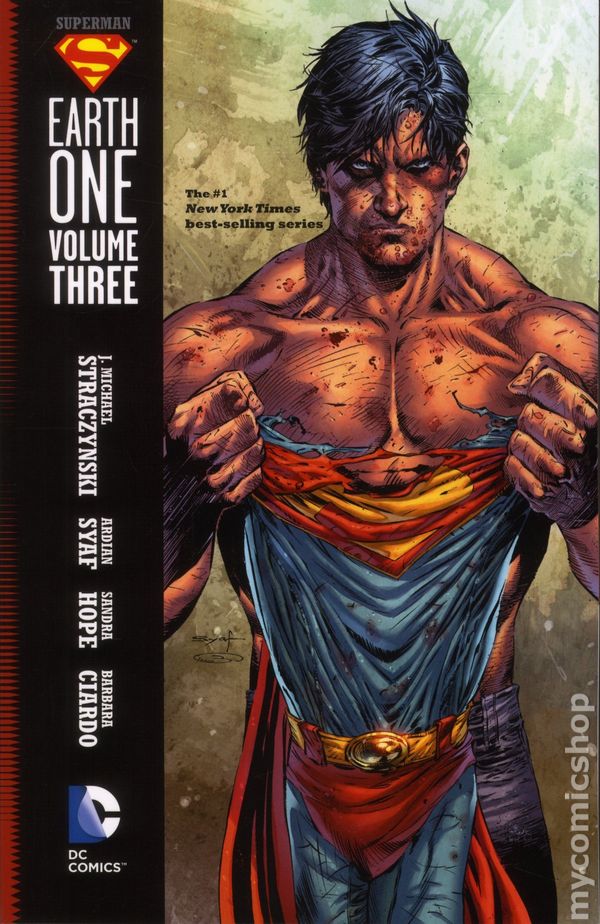
Superman: Earth One vol. 3 (comics)
Writer: J. Michael Straczynski
Artist: Ardian Syaf
Original Graphic Novel
I get the feeling JMS realized he screwed up.
When I reviewed Volume 2 of Superman: Earth One, I mentioned a bunch of story points that, to be blunt, destroyed the work and anything it was trying to do. New supporting character Lisa Lassalle working escort on the side - because of course - was one. Lois Lane going full stalker was another. Even if you could excuse that, Superman incited a full on revolution in a Middle Eastern country, one that was heavily implied to be violent. I know I've taken a sarcastic shot or two at people who have a rigid, immovable idea of Superman in the past, but there are some things you just don't do with him.
Volume 3 feels almost like an apology tour at times. The book goes out of its way to deal with the Lois Lane situation up top, addressing how screwed up her actions were - with Clark himself calling her out - while also attempting to give her some legitimate reasons for her paranoia without throwing her under the bus. I'm not sure it entirely works, but it does a fair job of letting us move on, especially considering Lois feels more like herself for the entire volume. Lisa's time as a hooker on the side is mentioned offhand at only one point and implied to be over, with any future reference relegated to vague mentions of things she regrets doing. Supermans actions in the foreign country are also central to the conflict of the book. I'm not sure that salvages what he did - that ending felt kind of sinister and acknowledged or not it's something that should not be done with the character - but addressing it goes a long way to making it easier to move forward from it, especially when Superman himself admits a couple times that while trying to do what he felt was right, he just wasn't thinking. At the very, very least, it can come off more like an impulsive action by a young adult prone to making mistakes on the way to figuring this out.
I don't think everything landed there, but at least we can try to move on.
Moving on seems like a decent idea anyway, because this book is far easier to enjoy than the last. Make no mistake, this story hits some pretty familiar beats. Zod is the main villain and the Luthors - yes, more than one - come into play. Obviously, we've seen this kind of thing before. I think the same basic Zod story has been told a solid six times now. But it works out fairly well, especially as Zods plan plays heavily into the worlds growing fear of Superman, which rightfully results in a "what the hell" from Superman himself. The odds are pretty believably stacked against Superman - and, as is acknowledged, it's kind of his own fault - but it does so without throwing humanity under the bus or undermining Supermans faith in it.
The big speech to the UN might not work for everyone - I'm sure some won't like that Superman appeals to the worlds sense of self interest rather than its more positive traits to convince them never to pull this kind of crap again - but it works in the context of the series and allows Superman to make some pretty salient points about what happens if he ever loses.
Regarding the Luthors, it's not the most amazingly different spin I've ever seen, but sometimes even the simple tweaks make for the best ones. Here, the usual, male Lex Luthor has a different set of values than we're used to seeing; while cautious regarding Superman, see's himself as purely a scientist and not a man interested in killing another being, even an alien. His wife is the one who is a bit more down with the idea, even if she has nothing against him for ninety percent of the volume. If nothing else, it plays into the climax well, with what I think might be the first time one of Supermans primary villains actually does something for selfless reasons. It didn't rock my world, but I liked it.
Ardian Syaf takes over for Shane Davis as the penciller. I'm not sure why the switch was made - maybe Shane Davis just got busy - but the book is in capable hands. I might even like Syafs work a little bit better than Davis. He's very, very good with character expressions and his sense of comic storytelling is pretty spot on. I also feel like he has a bit more varied a take on some characters and their fashion choices; Lisa Lassalle isn't always wearing form fitting clothing this time, for one. For an extra bonus, I didn't spy any panels or poses with Clark/Superman that felt... off, or sinister, as occasionally happened previously. I liked the art on previous volumes, but if Syaf's going to be the regular going forward, I'm cool with it.
All told, volume three is a marked improvement over the second, even if it doesn't necessarily redeem it, and is worth giving the series a second chance.
My Opinion: Read It
Artist: Ardian Syaf
Original Graphic Novel
I get the feeling JMS realized he screwed up.
When I reviewed Volume 2 of Superman: Earth One, I mentioned a bunch of story points that, to be blunt, destroyed the work and anything it was trying to do. New supporting character Lisa Lassalle working escort on the side - because of course - was one. Lois Lane going full stalker was another. Even if you could excuse that, Superman incited a full on revolution in a Middle Eastern country, one that was heavily implied to be violent. I know I've taken a sarcastic shot or two at people who have a rigid, immovable idea of Superman in the past, but there are some things you just don't do with him.
Volume 3 feels almost like an apology tour at times. The book goes out of its way to deal with the Lois Lane situation up top, addressing how screwed up her actions were - with Clark himself calling her out - while also attempting to give her some legitimate reasons for her paranoia without throwing her under the bus. I'm not sure it entirely works, but it does a fair job of letting us move on, especially considering Lois feels more like herself for the entire volume. Lisa's time as a hooker on the side is mentioned offhand at only one point and implied to be over, with any future reference relegated to vague mentions of things she regrets doing. Supermans actions in the foreign country are also central to the conflict of the book. I'm not sure that salvages what he did - that ending felt kind of sinister and acknowledged or not it's something that should not be done with the character - but addressing it goes a long way to making it easier to move forward from it, especially when Superman himself admits a couple times that while trying to do what he felt was right, he just wasn't thinking. At the very, very least, it can come off more like an impulsive action by a young adult prone to making mistakes on the way to figuring this out.
I don't think everything landed there, but at least we can try to move on.
Moving on seems like a decent idea anyway, because this book is far easier to enjoy than the last. Make no mistake, this story hits some pretty familiar beats. Zod is the main villain and the Luthors - yes, more than one - come into play. Obviously, we've seen this kind of thing before. I think the same basic Zod story has been told a solid six times now. But it works out fairly well, especially as Zods plan plays heavily into the worlds growing fear of Superman, which rightfully results in a "what the hell" from Superman himself. The odds are pretty believably stacked against Superman - and, as is acknowledged, it's kind of his own fault - but it does so without throwing humanity under the bus or undermining Supermans faith in it.
The big speech to the UN might not work for everyone - I'm sure some won't like that Superman appeals to the worlds sense of self interest rather than its more positive traits to convince them never to pull this kind of crap again - but it works in the context of the series and allows Superman to make some pretty salient points about what happens if he ever loses.
Regarding the Luthors, it's not the most amazingly different spin I've ever seen, but sometimes even the simple tweaks make for the best ones. Here, the usual, male Lex Luthor has a different set of values than we're used to seeing; while cautious regarding Superman, see's himself as purely a scientist and not a man interested in killing another being, even an alien. His wife is the one who is a bit more down with the idea, even if she has nothing against him for ninety percent of the volume. If nothing else, it plays into the climax well, with what I think might be the first time one of Supermans primary villains actually does something for selfless reasons. It didn't rock my world, but I liked it.
Ardian Syaf takes over for Shane Davis as the penciller. I'm not sure why the switch was made - maybe Shane Davis just got busy - but the book is in capable hands. I might even like Syafs work a little bit better than Davis. He's very, very good with character expressions and his sense of comic storytelling is pretty spot on. I also feel like he has a bit more varied a take on some characters and their fashion choices; Lisa Lassalle isn't always wearing form fitting clothing this time, for one. For an extra bonus, I didn't spy any panels or poses with Clark/Superman that felt... off, or sinister, as occasionally happened previously. I liked the art on previous volumes, but if Syaf's going to be the regular going forward, I'm cool with it.
All told, volume three is a marked improvement over the second, even if it doesn't necessarily redeem it, and is worth giving the series a second chance.
My Opinion: Read It
Labels:
Ardian Syaf,
Comics,
DC Comics,
Earth One,
JMS,
Read It,
Review,
Superman,
Trade Paperback
Sunday, January 3, 2016
Uncanny X-Men: Revolution (comics)
Writer: Brian Michael Bendis
Artists: Chris Bachalo, Frazier Irving
Collects: Uncanny X-Men (vol. 3) #1-5
I swear, I can't escape. Whenever I think I'm out, Marvel will throw Chris Bachalo and Frazier Irving at me and suddenly I'm reading about Cyclops again. It never ends.
Revolution picks up after Avengers vs X-Men* and deals pretty heavily with the fallout from said event. Cyclops has since escaped and - after a stop to his tailor for an upgrade to the coolest costume he's ever had - he's attempting to get the crew back together**. Problem is, their time as the Phoenix Five has effectively broken their powers in a way they don't understand. Regardless, Cyclops proves that's not enough to keep a good douchebag down, so he opens a new school, recruits some new mutants and doubles down on his previous rhetoric. He's not just threatening people anymore; Cyclops is straight up calling for revolution. Meanwhile, Magneto's gone triple agent; he's playing both sides of the field so well even we can't really tell whose side he's actually on.
I'm going to just say upfront that this series is not one you can really read on its own. This new volume of Uncanny X-Men shares a somewhat symbiotic relationship with All New X-Men, weaving in and out of that book while trying to do its own thing on the side. On the one hand, it makes for a richer overall experience; Bendis writes both books, so there's a tight connection between the two. On the other, it hobbles Uncannys ability to stand alone; this comic genuinely feels more like a full on spin-off of All New X-Men than its own entity at times.
There's no getting around it. To get the full experience of the Bendis run, you're going to have to read both books.
Is it worthwhile reading? Sure. Look, I can't stand Cyclops. I've made it clear by now. But I have to admit that while, given the choice, I'd rather not read about him, he's still an interesting character. Here, he's not even remotely humbled by what happened in AvX. Oh no, he's doubling down. As a result, he's not only alienating the rest of the mutant community, he's actively putting a target on everyones back by becoming exactly what everyone feared mutants could and would become.
He's so detached from the reality of what he's doing and what he's already done that he actually names his new school the New Xavier Institute. He has more or less rejected the teachings of his mentor - who he killed, Phoenix Force influence or not - while turning around and using the mans name for teaching schools of thought that man would actively oppose. He's ended up perverting Xaviers Dream in a way. This is interesting stuff to read about, even if the end result is that you don't particularly like the character.
If nothing else, we've at least abandoned the pretense that Cyclops is in the right, seemingly for real this time, which is a large part of what made the direction of the line unpalatable for years. Before, no one opposed him and he was treated like some unassailable leader. After Schism, people backed away from his increasingly extreme methods, but he still held enough clout to get the vast majority of mutants to rally behind him against the Avengers. Now, pretty much everyone recognizes the man not only lost his way somewhere up the line but is actively leading mutants into darker days.
I do wonder, however, if Bendis will end up acknowledging some of the problems with this direction and why Cyclops and his tactics have always come off so poorly. Mutants have special, super destructive powers that could easily wipe humans out and have a history of counting people who think that's a bitchin' idea among their number. See half of Magnetos schemes over the years, which at least had the X-Men around to stop them and act as a counterpoint. Hell, if you want to see an example of something like that actually coming to pass, Marvel already did that story; it was called Age of Apocalypse. Granted, the humans of the Marvel universe have taken it to extremes just as scary. The other side of the coin is Days of Future Past. But heroes are supposed to be better.
Point is, Cyclops and company are now punching down and I kind of hope that might be brought up, but I also realize that may be something the X-Men franchise never addresses for various reasons***.
Anyway, regarding the new school, we meet a couple new mutants due to the premise. So far, they all seem appealing enough, but it's early. We don't have a ton of time to really get to know them, especially since a good chunk of the book is about what trouble Cyclops and his team are getting into. So far, Uncanny doesn't quite reach the balance Wolverine and the X-Men has. That said, there's time.
Joining Bendis for this book is Chris Bachalo and Frazier Irving. I don't think I need to reiterate my love for both of these guys; I admit I'd rather they were on a book with a concept I could embrace, but given the fact that I'm going to be reading this comic anyway, it's nice to have such top shelf talent. I will express some reservations, however. Bachalo and Irving have wildly different art styles and they clash hard. So far, I'm not having too much trouble with it - and I completely understand that Bachalo needs an artist to switch off with, as the same thing happened with WatXM - but it's a jarring shift.
All told, it's a pretty good read. If you're already reading All New X-Men, you might as well get this as well. Just don't expect it to read well on its own.
My Opinion: Read It
Cyclops Douchebaggery Alert: Hoo boy. Dude's gone full Che Guevera. He's calling for a revolution now. I'm sure that will work out great. On top of that, he decides the "New Xavier School" is a great name for his new headquarters. Look, I get some crazy circumstances were involved and the Phoenix didn't help, but he still killed Xavier. Maybe name it something else? At the bare minimum, it's tasteless. Oh well. At least he isn't creeping on Jean Grey in this volume.
* Yes, I did read that. The fact that I didn't bother reviewing it should tell you all you need to know. I might get around to it some day, but for now I'll just say that it's about as good as most of Marvels other events. Which is to say, not very.
** Minus Colossus. He kind of hates his sister now and she's on this team. He'll wander off to do his own thing in X-Force for a while.
*** Chief among them being that acknowledging this might break the "mutant as a stand in for race" metaphor for good. Say what you want about how completely played out it is, but it's meant a great deal to a lot of readers over the years and Marvel has plenty of reasons not to want to toss it out the window.
Artists: Chris Bachalo, Frazier Irving
Collects: Uncanny X-Men (vol. 3) #1-5
I swear, I can't escape. Whenever I think I'm out, Marvel will throw Chris Bachalo and Frazier Irving at me and suddenly I'm reading about Cyclops again. It never ends.
Revolution picks up after Avengers vs X-Men* and deals pretty heavily with the fallout from said event. Cyclops has since escaped and - after a stop to his tailor for an upgrade to the coolest costume he's ever had - he's attempting to get the crew back together**. Problem is, their time as the Phoenix Five has effectively broken their powers in a way they don't understand. Regardless, Cyclops proves that's not enough to keep a good douchebag down, so he opens a new school, recruits some new mutants and doubles down on his previous rhetoric. He's not just threatening people anymore; Cyclops is straight up calling for revolution. Meanwhile, Magneto's gone triple agent; he's playing both sides of the field so well even we can't really tell whose side he's actually on.
I'm going to just say upfront that this series is not one you can really read on its own. This new volume of Uncanny X-Men shares a somewhat symbiotic relationship with All New X-Men, weaving in and out of that book while trying to do its own thing on the side. On the one hand, it makes for a richer overall experience; Bendis writes both books, so there's a tight connection between the two. On the other, it hobbles Uncannys ability to stand alone; this comic genuinely feels more like a full on spin-off of All New X-Men than its own entity at times.
There's no getting around it. To get the full experience of the Bendis run, you're going to have to read both books.
Is it worthwhile reading? Sure. Look, I can't stand Cyclops. I've made it clear by now. But I have to admit that while, given the choice, I'd rather not read about him, he's still an interesting character. Here, he's not even remotely humbled by what happened in AvX. Oh no, he's doubling down. As a result, he's not only alienating the rest of the mutant community, he's actively putting a target on everyones back by becoming exactly what everyone feared mutants could and would become.
He's so detached from the reality of what he's doing and what he's already done that he actually names his new school the New Xavier Institute. He has more or less rejected the teachings of his mentor - who he killed, Phoenix Force influence or not - while turning around and using the mans name for teaching schools of thought that man would actively oppose. He's ended up perverting Xaviers Dream in a way. This is interesting stuff to read about, even if the end result is that you don't particularly like the character.
If nothing else, we've at least abandoned the pretense that Cyclops is in the right, seemingly for real this time, which is a large part of what made the direction of the line unpalatable for years. Before, no one opposed him and he was treated like some unassailable leader. After Schism, people backed away from his increasingly extreme methods, but he still held enough clout to get the vast majority of mutants to rally behind him against the Avengers. Now, pretty much everyone recognizes the man not only lost his way somewhere up the line but is actively leading mutants into darker days.
I do wonder, however, if Bendis will end up acknowledging some of the problems with this direction and why Cyclops and his tactics have always come off so poorly. Mutants have special, super destructive powers that could easily wipe humans out and have a history of counting people who think that's a bitchin' idea among their number. See half of Magnetos schemes over the years, which at least had the X-Men around to stop them and act as a counterpoint. Hell, if you want to see an example of something like that actually coming to pass, Marvel already did that story; it was called Age of Apocalypse. Granted, the humans of the Marvel universe have taken it to extremes just as scary. The other side of the coin is Days of Future Past. But heroes are supposed to be better.
Point is, Cyclops and company are now punching down and I kind of hope that might be brought up, but I also realize that may be something the X-Men franchise never addresses for various reasons***.
Anyway, regarding the new school, we meet a couple new mutants due to the premise. So far, they all seem appealing enough, but it's early. We don't have a ton of time to really get to know them, especially since a good chunk of the book is about what trouble Cyclops and his team are getting into. So far, Uncanny doesn't quite reach the balance Wolverine and the X-Men has. That said, there's time.
Joining Bendis for this book is Chris Bachalo and Frazier Irving. I don't think I need to reiterate my love for both of these guys; I admit I'd rather they were on a book with a concept I could embrace, but given the fact that I'm going to be reading this comic anyway, it's nice to have such top shelf talent. I will express some reservations, however. Bachalo and Irving have wildly different art styles and they clash hard. So far, I'm not having too much trouble with it - and I completely understand that Bachalo needs an artist to switch off with, as the same thing happened with WatXM - but it's a jarring shift.
All told, it's a pretty good read. If you're already reading All New X-Men, you might as well get this as well. Just don't expect it to read well on its own.
My Opinion: Read It
Cyclops Douchebaggery Alert: Hoo boy. Dude's gone full Che Guevera. He's calling for a revolution now. I'm sure that will work out great. On top of that, he decides the "New Xavier School" is a great name for his new headquarters. Look, I get some crazy circumstances were involved and the Phoenix didn't help, but he still killed Xavier. Maybe name it something else? At the bare minimum, it's tasteless. Oh well. At least he isn't creeping on Jean Grey in this volume.
* Yes, I did read that. The fact that I didn't bother reviewing it should tell you all you need to know. I might get around to it some day, but for now I'll just say that it's about as good as most of Marvels other events. Which is to say, not very.
** Minus Colossus. He kind of hates his sister now and she's on this team. He'll wander off to do his own thing in X-Force for a while.
*** Chief among them being that acknowledging this might break the "mutant as a stand in for race" metaphor for good. Say what you want about how completely played out it is, but it's meant a great deal to a lot of readers over the years and Marvel has plenty of reasons not to want to toss it out the window.
Subscribe to:
Posts (Atom)